
Call Us 01482 861 040
Prepare for the Key Changes Coming in October 2026 with our Sexual Harassment Awareness Training Course
Online Working in Cold Conditions Training
25.00+ VATWorking in Cold Conditions


Unlimited Resits Customer Support Instant Access
£25.00 +VAT per person
This online Working in Cold Conditions Training course focuses on working safely in environments where employees may be exposed to low temperatures, including construction, agriculture, transport, food processing, cold storage and retail. It also explores the responsibilities of employers and employees in managing the risks associated with working in cold conditions.
Working in cold environments can pose significant risks to employees' health and safety, whether they work outdoors during winter or indoors in refrigerated environments such as cold stores and food processing facilities.
Recognising the early warning signs of cold stress is important for anyone exposed to low temperatures, as taking appropriate action can help prevent cold-related illness and injury.
- Train online at your own pace with a full audio voiceover
- Translations across multiple languages available
- Accredited by CPD
- Certificate on successful completion
- Course duration: 45 minutes
- Unlimited resits at no cost
Discounts on Bulk Purchases
Take advantage of our bulk discounts which will reduce your overall cost of training. Better still, any courses you order can be registered to users upto two years later so there's no need to worry about training credits expiring.
| Courses Purchased | Discount |
|---|---|
| 10+ | 10% |
| 20+ | 20% |
| 50+ | 30% |
| 75+ | 40% |
| 100+ | 50% |
Who is this Working in Cold Conditions Course for?
This online awareness training is designed for outdoor workers, including those in construction and agriculture, and employees working in refrigerated or cold-storage environments. It is suitable for anyone who needs to understand how exposure to low temperatures can affect the body and increase the risk of cold-related illness or injury.
The course is also beneficial for supervisors and managers responsible for employees working in cold conditions. It helps learners understand the importance of workplace risk assessments and appropriate control measures, including engineering controls, work scheduling, welfare facilities and protective clothing.
Learners will also gain an understanding of the responsibilities of employers and employees in managing the risks associated with working in cold environments.
Course Screenshots


Course Aim
The aim of this Working in Cold Conditions Training course is to provide learners with an understanding of the health and safety risks associated with exposure to low temperatures in the workplace.
Learners will explore cold-related injuries and illnesses, relevant health and safety legislation, risk assessment principles and control measures that can help protect employees from the harmful effects of cold exposure.
For workplaces where employees may also be exposed to high temperatures, our Working in Hot Conditions Training course provides additional guidance on recognising and managing heat-related risks.
Learning Objectives
On completion of the course, you should be able to:
- State how cold conditions can affect our health
- Identify the types of cold-related injuries and illnesses
- Identify measures to prevent slips, trips and falls in cold and icy conditions
- List the individual factors that increase susceptibility to cold stress
- Identify industries and work environments affected by cold conditions
- Identify the key legislation relating to working in cold conditions
- List the process steps involved in a thermal risk assessment
- Identify appropriate control measures for cold working
- Recognise the symptoms of cold stress
- State the key first aid actions for cold-related emergencies
- Identify the roles and responsibilities relating to cold working
Course Content
This course is made up of the following modules:
-
An Introduction to Working in Cold Conditions
This section introduces the learner to the course and looks at what working in cold conditions is, statistics relevant to working in cold conditions and a scenario where potential hazards and control measures are considered.
-
Module 1 - Working in Cold Conditions and impacts on Health
In this section we look at the health affects of working in cold conditions, covering acute and chronic effects, types of cold-related injuries and illnesses, frostbite and non-freezing cold injuries.
-
Module 2 - Industries and Work Environments
In this section the course looks at the different environments and industries which are affected by cold conditions, covering: outdoor work in cold weather, working at high altitude or exposed locations, cold stores and refrigerated environments, transport and logistics and emergency and public services.
-
Module 3 - The Law and Cold Working
This final section of the course covers the legislation that covers workers from the risks of cold working, risk assessments and control measures required, welfare provisions, PPE. The course then completes with looking at the first aid and emergency response to cold working and recognising at the symptoms of cold stress and roles and responsibilities.
Download Course Overview (PDF)
Assessment
On completion of the course lessons and training material an online assessment will automatically unlock. The assessment will contain 15 multiple-choice questions and a mark of 75% or above will be required to pass.
The assessment will be marked instantly and so you will know straight away if you have passed or not. If you don't pass first time there's no need to worry. Unlimited resits at absolutely no additional charge are available so you can retake the assessment again as many times as you need to.
Working in Cold Conditions Certificate
Our entire library of training courses is accredited by the CPD Certification Service as adhering to the universally recognised Continuing Professional Development (CPD) guidelines.
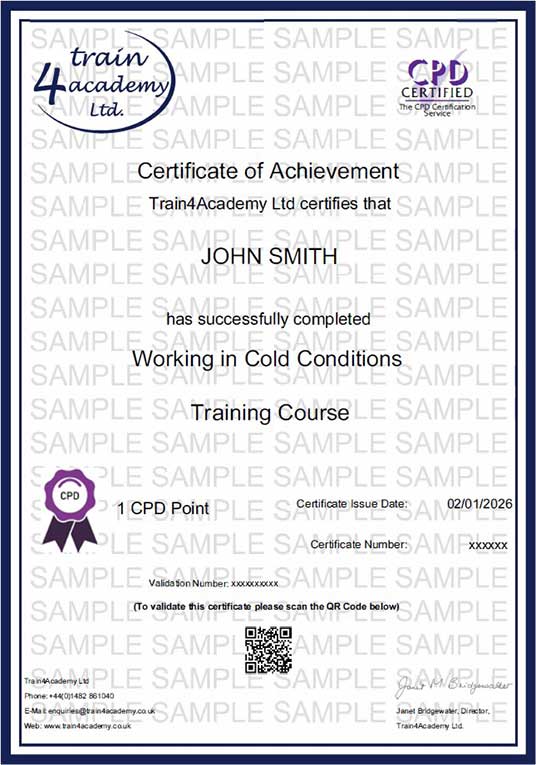
Upon passing the online assessment you will have the options to both print and download your Working in Cold Conditions Certificate in PDF format. In addition to this an automated email will also be sent to your chosen email address containing a link to your certificate ensuring you always have access to a copy.
Furthermore, a QR code is displayed on each certificate which when scanned by a smartphone links to our certification database. This allows employers, auditors and local authority inspectors, for example, to establish a certificates validity instantly and at any time.
Available in Multiple Languages
This training course includes machine generated translated content free of charge in the languages listed below:
- Hungarian, Polish
- Romanian & Russian
Please note: Course content which is not English may be machine translated and is made available for assistive purposes only. We cannot guarantee the accuracy of any translations.
Related Online Training Courses
-
Asbestos Awareness
£25.00 +VAT
For every task that must be undertaken in the workplace it is a legal requirement that a risk assessment must be completed to highlight any hazards that may be encountered. This course will help those responsible for completing risk assessments to do the task successfully. .
-
Manual Handling (Understanding)

£25.00 +VAT
Manual handling is the moving of loads by pushing, pulling, or lifting when machinery is not involved. Many injuries have been caused by these activities and many can be avoided by using correct techniques. This course has been developed for staff where handling bulky or heavy items manually is involved in their jobs. .
£25.00 +VAT per person
Discounts on bulk purchases
- 10% Discount 10+ courses
- 20% Discount 20+ courses
- 30% Discount 50+ courses
- 40% Discount 75+ courses
- 50% Discount 100+ courses
- Compare plans & pricing
Training 10 or more people? Let us quote you
Training Management Suite (TMS) included
with orders of 5 or more courses.