Basket 0 item(s) £0.00 + VAT
Call Us 01482 861 040

Prepare for the Key Changes Coming in October 2026 with our Sexual Harassment Awareness Training Course

Manual Handling Training Course

Understanding safe manual handling techniques RoSPA Assured Certificate

Unlimited Resits Customer Support Instant Access

£25.00 +VAT per person

Course information
  • Certificate on Successful Completion
  • Access course on Desktop, Laptop or Tablet
  • 30 Multiple Choice Questions
  • Course Duration: 90 Minutes
  • CPD Points: 2

This online Manual Handling Course provides employees with the knowledge needed to carry out manual handling activities more safely in the workplace. Manual handling can include lifting, lowering, carrying, pushing or pulling a load, and poor handling practices can increase the risk of injury.

Employers should take appropriate steps to reduce the risks associated with manual handling, including providing suitable information and training where required. This course helps learners understand safer handling techniques and the procedures to consider when moving and handling loads as part of their work.

The manual handling training course also explores common hazards and risk factors associated with manual handling tasks. By understanding these risks, employees and employers can take appropriate measures to reduce the likelihood of injury and help create safer working practices.


  • Work towards compliance with UK Health and Safety legislation
  • Train online at your own pace with a full audio voiceover
  • Assured by RoSPA & Accredited by CPD
  • Certificate on successful completion
  • Course duration: 90 minutes
  • Unlimited resits at no cost

Discounts on Bulk Purchases

Take advantage of our bulk discounts which will reduce your overall cost of training. Better still, any courses you order can be registered to users upto two years later so there's no need to worry about training credits expiring.

Courses Purchased Discount
10+ 10%
20+ 20%
50+ 30%
75+ 40%
100+ 50%


Who is this Manual Handling Course for?

This online Manual Handling Course is suitable for employees whose work involves lifting, lowering, carrying, pushing, pulling or moving loads, particularly where these activities could present a risk of injury.

Warehouse workers, delivery drivers, factory and manufacturing employees, retail workers and those working in construction or maintenance are examples of people who may regularly carry out manual handling activities. Office and hospitality workers may also encounter manual handling tasks when moving equipment, supplies, deliveries or other loads.

Employers should consider the manual handling activities employees are expected to perform and the level of risk involved when determining what information, instruction or training is appropriate.

If you require a general introduction to manual handling, you may be interested in our manual handling awareness level course.


Course Screenshots
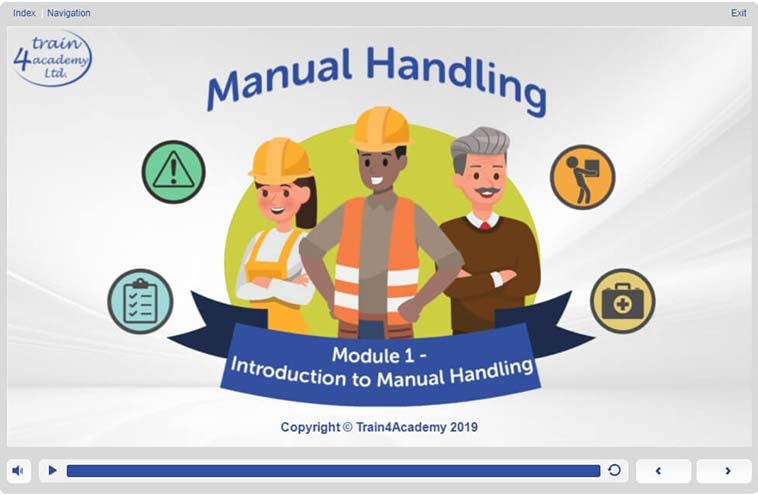
  • Manual Handling Training Course - Introduction to Manual Handling
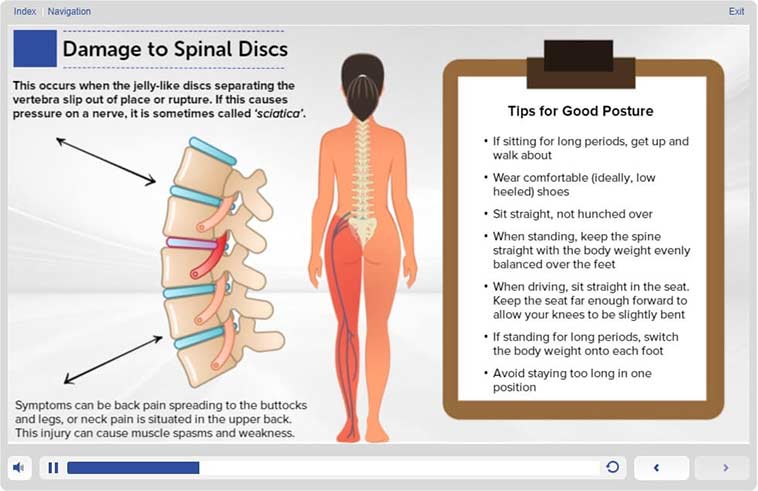
  • Manual Handling Training Course - Damage to Spinal Discs
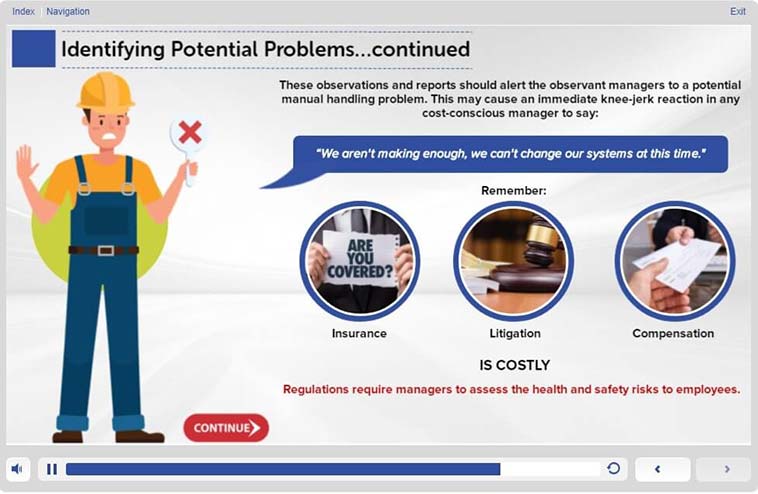
  • Manual Handling Training Course - Identifying Potential Problems

Course Aim

The aim of this online Manual Handling Course is to provide you with the appropriate knowledge on moving and handling objects safely and properly. It looks at how manual handling can cause serious injuries to health and how to prevent these injuries and other accidents from happening within the workplace.

If your job role involves loading or offloading vehicles, our Banksman Training course is a valuable option when working in dynamic environments with moving vehicles.


Learning Objectives

On completion of the course, you should be able to:

  • Identify what manual handling is
  • Identify what Musculoskeletal Disorders (MSDs) are
  • Name what the 5 areas of the spine are
  • Recognise what good posture is
  • List the regulations that relate to manual handling
  • Identify what the duties of employees and employers are
  • Identify what hazards may appear on a risk assessment for manual handling
  • Identify what a MAC (Manual Handling Assessment Chart) is and what it is used for

Course Content

This course is made up of the following modules:

  • An Introduction to Manual Handling

    This section covers an introduction to Manual Handling and work-related MSD statistics

  • Module 1 - Manual Handling

    This section covers what manual handing is, factors that can increase the risk of injury, accident reporting, Musculoskeletal Disorders (MSDs), the spine and what is it comprised of, muscles and injuries that can be caused by manual handling, regulations and moving and handling equipment.

  • Module 2 - Risks and Hazards in Manual Handling

    This section covers assessing the workstation, workstation ergonomics, manual handling risk assessments, hazards and risks, the Manual Handling Assessment Chart (MAC), TILE, guidelines for safe lifting and lifting aids.

Download Course Overview (PDF)

Assessment

On completion of the course lessons and training material an online assessment will automatically unlock. The assessment will contain 30 multiple-choice questions and a mark of 75% or above will be required to pass.

The assessment will be marked instantly and so you will know straight away if you have passed or not. If you don't pass first time there's no need to worry. Unlimited resits at absolutely no additional charge are available so you can retake the assessment again as many times as you need to.


Manual Handling Certification

Our entire library of training courses is accredited by the CPD Certification Service as adhering to the universally recognised Continuing Professional Development (CPD) guidelines.

This training course and its content has also been assured by RoSPA, the Royal Society for the Prevention of Accidents.

Upon passing the online assessment you will have the options to both print and download your Manual Handling Certificate in PDF format. In addition to this an automated email will also be sent to your chosen email address containing a link to your certificate ensuring you always have access to a copy.

Furthermore, a QR code is displayed on each certificate which when scanned by a smartphone links to our certification database. This allows employers, auditors and local authority inspectors, for example, to establish a certificates validity instantly and at any time.


Common Manual Handling Training Questions

Manual handling training helps employees understand the risks involved when lifting, lowering, carrying, pushing or pulling loads as part of their work. It provides workers with the knowledge needed to recognise potentially hazardous manual handling activities and understand how the risk of injury can be reduced.

Effective manual handling training can help employees understand:

  • Common hazards and risk factors associated with manual handling tasks.

  • Safer handling techniques appropriate to the work being carried out.

  • When mechanical aids or equipment may be needed rather than relying on manual effort alone.

  • How to follow safe systems of work and the control measures put in place by their employer.

  • Why hazardous manual handling should be avoided or reduced wherever reasonably practicable.

Training is an important part of managing manual handling risks, but it should not be relied upon as the only control measure. Employers should first consider whether hazardous manual handling can be avoided and what steps can be taken to reduce the risk of injury.

There is no specific UK law stating that every employee must complete a manual handling training course. However, employers have a legal duty to protect workers from the risks associated with hazardous manual handling and to provide appropriate information and training where it is needed.

The Manual Handling Operations Regulations 1992 (MHOR) require employers to manage the risks from manual handling activities. The regulations follow three key principles:

  • Avoid – avoid hazardous manual handling operations so far as reasonably practicable.

  • Assess – where hazardous manual handling cannot be avoided, carry out a suitable and sufficient assessment of the risk of injury.

  • Assess Reduce – take appropriate steps to reduce the risk of injury to the lowest level reasonably practicable.

Manual handling training can form an important part of these control measures. Where employees undertake manual handling activities that could present a risk of injury, suitable training can help them understand the hazards, follow safer working practices and use any equipment or handling aids provided.

Training alone does not make a hazardous manual handling task safe. Employers should first look at whether the task can be avoided, redesigned or made safer before relying on training as a control measure.

There is no fixed legal timeframe for how often manual handling training must be refreshed. Employers should review training needs regularly and provide refresher training when it is necessary to ensure employees continue to have the knowledge and skills needed to carry out manual handling tasks safely.

Effective manual handling training can help employees understand:

  • Working practices change – employees are asked to perform new or different manual handling tasks.

  • New equipment is introduced – such as lifting aids, trolleys or other handling equipment.

  • An accident or near miss occurs – indicating that existing controls, knowledge or working practices may need reviewing.

  • Unsafe handling techniques are observed – suggesting that employees may need additional instruction or training.

  • A risk assessment identifies new or changing risks – particularly where changes affect how a load should be moved or handled.

  • Knowledge or skills need reinforcing – for example, where a significant amount of time has passed since previous training.

Rather than relying on an arbitrary expiry date, employers should consider the level of risk, the manual handling activities being performed and the competence of employees when deciding when refresher training is needed.

A manual handling certificate does not have a legally defined expiry date in the UK. There is no requirement under the Manual Handling Operations Regulations 1992 that states a manual handling certificate must be renewed after a specific number of years.

However, holding a certificate does not necessarily mean that a person's knowledge and skills will remain current indefinitely.

  • A certificate provides evidence that the learner successfully completed the training and assessment at a particular point in time.
  • Training may need to be refreshed when knowledge needs reinforcing or when workplace tasks, equipment or risks change.
  • An employer should review training needs and ensure employees remain competent to carry out the manual handling activities expected of them.

For this reason, employers should not rely solely on the date shown on a certificate. Refresher training should be considered when it is needed to maintain safe working practices and reflect any changes to the manual handling risks employees may encounter.


Understanding Manual Handling Risks and Safety


The level of risk can depend on what is being handled, how the task is performed, the individual carrying it out and the environment in which the activity takes place.

Common manual handling risk factors include:

  • Heavy or difficult loads – loads that are heavy, bulky, unstable or difficult to grip can be harder to control and place greater demands on the body.

  • Awkward movements and posture – twisting, stooping, reaching, bending or handling a load away from the body can increase physical strain.

  • Repetitive handling – frequently lifting, carrying, pushing or pulling loads without sufficient recovery time can increase the risk of injury.

  • Long carrying distances – carrying a load over a greater distance can increase fatigue and make it more difficult to maintain safe handling practices.

  • Pushing and pulling – moving trolleys, equipment or other loads can require considerable force, particularly when they are heavy or difficult to manoeuvre.

  • Unsuitable working environments – restricted space, uneven or slippery floors, poor lighting and other environmental conditions can make handling tasks more difficult.

  • Individual capability – a person's physical capability, experience and other individual factors should be considered when assessing whether a manual handling activity presents a risk.

These factors should be considered as part of a manual handling risk assessment. Where a hazardous manual handling activity cannot be avoided, employers should identify appropriate measures to reduce the risk of injury as far as reasonably practicable.

TILE stands for Task, Individual, Load and Environment. It is a useful framework for identifying factors that could increase the risk of injury when assessing a manual handling activity.

Using TILE can help employers and employees take a more structured approach to recognising manual handling risk factors. Where a risk is identified, consideration should then be given to whether the activity can be avoided or whether changes can be made to reduce the risk.

TILE Manual Handling Risk Factors
TILE What should be considered?
T – Task Consider what the activity involves. Does it require twisting, stooping, reaching, repetitive movements, carrying over long distances or holding a load away from the body?
I – Individual Consider the person carrying out the task, including their physical capability, experience and whether they require additional information, instruction or support.
L – Load Consider the weight, size and shape of the load, whether it is stable, and whether it is difficult to grip or control safely.
E – Environment Consider the area where the task takes place, including available space, flooring, lighting, temperature and any other conditions that could make handling more difficult.

TILE is sometimes extended to TILEO, where the O stands for Other Factors, such as the need for personal protective equipment or other circumstances that may affect how the task is carried out.

Employers can reduce manual handling risks by first considering whether hazardous handling can be avoided altogether. Where it cannot be avoided, the task should be assessed and appropriate measures introduced to reduce the risk of injury as far as reasonably practicable.

Practical steps can include:

  • Avoid unnecessary manual handling – consider whether the load needs to be moved manually or whether the task can be eliminated, automated or completed differently.
  • Assess the activity – identify the risks associated with the task, individual, load and working environment. Tools such as TILE can help structure this process.
  • Use mechanical aids where appropriate – trolleys, pallet trucks, hoists and other handling equipment can help reduce the physical demands placed on employees.
  • Improve the task or workplace – reduce carrying distances, improve storage heights, provide sufficient working space and remove obstacles or other environmental hazards.
  • Provide suitable information and training – employees should understand the risks involved, the control measures in place and how to carry out relevant manual handling activities more safely.
  • Review the controls – manual handling arrangements should be reviewed when tasks, equipment or working conditions change, or where an accident, near miss or other concern indicates that existing controls may no longer be effective.

The appropriate controls will depend on the particular manual handling activity. Training should support these measures rather than replace them, as providing training alone does not remove risks created by a poorly designed or unnecessarily hazardous task.

Poor manual handling can cause a range of injuries, particularly when tasks involve heavy loads, repetitive movements, awkward postures or excessive physical effort. Some injuries can occur suddenly, while others may develop gradually through repeated or prolonged manual handling activities.

Common manual handling injuries can include:

  • Back injuries – strains and other injuries can occur when lifting, carrying or moving loads, particularly where poor posture, twisting or excessive force is involved.
  • Muscle strains and sprains – muscles, tendons and ligaments can be injured when they are overstretched or placed under excessive strain.
  • Upper limb disorders – repetitive or physically demanding handling can affect areas such as the shoulders, arms, wrists and hands.
  • Musculoskeletal disorders (MSDs) – manual handling can contribute to conditions affecting the muscles, joints and other structures within the musculoskeletal system.
  • Hand and foot injuries – loads that are dropped, difficult to control or have sharp or rough surfaces can cause cuts, bruising, crushing injuries or other harm.
  • Injuries caused by slips, trips or falls – carrying or moving a load can restrict a person's view or affect their balance, increasing the risk of an accident.

The risk of injury depends on more than the weight of a load. How often it is handled, the posture required, the working environment and the capabilities of the individual can all influence the level of risk.

Identifying these factors through an appropriate manual handling risk assessment can help employers decide whether a task should be avoided, changed or supported with additional control measures.


Course Reviews

4.6.

(364 reviews)

Read more reviews


Related Online Training Courses

  • cert
    Working at Height (Understanding)

    £25.00 +VAT

    Not only window cleaners and painters work at heights. All industries often require simple maintenance work to be completed at height for example something as simple as changing light bulbs. This course will enable those who have occasion to use ladders or other equipment to do so safely and follow current legislation. .

  • Asbestos Awareness

    £25.00 +VAT

    For every task that must be undertaken in the workplace it is a legal requirement that a risk assessment must be completed to highlight any hazards that may be encountered. This course will help those responsible for completing risk assessments to do the task successfully. .

Understanding safe manual handling techniques RoSPA Assured Certificate

4.6 (364 reviews)

£25.00 +VAT per person

Discounts on bulk purchases
  • 10% Discount 10+ courses
  • 20% Discount 20+ courses
  • 30% Discount 50+ courses
  • 40% Discount 75+ courses
  • 50% Discount 100+ courses
  • Compare plans & pricing

Training 10 or more people? Let us quote you

Training Management Suite (TMS) included
with orders of 5 or more courses.

Course information
  • Certificate on Successful Completion
  • Access course on Desktop, Laptop or Tablet
  • 30 Multiple Choice Questions
  • Course Duration: 90 Minutes
  • CPD Points: 2


Frequently Asked Questions

Our training is completed online, using only a web browser.

After choosing the courses and completing the online transaction, you'll recieve an email providing access to the course. Use the details to register the course yourself or if it's for someone else, simply forward the email on.

Purchasing training for your team is simple.

Just add the courses you need to your basket and complete the checkout process. If you're purchasing 5 or more courses, we'll provide you with access to our Training Management System (TMS).

The TMS gives you full control over your learners, allowing you to enrol staff, monitor progress, track completion rates, and download certificates.

Once your account is set up, we're happy to show you around the system and help you get the most from its features. If you have any questions, our support team is always here to help at support@train4academy.co.uk.

Yes. We offer automatic discounts on larger orders, and any applicable discount will be applied instantly at checkout across all courses in the basket.

Depending on the number of courses purchased we provide the following discounts below. If you're looking to purchase a higher volume, please contact us and we'll be happy to discuss additional volume discounts.

  • Purchase 10+ courses and recieve 10%
  • Purchase 20+ courses and recieve 20%
  • Purchase 50+ courses and recieve 30%
  • Purchase 75+ courses and recieve 40%
  • Purchase 100+ courses and recieve 50%

Our training can be purchased easily using a debit or credit card.

If you're purchasing a larger volume of training and would prefer to be invoiced, please contact us on 01482 861 040 or email enquiries@train4academy.co.uk.

Our training is designed to fit around your schedule. Everybody receives 2 years from date of purchase, so there's no rush to complete your training course.

You can work through the training at your own pace, pause whenever you need to, and return whenever it's convenient. Your progress is automatically saved, allowing you to pick up exactly where you left off.

Even after you've successfully passed the assessment, you'll still be able to access the training materials whenever you need to refresh your knowledge

Read further FAQ