Basket 0 item(s) £0.00 + VAT
Call Us 01482 861 040

Prepare for the Key Changes Coming in October 2026 with our Sexual Harassment Awareness Training Course

Working at Height Online Course

A key online course helping individuals & businesses operate safely when working at heights in accordance to the Working at Height Regulations 2005 RoSPA Assured Certificate

Unlimited Resits Customer Support Instant Access

£25.00 +VAT per person

Course information
  • Certificate on Successful Completion
  • Access course on Desktop, Laptop or Tablet
  • 30 Multiple Choice Questions
  • Course Duration: 90 Minutes
  • CPD Points: 2

Working at height can expose employees to the risk of serious injury if the work is not properly planned, assessed and carried out safely. This online Working at Height course helps learners understand the hazards associated with working at height and the precautions that can be taken to reduce the risk of falls and other related accidents.

The course covers key principles of the Work at Height Regulations 2005, including risk assessment, safe working practices and the use of suitable equipment. Learners will develop a greater understanding of how work at height risks can be identified and controlled, helping them carry out relevant activities more safely in the workplace.


  • Helps you comply with the Working at Height Regulations 2005
  • Work towards compliance with UK Health and Safety legislation
  • Train online at your own pace with a full audio voiceover
  • Assured by RoSPA & Accredited by CPD
  • Certificate on successful completion
  • Course duration: 90 minutes
  • Unlimited resits at no cost

Discounts on Bulk Purchases

Take advantage of our bulk discounts which will reduce your overall cost of training. Better still, any courses you order can be registered to users upto two years later so there's no need to worry about training credits expiring.

Courses Purchased Discount
10+ 10%
20+ 20%
50+ 30%
75+ 40%
100+ 50%


Who is this Working at Height Course for?

This online Working at Height course is suitable for employees whose work involves tasks where there is a risk of falling from one level to another and causing injury. It is also suitable for those who need a general understanding of working at height risks and the precautions that should be taken to work safely.

The training may be suitable for employees who:

  • use ladders or stepladders as part of their work;
  • work on roofs, platforms or other raised working areas;
  • carry out maintenance, installation, cleaning or similar tasks at height;
  • work near openings, edges or fragile surfaces where there is a risk of falling; or
  • need an understanding of working at height safety as part of their workplace responsibilities.

The course provides knowledge-based online training and does not replace any practical, equipment-specific or task-specific training that may be required for particular work at height activities.


Course Screenshots
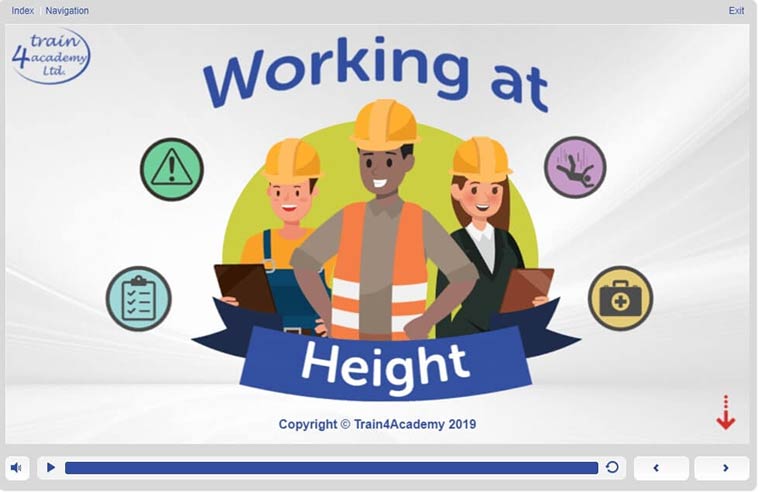
  • Working at Height Training Course - Introduction to Working at Heights
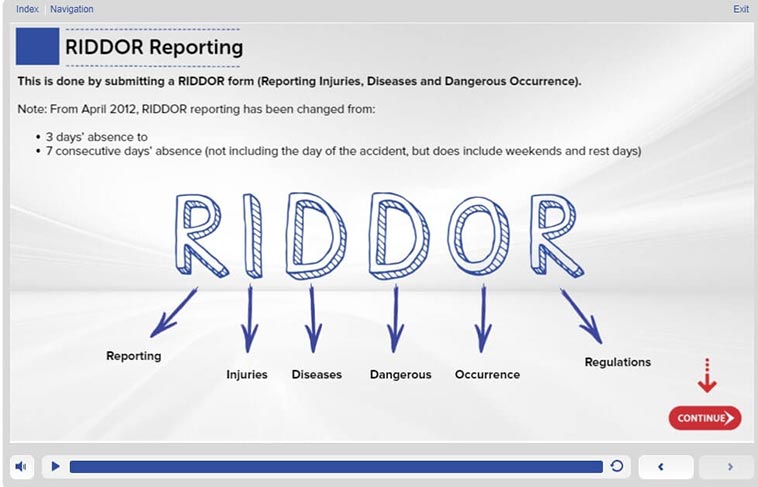
  • Working at Height Training Course - RIDDOR Reporting, to report injuries, diseases and dangerous occurances
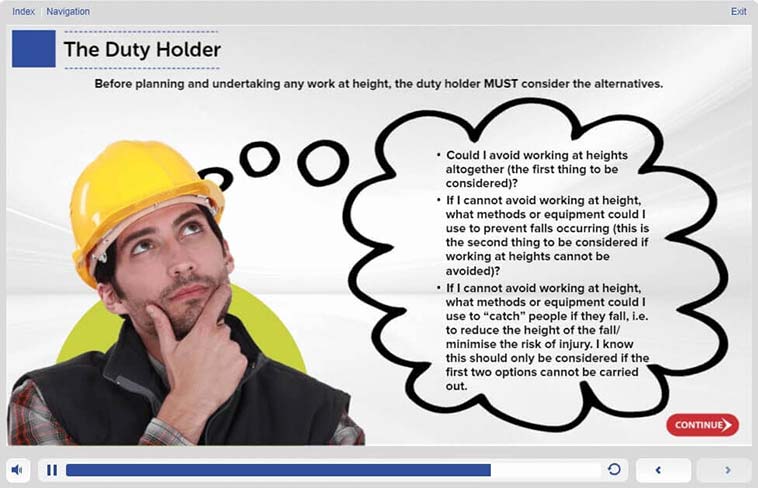
  • Working at Height Training Course - The Duty holder needs to carry out a Working at Heights risk assessment

Course Aim

The aim of this Working at Height course is to provide learners with the knowledge needed to recognise common hazards associated with working at height and understand how the risks can be assessed and controlled.

Learners will develop an understanding of their responsibilities, the importance of planning work at height and the precautions that can be taken to help prevent falls and carry out work more safely.


Learning Objectives

On completion of the course, you should be able to:

  • Explain Working at Height
  • Know the Responsibilties, considerations and precautions
  • Know the safety measures and what protective equipment to be used
  • Write an effective 5-step risk assessment
  • List factors included in a ladder safety checklist
  • Inspect working areas, what dangers to consider and site security
  • Explain who is the duty holder

Course Content

This course is made up of the following modules:

  • An Introduction to Working at Height

    This section works as an introduction to the course assessment.

  • Module 1 - Working Responsibly

    This section covers working at height responsibly, considerations and precautions as well as CDM Regulations 2015.

  • Module 2 - Hazards and Risks

    This sections includes what the 5-steps of risk assessments and what is on the HSE inspection checklist.

Download Course Overview (PDF)

Assessment

On completion of the course lessons and training material an online assessment will automatically unlock. The assessment will contain 30 multiple-choice questions and a mark of 75% or above will be required to pass.

The assessment will be marked instantly and so you will know straight away if you have passed or not. If you don't pass first time there's no need to worry. Unlimited resits at absolutely no additional charge are available so you can retake the assessment again as many times as you need to.


Working at Heights Certificate

Our entire library of training courses is accredited by the CPD Certification Service as adhering to the universally recognised Continuing Professional Development (CPD) guidelines.

This training course and its content has also been assured by RoSPA, the Royal Society for the Prevention of Accidents.
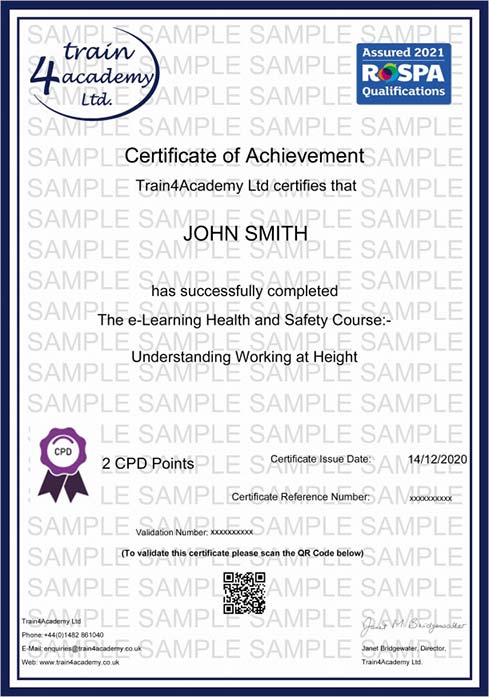
Working at heights certificate

Upon passing the online assessment you will have the options to both print and download your Working at Heights Certificate in PDF format. In addition to this an automated email will also be sent to your chosen email address containing a link to your certificate ensuring you always have access to a copy.

Furthermore, a QR code is displayed on each certificate which when scanned by a smartphone links to our certification database. This allows employers, auditors and local authority inspectors, for example, to establish a certificates validity instantly and at any time.


Common Working at Height Training Questions

There is no legal requirement for every employee who works at height to complete a specific Working at Height course or hold a particular certificate. However, employers have legal duties to ensure that work at height is properly planned, appropriately supervised and carried out by people who are competent to do so.

Under the Work at Height Regulations 2005, anyone involved in work at height should have the necessary skills, knowledge and experience for the task, or be appropriately supervised if they are being trained.

Employers must therefore consider what information, instruction and training employees need for the work they are expected to carry out. The level and type of training required will depend on factors such as:

  • the nature and complexity of the task;
  • the risks involved;
  • the equipment being used; and
  • the employee's existing knowledge, skills and experience.

Working at height training can help employees develop their knowledge of hazards, responsibilities and safe working principles, but additional practical or equipment-specific training may be necessary for certain activities.

Working at height means working in any place where, if suitable precautions were not in place, a person could fall a distance that could cause personal injury. There is no minimum height that determines whether the Work at Height Regulations 2005 apply.

Working at height can include:

  • Working above ground level such as using ladders, stepladders, scaffolds or raised working platforms.
  • Working on roofs or other elevated areas particularly where there are unprotected edges, openings or fragile surfaces.
  • Working near an opening or edge where someone could fall from one level to another.
  • Working at ground level near a drop for example, where there is a risk of falling into an excavation, pit or opening.
  • Using access equipment where a person could fall while accessing or leaving an elevated working position.

There is no single legal expiry period for working at height training. How often training should be refreshed will depend on the work being carried out, the risks involved and the needs of the employee and organisation.

Refresher training may be appropriate when:

  • Work practices or procedures change
  • Different equipment is introduced
  • An employee's responsibilities change
  • Knowledge or understanding has declined
  • An incident or near miss occurs
  • A risk assessment identifies a need

Employers should review working at height training periodically and when circumstances change, rather than relying solely on a fixed renewal date.

Completing working at height training can help develop the knowledge and understanding needed to work safely, but completing a course alone does not necessarily make someone competent to carry out every type of work at height.

Competence depends on the particular task and may require an appropriate combination of skills, knowledge, training and experience. For more complex or higher-risk activities, practical or equipment-specific training may also be necessary.

For example, an employee may understand the general principles of working safely at height but still require additional training before using specialist access or fall protection equipment.

Employers should therefore consider whether an employee has the appropriate level of competence for the work they are expected to carry out, taking into account factors such as:

  • the complexity of the task;
  • the risks involved;
  • the equipment being used;
  • the employee's training and experience; and
  • whether additional instruction or supervision is required.

Working at height training provides an important foundation of knowledge, but it should form part of the wider arrangements used to ensure employees can carry out their specific work safely.


Why Working at Height Safety Matters

Falls are one of the main risks associated with working at height, but accidents can also occur when access equipment is unstable, surfaces are fragile or objects fall onto people below.

Common risks when working at height can include:

  • Falls from an edge or opening such as from roofs, platforms, unprotected edges or floor openings.
  • Falls through fragile surfaces including rooflights or roofing materials that may not safely support a person's weight.
  • Unsafe or unstable access equipment ladders, stepladders and other equipment can create additional risks if they are unsuitable, incorrectly positioned or poorly maintained.
  • Falling tools or materials objects dropped from height can seriously injure employees or other people below.
  • Changing workplace conditions poor weather, slippery surfaces, obstructions or other environmental conditions can make work at height more hazardous.

Work at height should be properly planned before the task begins. This includes considering whether working at height can be avoided and, where it cannot, identifying the hazards and deciding what precautions are needed to carry out the work safely.

Planning should take into account:

  • Tasking what work needs to be completed, how long it is expected to take and whether it can be carried out without working at height.
  • The working environment including ground conditions, fragile surfaces, openings, nearby hazards and the safety of people below.
  • The people carrying out the work ensuring they have the appropriate information, instruction, training and, where required, skills and experience for the task.
  • Suitable equipment for the work and checking that it is properly positioned and safe to use.
  • Weather and changing conditions considering whether wind, rain, ice or other conditions could make the work unsafe.
  • Emergency arrangements considering what action may be needed if something goes wrong and how assistance or rescue could be provided where necessary.

Planning should be proportionate to the level of risk involved. A straightforward, low-risk task may require relatively simple precautions, while more complex or higher-risk work will require more detailed planning and control measures.

The risk of falls should be considered before work at height begins. Where reasonably practicable, the first option should be to avoid working at height altogether. If this is not possible, suitable measures should be used to prevent falls and reduce the potential consequences if a fall could still occur.

A useful approach is to follow three stages:

  • Avoid working at height where possible

    Consider whether the task can be completed safely from ground level. For example, equipment or working methods may allow some inspection, cleaning or maintenance activities to be carried out without someone needing to work at height.

  • Prevent falls where working at height cannot be avoided

    Where the work must take place at height, measures should be taken to prevent people from falling. This may include selecting suitable work equipment, providing safe access and using appropriate edge protection or other collective protective measures.

  • Minimise the distance and consequences of a fall

    Where a risk of falling remains, appropriate measures should be considered to reduce the distance a person could fall and the potential for injury. The precautions required will depend on the task, working environment and level of risk involved.

The most appropriate controls will depend on the work being carried out, which is why suitable planning and risk assessment are important before work at height begins.

Employees have a responsibility to take reasonable care of their own health and safety and that of others who may be affected by their actions when working at height. They should also cooperate with their employer and follow the safety arrangements put in place for the work.

Employees should:

  • Follow their training and instructions
  • Use equipment correctly
  • Check equipment before use
  • Report hazards and defects
  • Avoid taking unnecessary risks
  • Cooperate with safety measures

Employees should raise concerns if they believe work at height cannot be carried out safely rather than continuing with a task and exposing themselves or others to unnecessary risk.


Course Reviews

4.6.

(175 reviews)

Read more reviews


Related Online Training Courses

  • Manually lifting a box RoSPA Assured
    Manual Handling (Understanding)

    £25.00 +VAT

    Manual handling is the moving of loads by pushing, pulling, or lifting when machinery is not involved. Many injuries have been caused by these activities and many can be avoided by using correct techniques. This course has been developed for staff where handling bulky or heavy items manually is involved in their jobs. .

  • Asbestos Awareness

    £25.00 +VAT

    For every task that must be undertaken in the workplace it is a legal requirement that a risk assessment must be completed to highlight any hazards that may be encountered. This course will help those responsible for completing risk assessments to do the task successfully. .

A key online course helping individuals & businesses operate safely when working at heights in accordance to the Working at Height Regulations 2005 RoSPA Assured Certificate

4.6 (175 reviews)

£25.00 +VAT per person

Discounts on bulk purchases
  • 10% Discount 10+ courses
  • 20% Discount 20+ courses
  • 30% Discount 50+ courses
  • 40% Discount 75+ courses
  • 50% Discount 100+ courses
  • Compare plans & pricing

Training 10 or more people? Let us quote you

Training Management Suite (TMS) included
with orders of 5 or more courses.

Course information
  • Certificate on Successful Completion
  • Access course on Desktop, Laptop or Tablet
  • 30 Multiple Choice Questions
  • Course Duration: 90 Minutes
  • CPD Points: 2


Frequently Asked Questions

Our training is completed online, using only a web browser.

After choosing the courses and completing the online transaction, you'll recieve an email providing access to the course. Use the details to register the course yourself or if it's for someone else, simply forward the email on.

Purchasing training for your team is simple.

Just add the courses you need to your basket and complete the checkout process. If you're purchasing 5 or more courses, we'll provide you with access to our Training Management System (TMS).

The TMS gives you full control over your learners, allowing you to enrol staff, monitor progress, track completion rates, and download certificates.

Once your account is set up, we're happy to show you around the system and help you get the most from its features. If you have any questions, our support team is always here to help at support@train4academy.co.uk.

Yes. We offer automatic discounts on larger orders, and any applicable discount will be applied instantly at checkout across all courses in the basket.

Depending on the number of courses purchased we provide the following discounts below. If you're looking to purchase a higher volume, please contact us and we'll be happy to discuss additional volume discounts.

  • Purchase 10+ courses and recieve 10%
  • Purchase 20+ courses and recieve 20%
  • Purchase 50+ courses and recieve 30%
  • Purchase 75+ courses and recieve 40%
  • Purchase 100+ courses and recieve 50%

Our training can be purchased easily using a debit or credit card.

If you're purchasing a larger volume of training and would prefer to be invoiced, please contact us on 01482 861 040 or email enquiries@train4academy.co.uk.

Our training is designed to fit around your schedule. Everybody receives 2 years from date of purchase, so there's no rush to complete your training course.

You can work through the training at your own pace, pause whenever you need to, and return whenever it's convenient. Your progress is automatically saved, allowing you to pick up exactly where you left off.

Even after you've successfully passed the assessment, you'll still be able to access the training materials whenever you need to refresh your knowledge

Read further FAQ