
Basket 0 item(s) £0.00 + VAT
Call Us 01482 861 040

Prepare for the Key Changes Coming in October 2026 with our Sexual Harassment Awareness Training Course

Stress Awareness in the Workplace Training Course

4.6 (45 reviews)
Stress Awareness in the Workplace cert

Unlimited Resits Customer Support Instant Access

£25.00 +VAT per person

Course information
  • Certificate on Successful Completion
  • Access course on Desktop, Laptop or Tablet
  • 15 Multiple Choice Questions
  • Course Duration: 30 Minutes
  • CPD Points: 2

Our online Stress Awareness in the Workplace Training Course helps learners recognise the signs and symptoms of stress, understand common causes of workplace stress, and identify actions that can help manage and reduce stress at work.

Suitable for both employers and employees, the course provides an understanding of workplace stress and the responsibilities organisations have for protecting the health, safety and wellbeing of their employees. The training can help organisations support their duties under the Health and Safety at Work etc. Act 1974.

Stress can affect anyone and can have a significant impact on both employees and organisations. Prolonged workplace stress can affect a person's physical and mental health, influence how they think, feel and behave, and impact their performance at work.


  • Helps you comply with the Health and Safety at Work Act 1974
  • Work towards compliance with UK Health and Safety legislation
  • Train online at your own pace with a full audio voiceover
  • Assured by RoSPA & Accredited by CPD
  • Certificate on successful completion
  • Course duration: 30 minutes
  • Unlimited resits at no cost

Discounts on Bulk Purchases

Take advantage of our bulk discounts which will reduce your overall cost of training. Better still, any courses you order can be registered to users upto two years later so there's no need to worry about training credits expiring.

Courses Purchased Discount
10+ 10%
20+ 20%
50+ 30%
75+ 40%
100+ 50%


Who is this Online Stress Awareness in the Workplace Training for?

This Stress Awareness in the Workplace Training Course is suitable for employees at all levels, including managers, supervisors and team leaders.

The course is designed for anyone who wants to better understand workplace stress, recognise common signs and symptoms, and learn what actions can be taken to manage and reduce stress at work. It can also help managers and employers better understand their responsibilities for supporting employee wellbeing and addressing work-related stress.


Course Screenshots
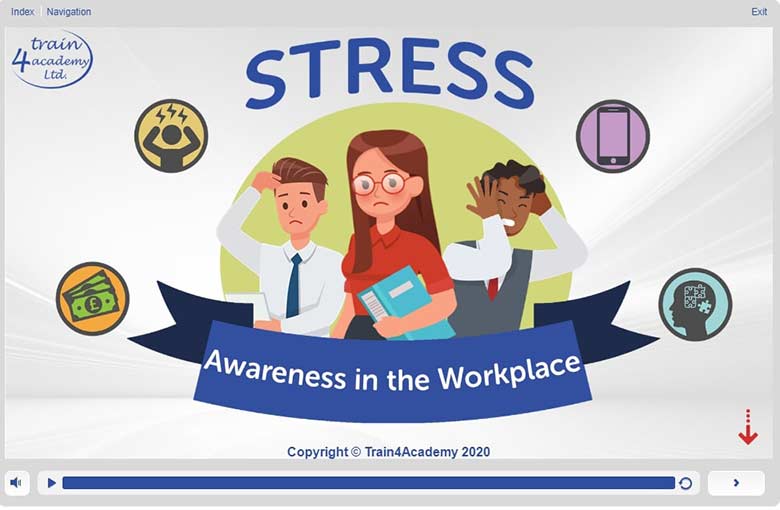
  • Welcome to Stress Awareness in the Workplace online training
  • What is Stress? - Stress Awareness in the Workplace
  • Employers' Duties – Stress Awareness in the Workplace


Course Aim

The aim of this course is to raise awareness of workplace stress and help learners understand its common causes, signs and symptoms.

Learners will develop an understanding of how stress can affect physical and mental wellbeing, the responsibilities employers have for managing work-related stress, and practical actions individuals can take to help manage and reduce stress in the workplace.


Learning Objectives

On completion of the course, you should be able to:

  • Give a definition of workplace stress
  • Name causes of stress
  • Identify physical and psychological symptoms of stress
  • Give the meaning of ‘fight or flight’
  • List some common causes of workplace stress
  • Give some Health and Safety Executive stress-related statistics
  • Identify the meaning of ‘Statutory law’ and ‘Common law’
  • Recognise the duties of employers
  • Give some examples of what actions employees can take if suffering with stress
  • Identify the meaning of ‘mindfulness’
  • Recognise what can happen if stress becomes prolonged’

Course Content

This course is made up of the following modules:

  • An Introduction to Stress Awareness in the Workplace

    This section introduces the learner to the course. It looks at who stress can affect plus the consequences that stress has on both the physical and mental aspects of an employee.

  • Module 1 - Stress in the Workplace

    This module concentrates on what stress is, what causes it and signs of workplace stress. It looks at the symptoms that can arise due to excessive amounts of stress and how this can impact mental and physical health.

  • Module 2 - Employers Duties and the Law

    This section of the course covers the duties that falls on the employer when it comes to workplace stress. It is important that the employer protects their workforce from workplace stress and put measures in place to help their staff.

    It also looks at what laws there are to protect workers from workplace stress.

  • Module 3 - Taking Action

    In this final section, you will cover the actions you can take as an individual if you feel that you are suffering from stress within the workplace. This module demonstrates different ways to ‘de-stress’ and look after your own mental health and wellbeing.

Download Course Overview (PDF)

Assessment

On completion of the course lessons and training material an online assessment will automatically unlock. The assessment will contain 15 multiple-choice questions and a mark of 75% or above will be required to pass.

The assessment will be marked instantly and so you will know straight away if you have passed or not. If you don't pass first time there's no need to worry. Unlimited resits at absolutely no additional charge are available so you can retake the assessment again as many times as you need to.


Stress Awareness in the Workplace Training Certification

Our entire library of training courses is accredited by the CPD Certification Service as adhering to the universally recognised Continuing Professional Development (CPD) guidelines.

This training course and its content has also been assured by RoSPA, the Royal Society for the Prevention of Accidents.
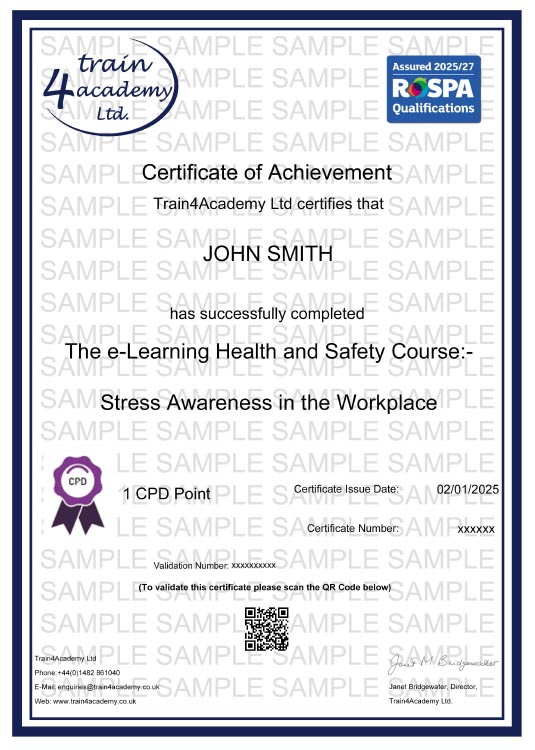
 Stress Awareness in the Workplace - Example Certificate

Upon passing the online assessment you will have the options to both print and download your Stress Awareness in the Workplace Training Certificate in PDF format. In addition to this an automated email will also be sent to your chosen email address containing a link to your certificate ensuring you always have access to a copy.

Furthermore, a QR code is displayed on each certificate which when scanned by a smartphone links to our certification database. This allows employers, auditors and local authority inspectors, for example, to establish a certificates validity instantly and at any time.


Common Workplace Stress Questions

Workplace stress, also known as work-related stress, can occur when the pressures or demands of a person's job become difficult for them to cope with.

Pressure at work is not always negative. A reasonable level of pressure can help people stay motivated and focused. However, when pressure becomes excessive or continues for a prolonged period without appropriate support or recovery, it can negatively affect an employee's health and wellbeing.

Workplace stress can develop for many reasons, including:

  • Excessive workloads or unrealistic deadlines
  • A lack of control over how work is carried out
  • Insufficient support from managers or colleagues
  • Difficult workplace relationships
  • Unclear roles or responsibilities
  • Poorly managed organisational change

Work-related stress can affect people differently. What one employee finds manageable may cause significant stress for another, which is why recognising potential sources of stress and addressing concerns early is important.

Workplace stress can have many causes and often develops when several pressures occur at the same time or continue for a prolonged period.

The Health and Safety Executive (HSE) identifies six key areas of work design that, when poorly managed, can contribute to work-related stress:

The six key areas of work design associated with work-related stress
Area Examples of potential causes of stress
Demands Excessive workloads, tight deadlines, difficult working patterns or an unsuitable working environment.
Control Having little influence over how or when work is carried out.
Support Not receiving sufficient information, resources, guidance or support from managers and colleagues.
Relationships Workplace conflict, poor working relationships, bullying or other unacceptable behaviour.
Role Unclear responsibilities, conflicting expectations or uncertainty about an employee's role.
Change Organisational changes that are poorly planned, managed or communicated.

The causes of workplace stress will not be the same for everyone. Factors such as an employee's role, responsibilities, working environment and the support available to them can all influence how they respond to workplace pressures.

Identifying the underlying causes is important because managing workplace stress effectively involves addressing the sources of excessive pressure, rather than focusing only on the symptoms an employee experiences.

Workplace stress can affect people physically, emotionally and behaviourally. The signs can vary from person to person and may develop gradually, making them difficult to recognise at first.

Common signs and symptoms of workplace stress
Type Examples
Physical Headaches, tiredness, muscle tension, difficulty sleeping or changes in appetite.
Emotional Irritability, anxiety, feeling overwhelmed, low mood or a loss of motivation.
Cognitive Difficulty concentrating, forgetfulness, indecision or finding it harder to complete usual tasks.
Behavioural Becoming withdrawn, changes in eating or sleeping habits, increased use of alcohol or other substances, or changes in how someone interacts with colleagues.
Work-related Increased absence, reduced performance, unusual mistakes, missed deadlines or changes in working patterns.

Experiencing one or more of these signs does not necessarily mean that workplace stress is the cause. However, noticeable or persistent changes may indicate that someone is struggling and should not simply be ignored.

Recognising potential signs of stress early can give individuals and managers an opportunity to discuss concerns, identify possible causes and consider what support or changes may help.

Workplace stress can be managed and reduced by identifying its underlying causes and taking appropriate action before excessive pressure becomes an ongoing problem. This may require changes within the workplace as well as actions individuals can take to support their own wellbeing.

Employers and managers can help manage workplace stress by:

  • Reviewing workloads, deadlines and working arrangements.
  • Providing employees with appropriate support, resources and training.
  • Encouraging open communication about workload and workplace concerns.
  • Making roles and responsibilities clear.
  • Managing organisational changes effectively and keeping employees informed.
  • Addressing workplace conflict, bullying or other unacceptable behaviour.
  • Identifying and controlling work-related stress risks through suitable risk assessments.

Employees can also take practical steps, such as raising concerns with their manager, taking appropriate breaks, maintaining healthy routines and seeking support when they are struggling.

Managing workplace stress effectively is not simply about helping someone cope with excessive pressure. Where possible, the causes of work-related stress should be identified and addressed to create a healthier and more supportive working environment.

Stress can affect people differently, so it may not always be obvious when someone is struggling. However, noticeable changes in a person's behaviour, mood or usual working patterns can sometimes indicate that they are experiencing excessive pressure or stress.

Changes to look out for may include:

  • Becoming quieter, withdrawn or less engaged with colleagues.
  • Increased irritability, frustration or emotional reactions.
  • Difficulty concentrating or making decisions.
  • Making more mistakes than usual or missing deadlines.
  • Changes in attendance, such as increased absence or arriving late.
  • Working longer hours, regularly missing breaks or struggling to switch off from work.
  • Appearing unusually tired, worried or overwhelmed.
  • A noticeable decline in motivation or confidence.

These changes do not necessarily mean that someone is experiencing workplace stress, and it is important not to make assumptions about their health or personal circumstances.

If you are concerned about a colleague, a supportive and private conversation can give them an opportunity to discuss how they are feeling. Managers should listen to concerns, consider whether aspects of the person's work may be contributing to the problem and identify what appropriate support or workplace changes may be available.

Recognising potential signs early and creating an environment where employees feel able to raise concerns can help prevent workplace pressures from becoming more difficult to manage.


Why Managing Workplace Stress Matters


Employers have a responsibility to protect the health, safety and welfare of their employees, which includes managing the risks associated with work-related stress.

Under the Health and Safety at Work etc. Act 1974 and the Management of Health and Safety at Work Regulations 1999, employers must assess risks to employees and take reasonably practicable steps to prevent or control harm, including risks arising from workplace stress.

Managing workplace stress may involve:

  • Identifying potential causes of stress within the workplace.
  • Assessing the risk of stress-related ill health arising from work activities.
  • Taking appropriate action to control risks that are identified.
  • Reviewing workloads, working arrangements and employee responsibilities where concerns arise.
  • Providing employees with appropriate information, resources and support.
  • Communicating effectively with employees, particularly during periods of organisational change.
  • Addressing workplace issues such as bullying, conflict or poor working relationships.
  • Encouraging employees to raise concerns about work-related stress.

Employers should take a preventative approach rather than waiting until an employee becomes unwell. This means considering how work is organised and managed, listening to employees and taking appropriate action when potential stress risks are identified.

The HSE Management Standards can also help employers identify and manage common causes of workplace stress across six key areas: Demands, Control, Support, Relationships, Role and Change.

Yes. Employers have a legal duty to assess the risk of stress-related ill health arising from work activities and take appropriate action to control identified risks.

A workplace stress risk assessment should consider the aspects of work that could contribute to excessive pressure or work-related stress. This may include workloads, deadlines, working patterns, levels of control, management support, workplace relationships, employees' roles and how organisational change is managed.

The risk assessment process can involve:

  • Identifying potential sources of work-related stress.
  • Consulting employees about pressures or concerns they experience at work.
  • Considering which employees or groups of employees may be affected.
  • Evaluating existing measures used to manage workplace stress.
  • Identifying additional actions needed to reduce or control risks.
  • Recording findings where required and implementing agreed actions.
  • Reviewing the assessment and checking whether the measures introduced are effective.

A stress risk assessment should focus on preventing and managing the causes of work-related stress rather than attempting to diagnose whether individual employees are experiencing a medical condition.

The HSE Management Standards provide employers with a framework that can be used to help identify and manage work-related stress risks within an organisation.

The HSE Management Standards provide a framework to help employers identify and manage the main workplace factors that can contribute to work-related stress.

The Standards focus on six key areas of work design:

  • Demands – including workload, working patterns and the working environment.

  • Control – how much influence employees have over the way they carry out their work.

  • Support – the encouragement, resources and support available from the organisation, managers and colleagues.

  • Relationships – promoting positive working relationships, preventing conflict and addressing unacceptable behaviour.

  • Role – ensuring employees understand their responsibilities and that conflicting roles are avoided.

  • Change – how organisational changes are managed and communicated to employees.

Rather than focusing only on individual employees who may be experiencing stress, the Management Standards help organisations examine how work is designed and managed and identify areas where improvements may be needed.

Employers can use the Management Standards as part of their approach to assessing work-related stress risks, consulting employees, identifying potential problems and developing actions to control or reduce those risks.

The Standards provide desirable conditions for organisations to work towards and can support a preventative approach to managing workplace stress.

Managers can play an important role in identifying and addressing potential workplace stress because they are often well placed to notice changes in an employee's behaviour, performance or working patterns.

Being able to recognise potential signs of stress can help managers:

  • Identify concerns before they become more difficult to manage.
  • Start supportive conversations with employees who may be struggling.
  • Understand whether workload, deadlines or other aspects of work could be contributing to excessive pressure.
  • Consider whether additional support or reasonable changes to working arrangements may help.
  • Encourage employees to raise concerns rather than allowing problems to continue unnoticed.
  • Identify recurring issues that could indicate a wider problem within a team or workplace.

Managers should not attempt to diagnose stress or make assumptions about an employee's health. Instead, they should listen to concerns, consider factors within the workplace that may be contributing to the problem and follow their organisation's procedures for providing appropriate support.

Early recognition can also help organisations move from reacting to stress-related problems after they occur towards identifying and managing workplace pressures before they have a greater impact on employees and the organisation.


Course Reviews

4.6.

(45 reviews)

Read more reviews


Related Online Training Courses

  • CPD Accredited
    Mental Health and Wellbeing

    £25.00 +VAT

    Staying Healthy whilst at work is a key element in maintaining a happy workforce. This course will help all managers and supervisors recognise the importance of health in the workplace, and understand the hazards of stress and musculoskeletal disorders, as well as other health triggers. A course for all in charge of the wellbeing of others..

  • cert
    Bullying and Harassment

    £25.00 +VAT

    A definition of bullying and harassment at work is "unwanted behaviour that makes someone feel intimidated, humiliated or offended." Could this happen in your workplace? This online training course looks at all aspects of bullying and harassment at work and will help identify where your organisation is falling short or could improve..

Stress Awareness in the Workplace cert

4.6 (45 reviews)

£25.00 +VAT per person

Discounts on bulk purchases
  • 10% Discount 10+ courses
  • 20% Discount 20+ courses
  • 30% Discount 50+ courses
  • 40% Discount 75+ courses
  • 50% Discount 100+ courses
  • Compare plans & pricing

Training 10 or more people? Let us quote you

Training Management Suite (TMS) included
with orders of 5 or more courses.

Course information
  • Certificate on Successful Completion
  • Access course on Desktop, Laptop or Tablet
  • 15 Multiple Choice Questions
  • Course Duration: 30 Minutes
  • CPD Points: 1

Frequently Asked Questions

Our training is completed online, using only a web browser.

After choosing the courses and completing the online transaction, you'll recieve an email providing access to the course. Use the details to register the course yourself or if it's for someone else, simply forward the email on.

Purchasing training for your team is simple.

Just add the courses you need to your basket and complete the checkout process. If you're purchasing 5 or more courses, we'll provide you with access to our Training Management System (TMS).

The TMS gives you full control over your learners, allowing you to enrol staff, monitor progress, track completion rates, and download certificates.

Once your account is set up, we're happy to show you around the system and help you get the most from its features. If you have any questions, our support team is always here to help at support@train4academy.co.uk.

Yes. We offer automatic discounts on larger orders, and any applicable discount will be applied instantly at checkout across all courses in the basket.

Depending on the number of courses purchased we provide the following discounts below. If you're looking to purchase a higher volume, please contact us and we'll be happy to discuss additional volume discounts.

  • Purchase 10+ courses and recieve 10%
  • Purchase 20+ courses and recieve 20%
  • Purchase 50+ courses and recieve 30%
  • Purchase 75+ courses and recieve 40%
  • Purchase 100+ courses and recieve 50%

Our training can be purchased easily using a debit or credit card.

If you're purchasing a larger volume of training and would prefer to be invoiced, please contact us on 01482 861 040 or email enquiries@train4academy.co.uk.

Our training is designed to fit around your schedule. Everybody receives 2 years from date of purchase, so there's no rush to complete your training course.

You can work through the training at your own pace, pause whenever you need to, and return whenever it's convenient. Your progress is automatically saved, allowing you to pick up exactly where you left off.

Even after you've successfully passed the assessment, you'll still be able to access the training materials whenever you need to refresh your knowledge

Read further FAQ