Basket 0 item(s) £0.00 + VAT
Call Us 01482 861 040

Prepare for the Key Changes Coming in October 2026 with our Sexual Harassment Awareness Training Course

Bullying and Harassment Training Course

4.8 (85 reviews)
Bullying and Harassment Training Course CPD Certified Course
Unlimited Resits Customer Support Instant Access

£25.00 +VAT per person

Course information
  • Certificate on Successful Completion
  • Access course on Desktop, Laptop or Tablet
  • 15 Multiple Choice Questions
  • Course Duration: 35 Minutes
  • CPD Points: 1

This Bullying and Harassment course highlights the negative impact that bullying and harassment can have on employees in the workplace. The course looks at the differences between bullying and harassment and the relevant legislation, such as the Equality Act 2010, which provides protection against harassment related to relevant protected characteristics.

Bullying and harassment at work can have negative consequences for people’s personal lives and can also impact the business. It is important that employers take appropriate steps to prevent bullying and harassment from happening, such as providing adequate and relevant training for their staff. Raising awareness of bullying and harassment can give people the knowledge they need to recognise warning signs and help ensure that their behaviour at work remains professional.


  • Train online at your own pace with a full audio voiceover
  • Accredited by CPD
  • Certificate on successful completion
  • Course duration: 35 minutes
  • Unlimited resits at no cost

Discounts on Bulk Purchases

Take advantage of our bulk discounts which will reduce your overall cost of training. Better still, any courses you order can be registered to users upto two years later so there's no need to worry about training credits expiring.

Courses Purchased Discount
10+ 10%
20+ 20%
50+ 30%
75+ 40%
100+ 50%


Who is this Online Bullying and Harassment Training for?

This course is suitable for anyone in the workplace, including employers and employees. It raises awareness of bullying and harassment, the impact these behaviours can have on individuals, and relevant legislation that protects workers from certain forms of workplace harassment. It is important that members of staff understand the seriousness of bullying and harassment and the effect it can have on people’s lives.

Employers have a duty of care towards their workers and should take appropriate steps to help prevent bullying and harassment in the workplace. Training is one way of raising awareness and helping staff understand appropriate workplace behaviour. Training in leadership and management can also help managers develop skills for handling difficult conversations and addressing workplace concerns appropriately.

This course can benefit people throughout the workplace by helping them understand what bullying and harassment are, the consequences these behaviours can have, and how complaints or concerns can be addressed appropriately.


Course Screenshots
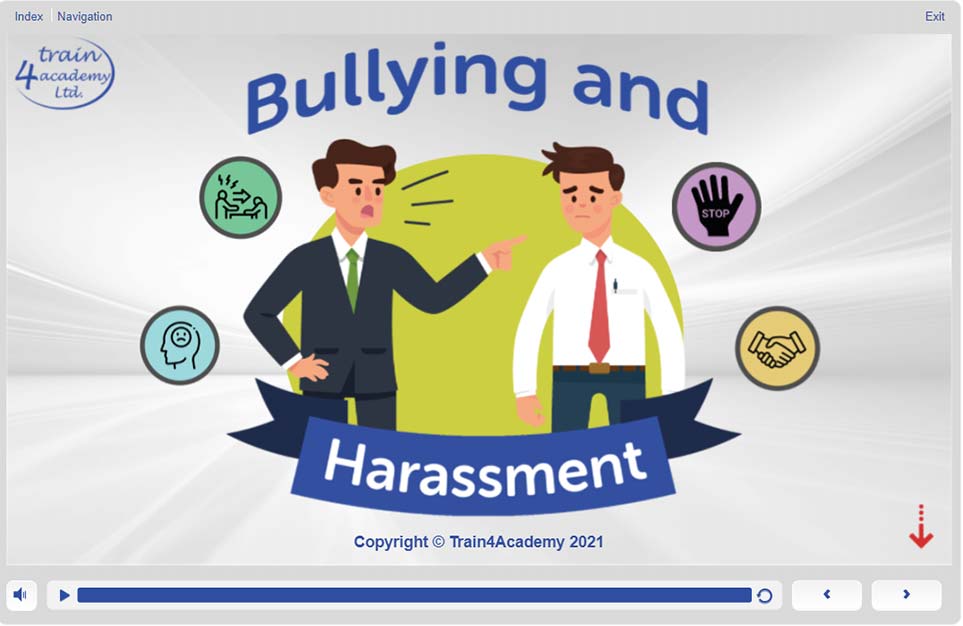
  • Introduction – Bullying and Harassment at the Workplace
  • Bullying and Harassment - costs of bullying and harassment to employees and organisations
  • Dealing with Bullying and Harassment – Training in Bullying and Harassment

Course Aim

The aim of this course is to raise awareness of what bullying and harassment are, how workers can be protected from bullying and harassment, and how concerns or complaints can be addressed appropriately. It also looks at how employers can respond to bullying and harassment in the workplace and the types of support they can provide for their workers.


Learning Objectives

On completion of the course, you should be able to:

  • Identify what bullying means
  • Identify actions of harassment
  • List some forms of bullying
  • Recognise the protected characteristics under the Equality Act 2010
  • Differentiate between bullying and harassment
  • Identify which laws are put in place to protect workers from bullying and harassment
  • List some good practices for employers
  • Identify some of the warning signs of bullying and harassment
  • Recognise the measures you can take to report bullying or harassment
  • Identify the support that could be offered by employers to victims of bullying and harassment
  • Identify what the ‘Insurance Iceberg’ is

Course Content

This course is made up of the following modules:

  • An Introduction to Bullying & Harassment at the workplace

    This section introduces the learner to the course. It discusses how bullying and harassment can have a negative impact on mental health, such as anxiety, depression, etc.

  • Module 1 - What is Bullying and Harassment?

    This section of the course concentrates on what exactly bullying is and what harassment is. It also differentiates between the two and gives an example of each. It also looks at the consequences of bullying and harassment within the workplace.

  • Module 2 - Legislation and Employer’s Responsibilitie

    This section of the course covers the relevant regulations that are in place to help protect workers who have been subjected to bullying or harassment at work. It looks at how employers hold the responsibility for ensuring their workers are protected and how they can put measures in place to help achieve that.

  • Module 3 - Providing Support

    In this final section, you will cover what you can do if you have been subjected to bullying or harassment and how to make a formal complaint. It also looks at the types of support employers can offer to workers.

Download Course Overview (PDF)

Assessment

On completion of the course lessons and training material an online assessment will automatically unlock. The assessment will contain 15 multiple-choice questions and a mark of 75% or above will be required to pass.

The assessment will be marked instantly and so you will know straight away if you have passed or not. If you don't pass first time there's no need to worry. Unlimited resits at absolutely no additional charge are available so you can retake the assessment again as many times as you need to.


Bullying and Harassment Training Certification

Our entire library of training courses are accredited by the CPD Certification Service as adhering to the universally recognised Continuing Professional Development (CPD) guidelines.
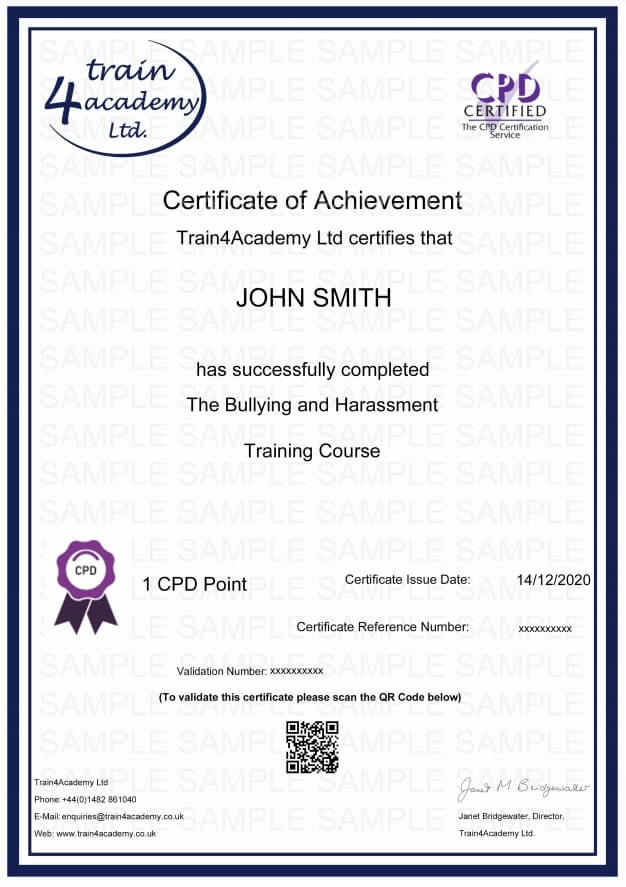
Bullying and Harassment Training - Certificate Example

Upon passing the online assessment you will have the options to both print and download your Bullying and Harassment Training Certificate in PDF format. In addition to this an automated email will also be sent to your chosen email address containing a link to your certificate ensuring you always have access to a copy.

Furthermore, a QR code is displayed on each certificate which when scanned by a smartphone links to our certification database. This allows employers, auditors and local authority inspectors, for example, to establish a certificates validity instantly and at any time.


Common Bullying and Harassment Training Questions

Bullying and harassment in the workplace involve unwanted or inappropriate behaviour that can make someone feel intimidated, humiliated, undermined or offended.

Bullying can include behaviour such as repeatedly putting someone down, excluding them, spreading malicious rumours or abusing a position of authority. There is no specific legal definition of workplace bullying, and bullying itself is not covered by a single specific law.

Harassment has a specific meaning under the Equality Act 2010. It can involve unwanted conduct related to a relevant protected characteristic that has the purpose or effect of violating someone’s dignity or creating an intimidating, hostile, degrading, humiliating or offensive environment.

Bullying and harassment can happen face to face or through other forms of workplace communication, including emails, messages and online communication.

The main difference between bullying and harassment is how they are treated under the law. There is no specific legal definition of workplace bullying, whereas harassment is defined under the Equality Act 2010.

Harassment can involve unwanted conduct related to a relevant protected characteristic that has the purpose or effect of violating someone’s dignity or creating an intimidating, hostile, degrading, humiliating or offensive environment.

Bullying does not have to be related to a protected characteristic. Although bullying itself is not covered by a specific law, some bullying behaviour may also amount to harassment or discrimination depending on the circumstances.

Signs of workplace bullying and harassment can vary, and some behaviours may be more difficult to recognise than others.

Warning signs can include:

  • Repeatedly criticising or undermining someone
  • Making insulting, offensive or intimidating comments
  • Deliberately excluding someone from workplace activities or communication
  • Spreading malicious rumours about a colleague
  • Misusing a position of authority to intimidate or unfairly target someone
  • Unwanted behaviour relating to a relevant protected characteristic

Changes in an employee’s behaviour, confidence or engagement at work may also indicate that something is wrong. However, these changes do not necessarily mean that bullying or harassment is taking place, so concerns should be handled appropriately rather than assumptions being made.

Workplace bullying is not covered by a specific law, but some bullying behaviour may be unlawful if it amounts to discrimination or harassment. Severe bullying could also lead to other legal issues in some circumstances.

Harassment can be unlawful under the Equality Act 2010. This includes unwanted conduct related to a relevant protected characteristic that has the purpose or effect of violating someone’s dignity or creating an intimidating, hostile, degrading, humiliating or offensive environment.

Employers also have a duty of care towards their workers and should take steps to prevent bullying and take complaints seriously.


Preventing and Responding to Bullying and Harassment at Work


If you experience bullying or harassment at work, you should raise the issue rather than feel that you have to deal with it alone. If you feel comfortable doing so, you may be able to address the behaviour informally by explaining to the person involved that their behaviour is unwanted and asking them to stop.

If this is not appropriate, does not resolve the problem, or the behaviour is serious, you can raise the concern with your manager, another appropriate manager or your HR department. You should follow your organisation’s bullying, harassment or grievance procedure where applicable.

It can also be helpful to keep a record of what has happened, including dates, times, what was said or done, any witnesses and relevant emails or messages. This information may be useful if the matter needs to be investigated formally.

If you witness bullying or harassment at work, you should not ignore the behaviour. If it is safe and appropriate to do so, you may be able to challenge the behaviour at the time or make it clear that it is unacceptable.

You can also speak privately with the person affected, offer support and encourage them to raise their concerns through the appropriate workplace procedure. Avoid putting pressure on them or making assumptions about how they want the situation to be handled.

If the behaviour is serious or continues, you should consider raising your concerns with an appropriate manager or HR. It can also be helpful to make a factual record of what you witnessed in case the matter is investigated.

If bullying or harassment is reported, a manager should take the concern seriously and respond promptly, fairly and sensitively. They should listen to the person raising the concern, avoid making assumptions and follow the organisation’s relevant policies and procedures.

Depending on the circumstances, the matter may be addressed informally or require a formal investigation. Managers should maintain confidentiality as far as possible, ensure everyone involved is treated fairly and keep appropriate records of the concern and any action taken.

Managers should also consider whether support is needed for those involved and seek advice from HR or another appropriate person if they are unsure how the matter should be handled.

Employers are responsible for taking reasonable steps to protect workers from bullying and harassment and for providing a safe and respectful working environment. They should make it clear that bullying and harassment are unacceptable and ensure workers understand the standards of behaviour expected of them.

Employers should have appropriate policies and procedures in place for raising and handling concerns. They should take complaints seriously, respond appropriately and ensure managers understand how to deal with concerns when they are reported. Providing appropriate training and raising awareness can also help employers prevent inappropriate behaviour, encourage concerns to be raised and promote respectful behaviour across the workplace.


Course Reviews

4.8.

(85 reviews)

Read more reviews


Related Online Training Courses

  • cert
    Leadership

    £25.00 +VAT

    A leader is one that stands out from the crowd to set a direction, build a vision and encourage others to follow. Leadership can be learned, and this course is intended to help those aspire to be good leaders to achieve their goals and shine in their various workplace..

  • cert
    Equality and Diversity

    £25.00 +VAT

    The Equality Act 2010 protects people from discrimination in the workplace and the wider society. It identified the nine protected categories, such as age, disability, becoming a transexual, marriage or civil partnership, race, religion, sex or sexual orientation.

Bullying and Harassment Training Course CPD Certified Course

4.8 (85 reviews)

£25.00 +VAT per person

Discounts on bulk purchases
  • 10% Discount 10+ courses
  • 20% Discount 20+ courses
  • 30% Discount 50+ courses
  • 40% Discount 75+ courses
  • 50% Discount 100+ courses
  • Compare plans & pricing

Training 10 or more people? Let us quote you

Training Management Suite (TMS) included
with orders of 5 or more courses.

Course information
  • Certificate on Successful Completion
  • Access course on Desktop, Laptop or Tablet
  • 15 Multiple Choice Questions
  • Course Duration: 35 Minutes
  • CPD Points: 1

Frequently Asked Questions

Our training is completed online, using only a web browser.

After choosing the courses and completing the online transaction, you'll recieve an email providing access to the course. Use the details to register the course yourself or if it's for someone else, simply forward the email on.

Purchasing training for your team is simple.

Just add the courses you need to your basket and complete the checkout process. If you're purchasing 5 or more courses, we'll provide you with access to our Training Management System (TMS).

The TMS gives you full control over your learners, allowing you to enrol staff, monitor progress, track completion rates, and download certificates.

Once your account is set up, we're happy to show you around the system and help you get the most from its features. If you have any questions, our support team is always here to help at support@train4academy.co.uk.

Yes. We offer automatic discounts on larger orders, and any applicable discount will be applied instantly at checkout across all courses in the basket.

Depending on the number of courses purchased we provide the following discounts below. If you're looking to purchase a higher volume, please contact us and we'll be happy to discuss additional volume discounts.

  • Purchase 10+ courses and recieve 10%
  • Purchase 20+ courses and recieve 20%
  • Purchase 50+ courses and recieve 30%
  • Purchase 75+ courses and recieve 40%
  • Purchase 100+ courses and recieve 50%

Our training can be purchased easily using a debit or credit card.

If you're purchasing a larger volume of training and would prefer to be invoiced, please contact us on 01482 861 040 or email enquiries@train4academy.co.uk.

Our training is designed to fit around your schedule. Everybody receives 2 years from date of purchase, so there's no rush to complete your training course.

You can work through the training at your own pace, pause whenever you need to, and return whenever it's convenient. Your progress is automatically saved, allowing you to pick up exactly where you left off.

Even after you've successfully passed the assessment, you'll still be able to access the training materials whenever you need to refresh your knowledge

Read further FAQ

Read more reviews