
Call Us 01482 861 040
Prepare for the Key Changes Coming in October 2026 with our Sexual Harassment Awareness Training Course
Level 3 Food Safety and Hygiene Training
95.00+ VATLevel 3 Food Safety and Hygiene for Supervisors

Unlimited Resits Customer Support Instant Access
£95.00 +VAT per person
Course information
- Instant Certificate on Successful Completion
- Access course on Desktop, Laptop or Tablet
- 45 Multiple Choice Questions
- Course Duration: 6 Hours
- CPD Points: 6
Our Level 3 Food Hygiene Course for Managers and Supervisors is an industry-recognised, RoSPA Assured and CPD Accredited online training course designed to support those responsible for food safety within the workplace.
Covering advanced food hygiene and food safety principles, the course helps build confidence during EHO inspections while supporting due diligence and protecting business reputation.
Suitable for catering, retail and manufacturing environments, the training provides a thorough understanding of supervisory food safety responsibilities.
- Work towards compliance with UK & EU Food Safety and Hygiene Legislation
- Train online at your own pace with a full audio voiceover
- Assured by RoSPA & Accredited by CPD
- Instant Certificate on successful completion
- Course duration: 6 Hours
- Unlimited resits at no cost
Discounts on Bulk Purchases
Take advantage of our bulk discounts which will reduce your overall cost of training. Better still, any courses you order can be registered to users upto two years later so there's no need to worry about training credits expiring.
| Courses Purchased | Discount |
|---|---|
| 10+ | 10% |
| 20+ | 20% |
| 50+ | 30% |
| 75+ | 40% |
| 100+ | 50% |
Who Is This Level 3 Food Hygiene Training For?
This Level 3 in Food Hygiene and Safety is ideal for business owners, managers, and supervisors responsible for tasks such as food preparation, storage, staff management, and ensuring compliance with food hygiene legislation.
The course is essential for professionals in the following roles but not limited to:
- Restaurant Owners & Managers
- Head Chefs, Sous Chefs, and Kitchen Supervisors
- Catering Managers & Staff Supervisors
- Food Retailers, Packagers & Distributors
If you work under supervision and handle food but do not manage staff or processes, our Level 2 Food Hygiene & Safety Training may be more suitable.
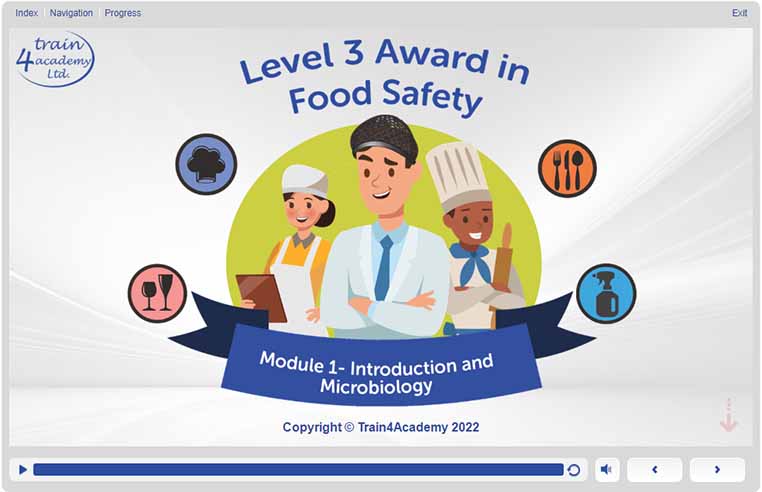
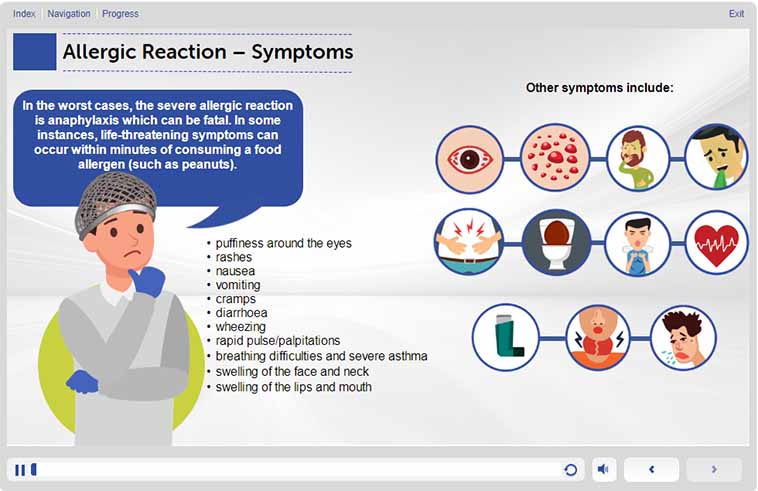
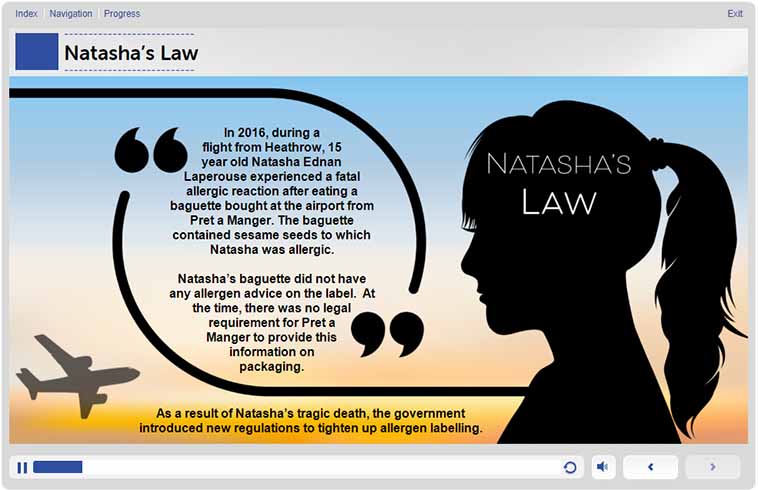
Course Screenshots
Course Aim
All food businesses are legally required to have at least one trained supervisor or manager to oversee food safety operations. This Food Safety Level 3 course provides the knowledge, skills, and accreditation needed to ensure full compliance and maintain the highest hygiene standards.
Senior staff can deepen their allergen knowledge with our Allergen Awareness Training, enhancing their understanding of food safety hazards.
Earning an Food Safety Level 3 Certificate online helps ensure full compliance with UK and EU food safety laws, including the Food Safety Act 1990 and the Food Hygiene Regulations 2005. Allowing businesses to achieve their legal obligations and maintain high standards.
Learning Objectives
On completion of the course, you should be able to:
- Explain your responsibilities as a manager or supervisor of food-handlers
- Understand the responsibilities that a supervisor or manager holds in a food business
- Know the importance of preventing foodborne illness and the impact it has legally
- Maintain a good knowledge of the risks surrounding bacteria and how it can affect food
- Recognise the importance of ensuring food handlers maintain good personal hygiene
- Know the 14 main food allergens and how to handle them safely
- Understand the importance of preventing contamination and cross-contamination
- Know how to dispose of waste safely and its importance
- Understand how to thoroughly and correctly disinfect and clean food work surfaces and equipment
- Recognise the importance of maintaining a successful HACCP system
- Recognise the safe temperatures for storing, cooking and freezing food safely
Course content
Our Level 3 Course is structured to ensure that managers and supervisors gain a comprehensive understanding of food safety principles, legal compliance, and risk management.
-
An Introduction to Food Safety & Biology
Covers food safety principles and factors responsible for incidents of foodborne illnesses.
-
Food-safety Hazards & their Control
Covers how to identify the different types of food safety hazards, including the four main groups, which are biological, chemical, physical and allergenic.
-
Food Poisoning & Food Borne Illnesses
It looks at food poisoning and foodborne illnesses, what factors are responsible for outbreaks, the symptoms and the control measures that can be put in place to minimise the risk of infection
-
Personal Hygiene
It looks at good hygiene practices to help ensure that when handling food, food-handlers do not become a source of contamination.
-
Cleaning & Disinfection
Covers how to carry out effective cleaning and disinfection of equipment and facilities while following the relevant health and safety precautions to ensure the safe use of chemicals.
-
Waste Control
It looks at the types of waste in a food environment.
-
Pests & their Control
It looks at signs of pest infestation, how pests can become food safety hazards and the actions that should be taken where pest infestations exist by using good housekeeping techniques.
-
Food Premises & Food Equipment
Before commercial food-handling operations can begin, the intended premises must be suitable and approved by the enforcement authority (environmental health).
-
Food Packaging, Labelling & Traceability
Designed to help you to understand how and why we package and label food to keep food safe for the consumer.
-
Food Preservation
It looks at how yeasts, moulds and bacteria can cause the decomposition and spoilage of foods, which can make food unfit for human consumption.
-
Food Safety Management
It looks at the seven principles of HACCP (Hazard Analysis Critical Control Point) as a food safety management system and the benefits of implementing it effectively.
-
Food Hygiene Legislation
Designed to give you a good understanding of the principal food hygiene legislation that applies to the UK and its relationship to European Community law.
Download Course Overview (PDF)
Assessment
On completion of the course lessons and training material an online assessment will automatically unlock. The assessment will contain 45 multiple-choice questions and a mark of 75% or above will be required to pass.
The assessment will be marked instantly and so you will know straight away if you have passed or not. If you don't pass the first time there's no need to worry. Unlimited resits at absolutely no additional charge are available so you can retake the assessment again as many times as you need to.
Achieving a Level 3 Food Safety and Hygiene Certificate
Our entire library of food hygiene training courses are accredited by the CPD Certification Service as adhering to the universally recognised Continuing Professional Development (CPD) guidelines.
This training course and its content has also been assured by RoSPA, the Royal Society for the Prevention of Accidents.
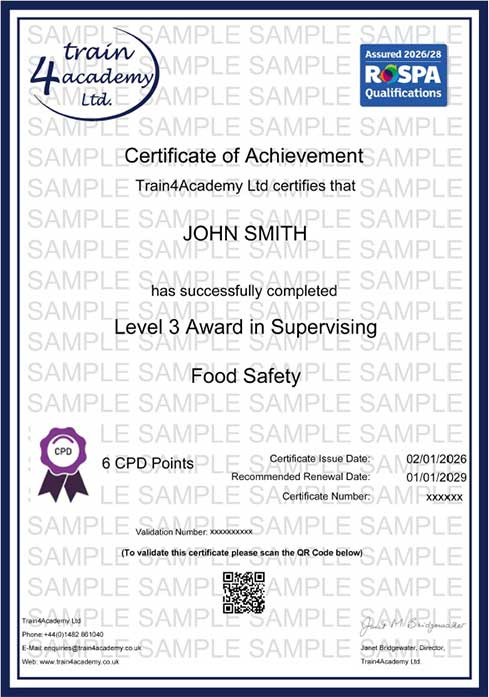
Upon passing the online assessment you will have the options to both print and download your Level 3 Award in Supervising Food Safety Certificate in PDF format. In addition to this an automated email will also be sent to your chosen email address containing a link to your certificate ensuring you always have access to a copy.
Furthermore, a QR code is displayed on each certificate which when scanned by a smartphone link
The Importance of a Level 3 Award in Supervising Food Safety
- For businesses
Helps ensure legal compliance with food safety legislation by providing supervisors with the knowledge to implement, monitor and verify food safety management systems such as HACCP. It supports due diligence by ensuring that critical controls like temperature monitoring, cleaning schedules, allergen management and staff supervision are consistently maintained and properly documented. This reduces operational risk, supports EHO inspection readiness and helps protect business reputation.
- For employees
Training provides the skills and understanding needed to supervise food safety procedures effectively and confidently. It enables staff in supervisory roles to identify risks early, correct unsafe practices, and ensure food handling standards are consistently followed. This creates a clearer sense of responsibility, improves decision-making in day-to-day operations, and supports progression into management-level roles within the food industry.
- For employers
Having trained supervisors in place helps ensure that food is prepared, stored and served safely and consistently. Strong supervisory control reduces the risk of contamination, allergen mismanagement and hygiene failures, helping to protect public health. It also increases confidence that the food business takes safety seriously and operates to high, verifiable standards.
Chilled Storage Running Too Warm
Situation
During your morning opening checks, you record the walk-in refrigerator temperature at 10°C. Yesterday's temperature records also show readings above the safe limit, but no one reported the issue. High-risk foods, including cooked meats and dairy products, are stored inside.
What went wrong?
The refrigeration unit has not been maintaining safe temperatures, and previous checks were not acted upon. This creates a risk that high-risk foods may no longer be safe to use.
Correct Supervision
The supervisor should immediately stop using the refrigerator, isolate any affected food and assess whether it is safe to keep or must be disposed of. The equipment should be reported for repair, corrective actions recorded, and temperature monitoring increased until the unit is operating safely again.
Raw Chicken Prepared on the Wrong Chopping Boardl
Situation
While carrying out a routine kitchen check, you observe a member of staff preparing raw chicken on a green chopping board before using the same board to prepare ready-to-eat salad without cleaning or disinfecting it.
What went wrong?
Raw poultry bacteria may have been transferred to ready-to-eat food through poor use of colour-coded equipment, creating a serious cross-contamination risk.
Correct Supervision
The supervisor should stop food preparation immediately, dispose of any contaminated ready-to-eat food, ensure all affected equipment is thoroughly cleaned and disinfected, reinforce colour-coded procedures with the employee and provide retraining where necessary.
Customer Requests Allergen Information
Situation
During a weekly records review, you notice several cleaning schedules have been signed as completed. However, food debris is still present on preparation surfaces and underneath equipment.
What went wrong?
Cleaning procedures were either not completed or not properly checked before records were signed. This means both hygiene standards and monitoring procedures have failed.
Correct Supervision
The supervisor should arrange immediate cleaning of the affected areas, investigate why records were completed incorrectly, remind staff of cleaning procedures, increase routine supervisory checks and ensure all future records accurately reflect the work completed.
Environmental Health Officer Inspection
Situation
An Environmental Health Officer arrives for an unannounced inspection and asks to see temperature records, cleaning schedules, staff training records and evidence of pest control monitoring. Several documents are incomplete or missing.
Why this matters
Food safety procedures have not been consistently monitored or documented, making it difficult to demonstrate that legal food safety controls are being effectively managed.
Correct Supervision
The supervisor should provide all available records, explain any corrective actions already taken, ensure missing monitoring systems are implemented immediately and review supervision procedures with the team. Accurate records should always be maintained as evidence that food safety systems are operating effectively.
Environmental Health Officers (EHOs) often assess how food businesses manage hygiene standards, monitoring procedures and food safety documentation. Level 3 Food Hygiene training helps supervisors understand the importance of maintaining structured food safety systems across daily operations that includes overseeing:
- cleaning schedules
- monitoring temperature controls
- managing allergen procedures
- ensuring accurate food safety records are maintained
Strong supervisory knowledge helps businesses demonstrate a proactive approach to food safety management during inspections.
Due diligence refers to the steps a business takes to demonstrate that reasonable food safety precautions and procedures are consistently followed. This may include monitoring systems, staff supervision, cleaning records, temperature checks and documented food safety procedures.
Supervisors play an important role in helping businesses maintain these standards across daily operations. Proper food safety management and accurate documentation can help demonstrate that food safety responsibilities are being actively monitored and maintained within the workplace.
Due Diligence in Action
A restaurant stores raw chicken in a walk-in refrigerator. As part of its food safety management system:- 1. The supervisor ensures the refrigerator temperature is checked and recorded twice daily.
- 2.Raw chicken is always stored on the bottom shelf to prevent juices dripping onto ready-to-eat foods.
- 3. Staff receive training on safe food storage and cross-contamination prevention.
- 4. The supervisor regularly checks that procedures are being followed.
- 5. Temperature records and training records are kept up to date.
One morning, the supervisor notices the refrigerator temperature has risen to 10°C, above the legal safe limit. Rather than ignoring the issue, they;
- Quarantine any high-risk food that may be unsafe.
- Arrange for the refrigerator to be repaired immediately.
- Record the fault and the corrective action taken.
- Review whether any food must be discarded.
- Continue monitoring temperatures after the repairs.
This demonstrates that the business took all reasonable precautions to protect consumers, which is the essence of due diligence.
Due diligence means being able to demonstrate that you have effective food safety procedures in place, monitor them consistently, keep accurate records, and take prompt corrective action whenever standards are not met.
Common Level 3 Food Hygiene and Safety Questions
Any business involved in food preparation, handling or service can benefit from having supervisors trained to Level 3 Food Hygiene standards. This includes restaurants, takeaways, cafes, pubs, bakeries, catering companies, schools, care homes, food retailers and food manufacturing environments.
Supervisory food hygiene training helps businesses maintain consistent food safety standards, improve monitoring procedures and support safer day-to-day operations across food handling environments.
Common food safety mistakes at supervisory level often involve poor monitoring, inconsistent procedures or missing documentation. These issues can increase contamination risks and affect overall food safety standards within the workplace.
Common supervisory mistakes include:
- Incomplete temperature monitoring records
- Poor allergen communication procedures
- Inconsistent cleaning checks
- Inadequate staff supervision
- Failure to enforce handwashing procedures
- Poor stock rotation practices
- Missing food safety documentation
Proper supervisory training helps managers identify these issues early while supporting stronger food safety management procedures across the business.
When food safety procedures are not followed correctly, businesses may face increased risks relating to contamination, foodborne illness, poor hygiene ratings and failed inspections. Inconsistent procedures can also affect customer confidence and business reputation.
Supervisors play an important role in ensuring food safety systems are monitored correctly and consistently followed by staff. Maintaining accurate records, enforcing hygiene procedures and monitoring food safety practices all help support due diligence and safer working environments.
4.6
Course Reviews
(382 reviews)
4.6
-
excellent
IsaacPosted 01-Sep-2026
5 5 -
good and informative
ButchPosted 22-Aug-2026
5 5 -
Would be nice to have a few pointers when taking the test
EmmaPosted 19-Aug-2026
4 5 -
EXCELLENT
ChristopherPosted 08-Jul-2026
5 5 -
very good training to learn
ClaudiuPosted 04-Jul-2026
5 5 -
Great course, easy to follow
ManjitPosted 22-Jun-2026
5 5 -
Good program, no issues whatsoever
AgnesePosted 29-Apr-2026
5 5 -
Excellent.
OanaPosted 20-Apr-2026
5 5Reply from Train4Academy
Hi Oana, thank you for sharing your feedback and well done for achieving a level 3 food hygiene certificate. We look forward to supporting your future training requirements.
-
Excellent
SimonPosted 29-Mar-2026
5 5 -
Interesting Assignment Especially The Properties of The Various Viruses & Bacteria - Psychrophiles, Mesophiles, & Thermophiles & how they perform in their exclusive temperature environment.
BrianPosted 28-Feb-2026
5 5
Related Online Training Courses
-
Level 2 Food Hygiene and Safety in Catering
£20.00 +VAT
Catering, arguably the most diverse form of food handing is constant in its fundamentals, that is, the use of quality ingredients, cooked thoroughly, and protected once cooked. This level 2 food hygiene course will meet all legislative and audit requirements, fulfilling your due diligence needs..
-
Manual Handling (Understanding)

£25.00 +VAT
Manual handling is the moving of loads by pushing, pulling, or lifting when machinery is not involved. Many injuries have been caused by these activities and many can be avoided by using correct techniques. This course has been developed for staff where handling bulky or heavy items manually is involved in their jobs. .
4.6 (382 reviews)
£95.00 +VAT per person
Discounts on bulk purchases
- 10% Discount 10+ courses
- 20% Discount 20+ courses
- 30% Discount 50+ courses
- 40% Discount 75+ courses
- 50% Discount 100+ courses
- Compare plans & pricing
Training 10 or more people? Let us quote you
Training Management Suite (TMS) included
with orders of 5 or more courses.
Course information
- Certificate on Successful Completion
- Access course on Desktop, Laptop or Tablet
- 45 Multiple Choice Questions
- Course Duration: 6 Hours
- CPD Points: 6