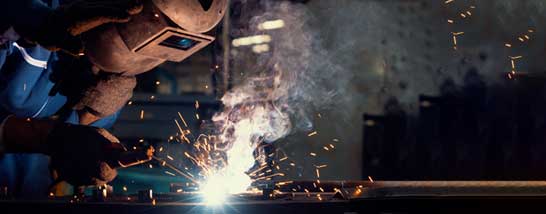
This Hot Work training course explores the risks and hazards surrounding hot work activities. Hot working usually involves using open flames, welding, cutting, or other processes that generate heat. In industrial settings, this can include tasks such as welding metal structures, cutting through materials, or soldering components.
The Hot Work course looks at the potential fire hazards hot work poses, the release of sparks and molten materials, which can burn skin, eyes or other parts of the body. This is why understanding the principles discussed in this course, is crucial for maintaining a safe working environment and preventing accidents and injuries.
Therefore, raising awareness of hot work activities for those undertaking this role should be well-trained in preventive measures to ensure that the risk of fire is kept to a minimum, and in the event of a fire, they are aware of the correct emergency procedures.
Work towards compliance with UK Health and Safety legislation
Train online at your own pace with a full audio voiceover
Assured by RoSPA & Accredited by CPD
Certificate on successful completion
Course duration: 30 minutes
Unlimited resits at no cost
Discounts on Bulk Purchases
Take advantage of our bulk discounts which will reduce your overall cost of training. Better still, any courses you order can be registered to users upto two years later so there's no need to worry about training credits expiring.
Courses Purchased
Discount
10+
10%
20+
20%
50+
30%
75+
40%
100+
50%
Who is this Online Hot Work Training for?
The Hot Work course is ideal if your job role involves the use of open flames, sparks, and high temperatures. If your job includes these elements, then you are working in an environment where hot works are being carried out.
For example, welding can be a job role that requires hot work, as it involves the use of open flames and high temperatures and so being aware of hot work safety is crucial when undertaking such a role.
This course is also suitable for employers who are aware that their staff works in an environment fitting the description of hot work. It is a legal requirement that your employees be competent to carry out the required tasks, ensuring they do not inadvertently risk their own health and safety, as well as the safety of others within the organisation.
This Hot Work course aims to raise awareness of the potential risks and safety measures associated with tasks involving open flames, welding, and heat-generating activities. Workers may also be exposed to high temperatures in other environments, and our Working in Hot Conditions training course explains how to manage heat exposure in both industrial and environmental settings.
Learners will also gain essential knowledge on fire prevention, hazard identification, and emergency response protocols, giving them the skills needed to stay safe in hot work environments where both fire and heat risks are present.
Learning Objectives
On completion of the course, you should be able to:
Differentiate between a risk and a hazard
Identify what hot work is
Name some legislation relating to hot work
Identify the purpose of DSEAR
Identify the importance of assessing the necessity of hot work
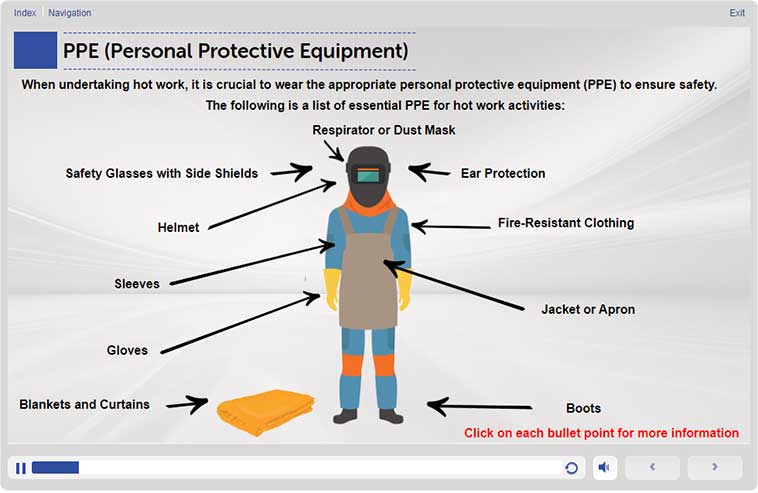
List some PPE (personal protective equipment) that should be worn when hot working
Identify the five steps to a risk assessment
Explain what a permit to work is and its purpose
List some main hot work activities
List some preventative measures
Identify employer and employee responsibilities when it comes to hot work
Explain the purpose of a fire watch
Identify a fire triangle
List some general safety rules for hot work
Course Content
This course is made up of the following modules:
An Introduction to Hot Work
This section introduces the learner to the training course.
Module 1 - Hot Work Legislation
This section of the course concentrates on the different types of hot work and the relevant legislation that is in place to help keep workers and the workspace safe.
Module 2 - Safety Measures and Prevention
This section of the course covers the different types of PPE (personal protective equipment) that should be worn, as well as carrying out a five-step risk assessment. It also looks at why implementing these safety measures, such as a permit-to-work, is important.
Module 3 - Roles and Responsibilities
This final section covers the different roles and responsibilities that fall on both the employee and the employer. It also looks at the role of a ‘fire watch’ team and why they may be needed on the premises when hot work is taking place.
On completion of the course lessons and training material an online assessment will automatically unlock. The assessment will contain 15 multiple-choice questions and a mark of 75% or above will be required to pass.
The assessment will be marked instantly and so you will know straight away if you have passed or not. If you don't pass first time there's no need to worry. Unlimited resits at absolutely no additional charge are available so you can retake the assessment again as many times as you need to.
Hot Work Training Certificate
Our entire library of training courses is accredited by the CPD Certification Service as adhering to the universally recognised Continuing Professional Development (CPD) guidelines.
This training course and its content has also been assured by RoSPA, the Royal Society for the Prevention of Accidents.
Upon passing the online assessment you will have the options to both print and download your Hot Work Certificate in PDF format. In addition to this an automated email will also be sent to your chosen email address containing a link to your certificate ensuring you always have access to a copy.
Furthermore, a QR code is displayed on each certificate which when scanned by a smartphone links to our certification database. This allows employers, auditors and local authority inspectors, for example, to establish a certificates validity instantly and at any time.
Common Hot Work Training Questions
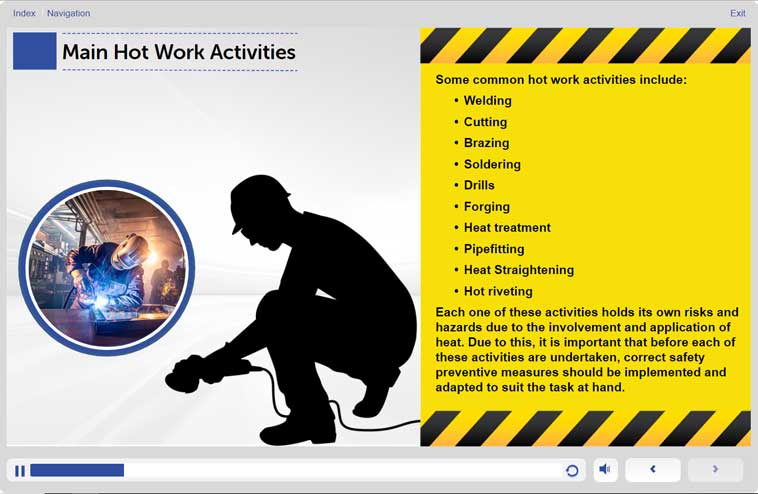
Hot work refers to any activity that produces heat, sparks, flames or sufficient energy to ignite combustible materials.
Examples of Activities Considered Hot Work Include
Activity
Why it is Considered Hot Work
Welding
Produces intense heat, molten metal and sparks.
Grinding
Generates high-temperature sparks that can travel several metres.
Flame Cutting
Uses an open flame capable of igniting nearby materials.
Brazing & Soldering
Involves heat sources that can ignite combustible materials.
Torch-on Roofing
Uses naked flames to bond roofing materials.
Metal Cutting
Produces heat, sparks and hot fragments that present a fire risk.
A Hot Work Permit is required whenever work involving heat, sparks or open flames is carried out outside of a designated safe area or where there is a risk that the work could ignite combustible materials, flammable substances or nearby structures.
A permit forms part of a Permit to Work system, ensuring that hazards have been identified, appropriate control measures are in place and the work has been formally authorised before it begins. While UK legislation does not specifically state that every hot work task requires a permit, it is recognised as industry best practice and is often required by employers, insurers and site-specific safety procedures.
A Hot Work Permit should always be considered where work is carried out:
Inside occupied buildings.
Near combustible materials such as timber, cardboard or packaging.
Close to flammable liquids, gases or vapours.
Within manufacturing or warehouse environments.
During maintenance or repair work.
In confined spaces where heat or fumes may accumulate.
On construction or refurbishment projects.
When contractors are working on-site.
These environments often contain hidden fire risks that may not be immediately obvious without a suitable risk assessment.
Hot Work Training is suitable for anyone who carries out, supervises, authorises or manages work involving heat, sparks or open flames. While it's commonly associated with welders and fabricators, many other employees, contractors and managers also have responsibilities for ensuring hot work is carried out safely.
Training helps individuals understand fire hazards, legal responsibilities, risk assessments, Hot Work Permit procedures and the control measures needed to reduce the risk of fire, injury and property damage.
Job roles requiring hot work training include
Job Role
Why Training Is Important
Welders
Produce intense heat, sparks and molten metal during fabrication and repair work.
Fabricators
Carry out cutting, grinding and welding operations.
Maintenance Engineers
Frequently undertake repair work involving hot work equipment.
Electricians
May carry out soldering or other heat-producing tasks during installations and repairs.
Plumbers & Pipefitters
Often use brazing and soldering equipment when installing or repairing pipework.
Roofers
Use torch-on felt systems and other flame-producing equipment.
Construction Workers
Carry out temporary hot work activities during building projects.
Mechanical Engineers
Perform fabrication, repairs and maintenance involving hot work processes.
There is no legal requirement in UK legislation that specifies how often Hot Work training must be renewed. However, employers have a duty under the Health and Safety at Work etc. Act 1974 to ensure workers remain competent to carry out their duties safely.
As a guide, most organisations refresh Hot Work training every 3 years as part of their ongoing health and safety programme. In higher-risk industries, annual refresher training or more frequent toolbox talks may also be appropriate.
When hot work training should be refreshed
Situation
Why it matters
Every 3 years (best practice)
Helps keep knowledge current and demonstrates ongoing competence.
After an incident or near miss
Allows lessons learned to be shared and unsafe practices corrected.
When work processes or equipment change
Ensures workers understand new hazards and control measures.
When legislation or company procedures are updated
Keeps employees compliant with current safety requirements.
If employees have not carried out hot work for a long period
Refreshes essential knowledge before returning to the task.
Following poor performance or unsafe behaviour
Reinforces safe working practices and permit procedures.
Why Hot Work Safety Matters
Hot work activities such as welding, grinding, flame cutting and brazing introduce heat, sparks and open flames into environments that may contain combustible materials, flammable liquids, gases or dust. Without suitable planning and control measures, these ignition sources can quickly develop into serious workplace fires or explosions.
Many hot work incidents occur not because the work itself is inherently unsafe, but because surrounding hazards were overlooked. Sparks can travel several metres, pass through small gaps, or remain hidden in roof spaces, wall cavities or beneath machinery before igniting combustible materials long after the work has finished.
People assume only obvious flammable substances present a risk. In reality, everyday workplace materials can ignite if exposed to heat or sparks.
Common combustible materials include:
Cardboard and paper packaging
Timber and wooden pallets
Plastic sheeting and insulation
Dust deposits
Paints, solvents and adhesives
Textiles and protective coverings
Waste materials and general rubbish
Removing or protecting these materials before work begins is one of the simplest and most effective fire prevention measures.
Protecting people is the primary objective of any hot work procedure. By understanding the hazards and following safe systems of work, organisations can reduce the likelihood of injuries and create a safer working environment for everyone involved.
Hot work activities expose employees and contractors to a range of hazards, including fire, explosions, burns, hazardous fumes and flying sparks. Whether carrying out welding, grinding, flame cutting or brazing, workers can be placed at risk if suitable precautions are not taken before work begins.
Employees should:
Follow Hot Work Permit conditions.
Wear the correct PPE.
Report hazards immediately.
Use equipment safely.
Stop work if conditions become unsafe
Contractors should:
Follow the site's permit procedures.
Comply with company safety rules
Coordinate with supervisors.
Ensure work areas remain safe.
Hot work safety is about protecting the people carrying out the work and everyone nearby. Proper planning, suitable PPE, competent supervision and clear communication all help reduce the risk of injury and create a safer workplace.
UK health and safety legislation places a legal duty on employers to protect employees, contractors and anyone who may be affected by their work. While there isn't a single law dedicated solely to hot work, several pieces of legislation require organisations to assess risks, implement suitable control measures and provide appropriate training.
Following these legal responsibilities not only helps organisations remain compliant but also reduces the likelihood of workplace incidents, enforcement action and costly business disruption.
Key Health and Safety Legislation
Legislation
Why It Matters
Health and Safety at Work etc. Act 1974
Requires employers to protect the health, safety and welfare of employees and others.
Management of Health and Safety at Work Regulations 1999
Requires suitable and sufficient risk assessments.
Regulatory Reform (Fire Safety) Order 2005
Requires fire risks to be assessed and managed.
DSEAR Regulations 2002
Protects workers where dangerous substances, gases or vapours may be present.
Provision and Use of Work Equipment Regulations (PUWER)
Requires equipment used during hot work to be suitable and properly maintained.
Most hot work incidents can be prevented through effective planning. Risk assessments and Hot Work Permits are two of the most important control measures because they ensure hazards are identified before work starts rather than after an incident has occurred.
Rather than treating them as paperwork, they should be viewed as practical safety tools that help everyone involved understand the work, recognise potential hazards and implement suitable controls.
Risk Assessment vs Hot Work Permit
Risk Assessment
Hot Work Permit
Identifies hazards.
Authorises the work.
Evaluates the risks.
Confirms controls are in place.
Determines suitable precautions.
Records who approved the work.
Completed before work begins.
Issued before work starts and closed after completion.
While protecting employees is always the priority, poor hot work practices can also have significant consequences for an organisation. A single fire can interrupt operations, damage equipment, delay projects and result in substantial financial losses.
Investing time in safe planning helps businesses maintain continuity while protecting their people, reputation and assets.
Potential Business Impacts of Hot Work Incidents
Potential Outcome
Business Impact
Workplace Fire
Damage to buildings, stock and equipment.
Equipment Damage
Expensive repairs and replacement costs.
Project Delays
Missed deadlines and increased costs.
Business Interruption
Loss of productivity and income.
Insurance Claims
Increased premiums and lengthy investigations.
Regulatory Action
Enforcement notices or prosecution where legal duties have not been met.
Reputational Damage
Reduced customer confidence and commercial impact.
Workplace Scenario
1 / 5
Sparks Ignite Hidden Combustibles
Situation
Situation
A maintenance contractor was using an angle grinder to remove a damaged steel bracket inside a warehouse. Although the immediate work area appeared clear, sparks travelled several metres and entered a storage area where cardboard packaging had accumulated behind shelving. Shortly after work was completed, a fire broke out.
What went wrong
Combustible materials had not been removed.
The work area inspection was incomplete.
Sparks travelled further than anticipated.
No fire-resistant screens or blankets were used.
Post-work fire watch was not carried out.
Key takeaway
Hot work sparks can travel several metres and ignite hidden combustible materials. A thorough inspection, removal of fire hazards and an appropriate fire watch are essential before, during and after hot work activities.
Workplace Scenario
No Hot Work Permit Issued
Situation
A contractor began welding inside a production area without obtaining a Hot Work Permit. During the work, nearby flammable liquids created an unexpected fire risk, forcing an emergency evacuation.
What went wrong?
No permit was issued.
Hazards were not formally assessed.
Flammable substances remained nearby.
Supervision was lacking.
Safe systems of work were bypassed.
Key takeaway
Hot Work Permits ensure hazards are identified before work begins. They are a critical control measure, not simply paperwork.
Workplace Scenario
Fire Starts After Work Has Finished
Situation
Roofing contractors completed torch-on felt work and left the site immediately after finishing. Around an hour later, heat transferred through the roof structure ignited concealed timber, resulting in a significant fire.
What went wrong?
No post-work inspection took place.
No fire watch was maintained.
Heat transfer through the structure was overlooked.
Hidden combustible materials were not considered
Key takeaway
Some hot work fires don't occur immediately. Fire watches and post-work inspections help detect smouldering materials before they develop into serious fires.
Workplace Scenario
Incorrect PPE During Cutting Work
Situation
An employee carried out metal cutting while wearing basic safety glasses instead of a full face shield. Flying sparks caused facial burns and an eye injury, requiring hospital treatment.
What went wrong?
Incorrect PPE selected.
Risk assessment underestimated hazards.
Face protection was inadequate.
Supervisors failed to verify PPE before work began.
Key takeaway
Suitable PPE should always match the specific hot work activity being carried out. Eye, face, hand and body protection all play an important role in preventing injury.
Workplace Scenario
Poor Ventilation During Welding
Situation
A welder completed repair work inside a confined plant room with limited ventilation. During the task, welding fumes accumulated, causing dizziness and breathing difficulties before work could be stopped safely.
What went wrong?
Ventilation requirements were ignored.
Fume exposure was underestimated.
Atmospheric conditions were not considered.
Additional extraction equipment was not used.
Key takeaway
Hot work hazards extend beyond fire. Adequate ventilation, fume control and atmospheric monitoring are essential to protect workers from harmful airborne contaminants.
4.6
Course Reviews
4.6.
(18 reviews)
4.6
18 Reviews
Excellent
MarkPosted 10-Jul-2026
55
Good short course to give basic idea on the safety of "hot works".
NigelPosted 29-Jan-2026
55
Reply from Train4Academy
Hi Nigel, thank you for sharing your training experience.
No problem over here. I enjoyed the training course...
MarkPosted 24-Feb-2025
55
Reply from Train4Academy
Hi Mark, thank you for sharing your feedback with us and we're happy to know you enjoyed our training course. We look forward to be seeing you again.
The assessment was straight forward...
DavidPosted 05-Feb-2025
45
Reply from Train4Academy
Hi David, thank you for sharing your feedback with us. We always design our online training courses with simplicity in mind and it's great to hear your experience was both positive and straightforward.
Excellent. Interesting content shown on the slides. Thank you...
MarkPosted 03-Feb-2025
55
Some informative material here, good course.
HarryPosted 29-Jan-2025
45
Reply from Train4Academy
Hi Harry, thank you for sharing your training experience and it's good to know you enjoyed working through the learning material.
Good. Glad I've done this course. Information was just right, not too much...
ThomasPosted 10-Jan-2025
55
Excellent
DeepuPosted 04-Dec-2024
55
The modules explained the training content well...
JoshuaPosted 22-Oct-2024
45
The course wasn't too hard, just about right and straight forward...
Everyone in the workplace should have an understanding of the risks associated with fire, and how to minimise fire risks. However if a fire does start there may be a requirement of designated individuals, armed with greater degree of knowledge, to take control, help to organise others, preventing panic and on occasions to control evacuation..
Manual handling is the moving of loads by pushing, pulling, or lifting when machinery is not involved. Many injuries have been caused by these activities and many can be avoided by using correct techniques. This course has been developed for staff where handling bulky or heavy items manually is involved in their jobs. .
Our training is completed online, using only a web browser.
After choosing the courses and completing the online transaction, you'll recieve an email providing access to the course. Use the details to register the course yourself or if it's for someone else, simply forward the email on.
Purchasing training for your team is simple.
Just add the courses you need to your basket and complete the checkout process. If you're purchasing 5 or more courses, we'll provide you with access to our Training Management System (TMS).
The TMS gives you full control over your learners, allowing you to enrol staff, monitor progress, track completion rates, and download certificates.
Once your account is set up, we're happy to show you around the system and help you get the most from its features. If you have any questions, our support team is always here to help at support@train4academy.co.uk.
Yes. We offer automatic discounts on larger orders, and any applicable discount will be applied instantly at checkout across all courses in the basket.
Depending on the number of courses purchased we provide the following discounts below. If you're looking to purchase a higher volume, please contact us and we'll be happy to discuss additional volume discounts.
Purchase 10+ courses and recieve 10%
Purchase 20+ courses and recieve 20%
Purchase 50+ courses and recieve 30%
Purchase 75+ courses and recieve 40%
Purchase 100+ courses and recieve 50%
Our training can be purchased easily using a debit or credit card.
If you're purchasing a larger volume of training and would prefer to be invoiced, please contact us on 01482 861 040 or email enquiries@train4academy.co.uk.
Our training is designed to fit around your schedule. Everybody receives 2 years from date of purchase, so there's no rush to complete your training course.
You can work through the training at your own pace, pause whenever you need to, and return whenever it's convenient. Your progress is automatically saved, allowing you to pick up exactly where you left off.
Even after you've successfully passed the assessment, you'll still be able to access the training materials whenever you need to refresh your knowledge