Basket 0 item(s) £0.00 + VAT
Call Us 01482 861 040

Prepare for the Key Changes Coming in October 2026 with our Sexual Harassment Awareness Training Course

Fire Extinguisher Training Course

4.5 (32 reviews)
Training includes Fire extinguisher types and uses RoSPA Assured

Unlimited Resits Customer Support Instant Access

£25.00 +VAT per person

Course information
  • Certificate on Successful Completion
  • Access course on Desktop, Laptop or Tablet
  • 15 Multiple Choice Questions
  • Course Duration: 30 Minutes
  • CPD Points: 1

This Fire Extinguisher course highlights the importance of assessing whether it is safe and appropriate to attempt to tackle a fire with firefighting equipment. It explains the benefits and risks associated with using firefighting equipment, including fire extinguishers and fire blankets.

Our Fire Extinguisher Training is designed to provide Responsible Persons and those who may be required to use firefighting equipment with information about the types of combustible materials that can fuel a fire and which firefighting equipment may be appropriate for different types of fire

Furthermore, the course provides learners with the knowledge needed to use fire extinguishers and fire blankets correctly, in line with recognised techniques. This includes how to raise the alarm and call for assistance before attempting to tackle a fire, where it is safe and appropriate to do so.


  • Work towards compliance with UK Health and Safety legislation
  • Train online at your own pace with a full audio voiceover
  • Assured by RoSPA & Accredited by CPD
  • Certificate on successful completion
  • Course duration: 30 minutes
  • Unlimited resits at no cost

Discounts on Bulk Purchases

Take advantage of our bulk discounts which will reduce your overall cost of training. Better still, any courses you order can be registered to users upto two years later so there's no need to worry about training credits expiring.

Courses Purchased Discount
10+ 10%
20+ 20%
50+ 30%
75+ 40%
100+ 50%


Who is this Online Fire Extinguisher Training for?

Fire Extinguisher Training is suitable for Responsible Persons and employees who may be required to use firefighting equipment, such as fire extinguishers or fire blankets, in the workplace. The course explains the safety considerations and recognised techniques involved in selecting and using firefighting equipment, including the importance of assessing whether it is safe and appropriate to attempt to tackle a fire.

If your role may involve using firefighting equipment, this course will help you understand the associated risks, how different types of firefighting equipment are used, and the precautions that should be considered before attempting to tackle a fire.

If you are interested in becoming a fire warden or need to appoint one within your workplace, our Fire Warden Training explains the role and responsibilities of a fire warden. Learners may also benefit from understanding the basic principles of workplace fire safety covered in our fire safety awareness training..

Employees looking to develop their knowledge further can explore our full range of Fire Safety Training courses.


Course Screenshots (click to view images)


Course Aim

The aim of this training course is to provide learners with the appropriate knowledge of selecting and using firefighting equipment, while understanding the risks involved and the importance of assessing whether it is safe and appropriate to attempt to tackle a fire.


Learning Objectives

On completion of the course, you should be able to:

  • Explain what is fire?
  • Understand what is required before using fire extinguishers
  • Explain the PASS method
  • Understand the basic steps for using fire extinguishers
  • Identify what fire extinguishers can be used on which type of fire
  • Identify how and when to use fire blankets
  • Identify the Fire Triangle
  • Name the classes of fire
  • Name the different types of fire extinguishers

Course Content

This course is made up of the following modules:

  • An Introduction to Fire Extinguisher Training

    This section introduces the learner to the fire extinguisher course. It looks at the chemistry involved for fires to start, the three components that are needed for a fire to start and continue to burn.

  • Module 1 - Extinguishing a Fire and Precautions

    This section of the course will look at how fires can be extinguished by removing elements from its chemical reaction, the precautions you should take before attempting to tackle a fire, checks that need to be made before using a fire extinguisher and the P.A.S.S method of firefighting.

  • Module 2 - Classes of Fire and Fire Extinguisher Types

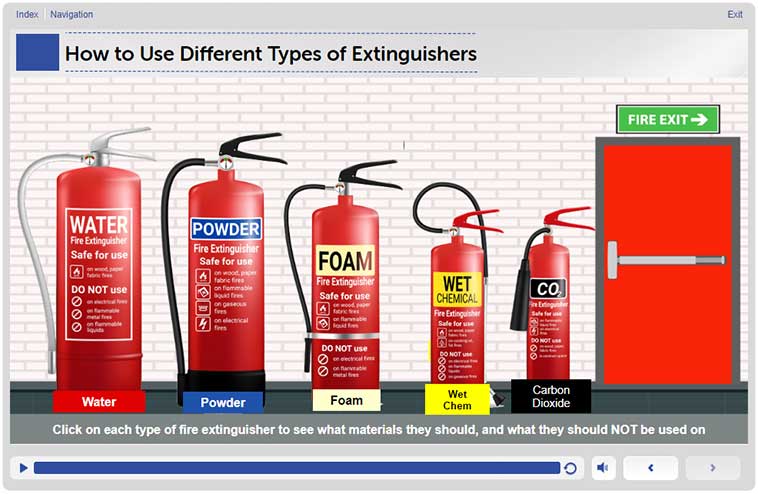
    This section of the course focuses on the six main categories of fire classes and what combustible material fall into each class of fire and the different types of fire extinguishers along with the fire classes they can and cannot be used on.

  • Module 3 - Using a Fire Extinguisher and Fire Blanket

    In this final section we look at how to use different types of fire extinguishers on different types of fires and looking at what a fire blanket is, when and how to safety use a fire blanket.

Download Course Overview (PDF)

Assessment

On completion of the course lessons and training material an online assessment will automatically unlock. The assessment will contain 15 multiple-choice questions and a mark of 75% or above will be required to pass.

The assessment will be marked instantly and so you will know straight away if you have passed or not. If you don't pass first time there's no need to worry. Unlimited resits at absolutely no additional charge are available so you can retake the assessment again as many times as you need to.


Fire Extinguisher Training Certification

Our entire library of training courses is accredited by the CPD Certification Service as adhering to the universally recognised Continuing Professional Development (CPD) guidelines.

This training course and its content has also been assured by RoSPA, the Royal Society for the Prevention of Accidents.

Fire Extinguisher Certificate

Upon passing the online assessment you will have the options to both print and download your Fire Extinguisher Certificate in PDF format. In addition to this an automated email will also be sent to your chosen email address containing a link to your certificate ensuring you always have access to a copy.

Furthermore, a QR code is displayed on each certificate which when scanned by a smartphone links to our certification database. This allows employers, auditors and local authority inspectors, for example, to establish a certificates validity instantly and at any time.


Common Fire Extingusher Training Questions

Yes, fire extinguisher training can be completed online, providing learners with knowledge of fire classes, different types of fire extinguishers, selecting appropriate firefighting equipment and the safety considerations involved when attempting to tackle a fire.

Online training can help employees understand how fire extinguishers and fire blankets are used, including when it may be unsafe or inappropriate to attempt to fight a fire.

However, the training provided should be appropriate to the workplace and the risks identified by the fire risk assessment. Where employees are expected to use firefighting equipment as part of their workplace responsibilities, employers should consider whether additional instruction or practical training is necessary.

Fire extinguisher training should be refreshed periodically to help ensure that employees maintain the knowledge needed to respond appropriately in the event of a fire. While there is no single refresher interval that will be suitable for every workplace, fire safety training is commonly refreshed annually.

Additional training may also be appropriate when there are changes to workplace fire risks, firefighting equipment, emergency procedures or an employee's responsibilities.

Employers should use their fire risk assessment and workplace arrangements to determine how frequently training needs to be refreshed, particularly for employees who may be expected to use firefighting equipment.

The person responsible for fire safety in the workplace must ensure that suitable firefighting arrangements are in place, but this does not necessarily mean they will personally use a fire extinguisher.

Where necessary, employees or other competent people should be nominated and suitably trained to use firefighting equipment. Employees should also be made aware of who is expected to use fire extinguishers as part of the workplace's fire safety arrangements.

People who have not received appropriate training should not be expected to attempt to extinguish a fire. Anyone expected to use a fire extinguisher should understand how to select and use the equipment correctly, as well as when it is safer to evacuate rather than attempt to tackle a fire.

Employees who have not received appropriate training should not be expected to attempt to extinguish a fire. However, employees should be familiar with the location and basic operating procedures of the firefighting equipment provided in their workplace.

Where employees are expected to use fire extinguishers as part of the workplace's fire safety arrangements, they should receive suitable training so they understand how to select and use the equipment appropriately.

Employees should never put themselves or others at unnecessary risk when attempting to tackle a fire. If there is any doubt about whether a fire can be tackled safely, they should raise the alarm, evacuate and follow the workplace's emergency procedures.


The Importance of Fire Extinguisher Training


Using the correct fire extinguisher is important because different types of fire involve different fuels and require suitable extinguishing methods. An extinguisher that is appropriate for one type of fire may be unsuitable for another.

Using the wrong extinguisher can be ineffective and, in some circumstances, may increase the risk to the person attempting to tackle the fire or cause the fire to spread.

Understanding fire classes and the types of extinguishers available helps employees recognise which firefighting equipment may be appropriate. Before attempting to use an extinguisher, employees should also consider whether it is safe to tackle the fire and should only do so if they have received appropriate instruction or training.

Understanding fire classes helps employees recognise the type of material or fuel involved in a fire. Different fire classes cover different combustible materials, such as solid materials, flammable liquids, gases, metals and cooking oils or fats.

Recognising the fire class can help determine which type of fire extinguisher may be suitable and, importantly, which extinguishers should not be used.

Fire classification therefore provides an important link between identifying what is burning and selecting appropriate firefighting equipment. Employees should still consider whether it is safe to attempt to tackle the fire and follow their workplace's fire safety procedures.

You should not attempt to tackle a fire if doing so could put you or others at risk. This may include situations where the fire is spreading, there is significant heat or smoke, you do not have a safe escape route, or you are unsure which firefighting equipment is appropriate.

Employees who have not received appropriate training should not be expected to attempt to extinguish a fire. Even where training has been provided, personal safety should always take priority.

If a fire cannot be tackled safely, raise the alarm, evacuate the area using the appropriate escape route and follow your workplace's emergency procedures. Never delay your evacuation to attempt to fight a fire.

Employers have a responsibility to ensure appropriate fire safety arrangements are in place within the workplace. This includes carrying out and regularly reviewing a fire risk assessment, providing appropriate firefighting equipment where necessary and ensuring that equipment is properly installed, tested and maintained.

Employees must also be provided with suitable fire safety information, instruction and training. Where employees are expected to use firefighting equipment, they should receive appropriate training so they understand the equipment provided and how it should be used.

Where necessary, competent people should be nominated to implement firefighting measures, with the level of training and equipment provided reflecting the size of the workplace and the specific fire risks present.


Course Reviews

4.5.

(32 reviews)

Read more reviews


Related Online Training Courses

  • Asbestos Awareness

    £25.00 +VAT

    For every task that must be undertaken in the workplace it is a legal requirement that a risk assessment must be completed to highlight any hazards that may be encountered. This course will help those responsible for completing risk assessments to do the task successfully. .

  • Manually lifting a box RoSPA Assured
    Manual Handling (Understanding)

    £25.00 +VAT

    Manual handling is the moving of loads by pushing, pulling, or lifting when machinery is not involved. Many injuries have been caused by these activities and many can be avoided by using correct techniques. This course has been developed for staff where handling bulky or heavy items manually is involved in their jobs. .

Training includes Fire extinguisher types and uses RoSPA Assured

4.5 (32 reviews)

£25.00 +VAT per person

Discounts on bulk purchases
  • 10% Discount 10+ courses
  • 20% Discount 20+ courses
  • 30% Discount 50+ courses
  • 40% Discount 75+ courses
  • 50% Discount 100+ courses
  • Compare plans & pricing

Training 10 or more people? Let us quote you

Training Management Suite (TMS) included
with orders of 5 or more courses.

Course information
  • Certificate on Successful Completion
  • Access course on Desktop, Laptop or Tablet
  • 15 Multiple Choice Questions
  • Course Duration: 30 Minutes
  • CPD Points: 1

Frequently Asked Questions

Our training is completed online, using only a web browser.

After choosing the courses and completing the online transaction, you'll recieve an email providing access to the course. Use the details to register the course yourself or if it's for someone else, simply forward the email on.

Purchasing training for your team is simple.

Just add the courses you need to your basket and complete the checkout process. If you're purchasing 5 or more courses, we'll provide you with access to our Training Management System (TMS).

The TMS gives you full control over your learners, allowing you to enrol staff, monitor progress, track completion rates, and download certificates.

Once your account is set up, we're happy to show you around the system and help you get the most from its features. If you have any questions, our support team is always here to help at support@train4academy.co.uk.

Yes. We offer automatic discounts on larger orders, and any applicable discount will be applied instantly at checkout across all courses in the basket.

Depending on the number of courses purchased we provide the following discounts below. If you're looking to purchase a higher volume, please contact us and we'll be happy to discuss additional volume discounts.

  • Purchase 10+ courses and recieve 10%
  • Purchase 20+ courses and recieve 20%
  • Purchase 50+ courses and recieve 30%
  • Purchase 75+ courses and recieve 40%
  • Purchase 100+ courses and recieve 50%

Our training can be purchased easily using a debit or credit card.

If you're purchasing a larger volume of training and would prefer to be invoiced, please contact us on 01482 861 040 or email enquiries@train4academy.co.uk.

Our training is designed to fit around your schedule. Everybody receives 2 years from date of purchase, so there's no rush to complete your training course.

You can work through the training at your own pace, pause whenever you need to, and return whenever it's convenient. Your progress is automatically saved, allowing you to pick up exactly where you left off.

Even after you've successfully passed the assessment, you'll still be able to access the training materials whenever you need to refresh your knowledge

Read further FAQ