This Teamwork Training course covers the importance of having essential teamworking skills that can be implemented in daily working life. Working as part of a team or as a team leader, may play a significant role in your job responsibilities, this requires a variety of skills, such as, dealing with conflict, time management and communication. To achieve successful team working, you or your staff members should have the appropriate foundations and knowledge in place to become valued members of a team.
This course looks at the different segments that can be considered to build a successful team, from the basics to the theories and dynamics of team development. It also looks at how you, as an individual, can find your role within a team, analysing the nine roles and characteristics.
This course will help workers to understand the importance of teamwork, team building and being a valued team member. Understanding the basics of teamwork can help to develop successful working relationships and collaboration between members of staff to achieve the ultimate team successes.
Discounts on Bulk Purchases
Take advantage of our bulk discounts which will reduce your overall cost of training. Better still, any courses you order can be registered to users upto two years later so there's no need to worry about training credits expiring.
Courses Purchased
Discount
10+
10%
20+
20%
50+
30%
75+
40%
100+
50%
Train online at your own pace with a full audio voiceover
Accredited by CPD
Certificate on successful completion
Course duration: 30 minutes
Unlimited resits at no cost
Who is this Online Teamwork Training for?
If your job involves being part of a team, then this course can be much-needed training to ensure you are aware of the different elements that are needed within teamwork to construct a successful team.
This course is ideal for both employers and employees, as it demonstrates what should be expected of workers when they are working within a team, and how to build the essential understanding of managing team conflict, giving feedback, and how to carve your own important role within a team.
Additionally, fostering an inclusive team environment is essential, and our Neurodiversity Awareness course provides valuable insights into how to work effectively with neurodivergent team members.
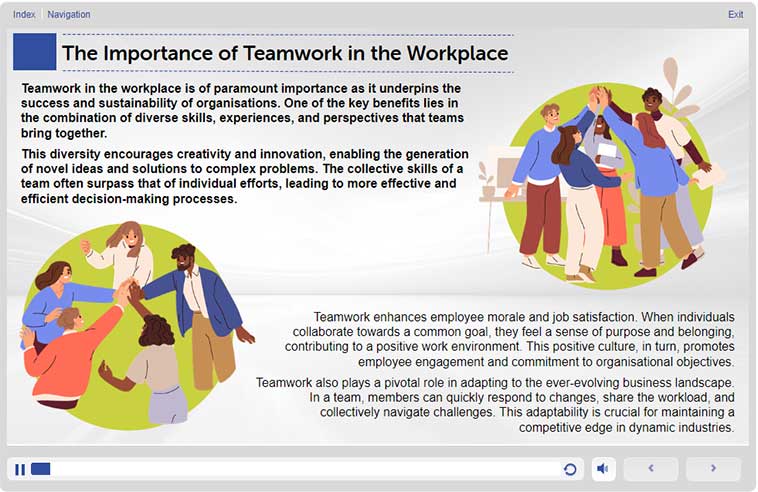
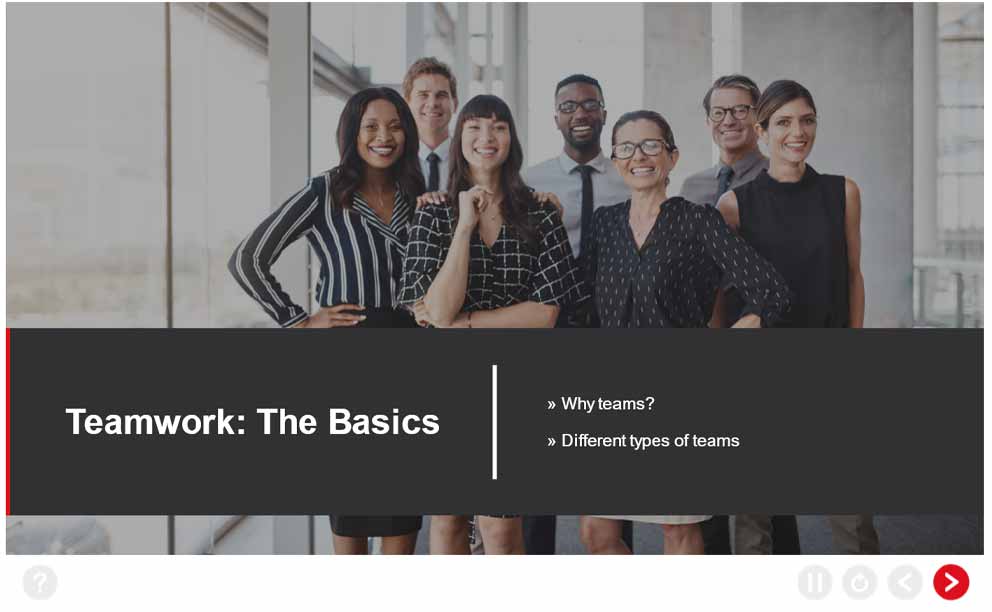
Course Screenshots
Course Aim
The aim of this Teamwork course is to provide you with the knowledge of how having a strong team within a business or company can benefit all employees in a variety of ways, such as gaining new business, building self-confidence when working with other members of staff, and gaining successful working team relationships.
This course aims to give learners the understanding of different types of teams and what to do when resolving team conflict and provide the much-needed skills to become a collaborative, successful and confident team member or team leader.
Learners wanting further self-development can take a look and explore our leadership and management courses, designed to help shape an organisation’s work culture.
Learning Objectives
On completion of the course, you should be able to:
Identify what teamwork is
Give a definition of teamwork
List the importance of teamwork in the workplace
List some benefits of good teamwork
Identify the benefits of working well as a team
Identify the importance of professional relationship building in a team
Identify the importance of empowering team members
List some different personalities that can be found within a team
List the four tips on being a good communicator
Identify the importance of feedback in teamwork
Course Content
This course is made up of the following modules:
An Introduction to Teamwork
This section introduces the learner to the course and looks at the definition of teamwork.
Module 1 - The Importance of Teamwork in the Workplace
This section of the course concentrates on the benefits of great teamwork and how it can improve the quality and workflow of various projects.
Module 2 - The Importance of Communication
This section of the course covers how communication plays a vital role in a team's success. It also examines how communication can be used to build professional relationships and gives tips on how to become a better communicator.
Module 3 - Building a Great Team
This final section will cover how to successfully build a great team and the skills a leader or manager will need in order to do so. It looks at how to utilise individual skills to work harmoniously with others and how a great team can lead to success.
On completion of the course lessons and training material an online assessment will automatically unlock. The assessment will contain 15 multiple-choice questions and a mark of 75% or above will be required to pass.
The assessment will be marked instantly and so you will know straight away if you have passed or not. If you don't pass first time there's no need to worry. Unlimited resits at absolutely no additional charge are available so you can retake the assessment again as many times as you need to.
Teamwork Training Certification
Our entire library of training courses is accredited by the CPD Certification Service as adhering to the universally recognised Continuing Professional Development (CPD) guidelines.
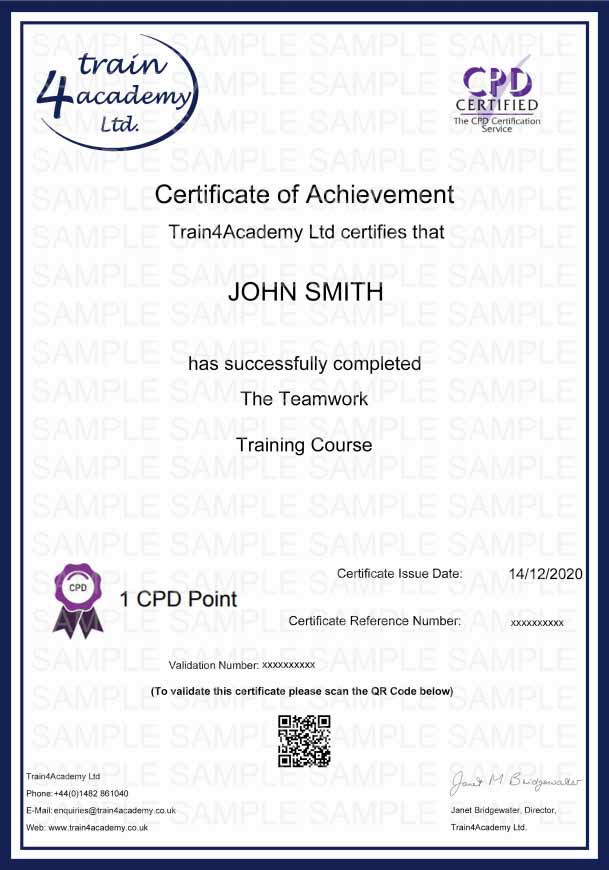
Upon passing the online assessment you will have the options to both print and download your Teamwork Training Certificate in PDF format. In addition to this an automated email will also be sent to your chosen email address containing a link to your certificate ensuring you always have access to a copy.
Furthermore, a QR code is displayed on each certificate which when scanned by a smartphone links to our certification database. This allows employers, auditors and local authority inspectors, for example, to establish a certificates validity instantly and at any time.
Common Teamwork Skills Training Questions
Teamwork skills are the personal qualities and behaviours that enable people to work effectively with others towards a shared goal. They help colleagues communicate clearly, solve problems together, support one another and complete tasks efficiently. Regardless of the industry or job role, strong teamwork skills contribute to a safer, more productive and collaborative workplace where everyone understands their responsibilities and works towards common objectives.
Key Teamwork Skills and Why They Matter in the Workplace
Teamwork Skill
Why It Matters in the Workplace
Communication
Enables colleagues to share information clearly, reducing misunderstandings and helping everyone stay informed.
Collaboration
Encourages people to combine their knowledge, skills and experience to achieve shared goals.
Problem Solving
Helps teams identify challenges, discuss solutions and make informed decisions together.
Reliability
Builds trust by ensuring team members consistently complete their responsibilities and support one another.
Respect
Creates an inclusive working environment where different ideas and opinions are valued.
Adaptability
Helps teams respond positively to change, unexpected challenges and shifting priorities.
Accountability
Encourages individuals to take responsibility for their work and contribute to the success of the wider team.
Putting Teamwork skills in practice
Whether employees work in an office, warehouse, healthcare setting, retail environment or construction site, very few roles are completed entirely independently. Teams rely on effective communication, cooperation and mutual support to deliver projects, meet deadlines and provide high standards of customer service. Developing these skills helps individuals contribute more effectively while improving the overall performance of the organisation.
Good teamwork isn't simply about working alongside other people. It involves communicating openly, supporting colleagues, respecting different perspectives and taking shared responsibility for achieving common goals. These skills form the foundation of productive, resilient and successful teams.
Strong teamwork skills help people work more effectively with colleagues, solve problems collaboratively and achieve shared goals. When employees communicate clearly, support one another and understand their individual responsibilities, teams are more productive, adaptable and better equipped to overcome workplace challenges. Developing teamwork skills not only improves individual performance but also contributes to the overall success of the organisation.
Benefits of Strong Teamwork in the Workplace
Benefit
How It Helps the Workplace
Improves Communication
Encourages clear, open communication, reducing misunderstandings and improving the flow of information.
Builds Trust
Helps colleagues develop confidence in one another, creating stronger and more reliable working relationships.
Enhances Problem-Solving
Brings together different ideas, experiences and perspectives to find practical solutions more effectively.
Increases Productivity
Enables teams to coordinate tasks efficiently, reduce duplication of work and achieve objectives more quickly.
Supports Better Decision-Making
Encourages collaboration and shared responsibility when making important workplace decisions.
Creates a Positive Working Environment
Promotes respect, inclusion and cooperation, helping employees feel valued and engaged.
Improves Customer Satisfaction
Teams that work well together are better able to deliver a consistent, high-quality service to customers.
Employers consistently rank teamwork among the most important workplace skills because almost every role involves working with other people. Whether collaborating with colleagues, supporting customers or contributing to wider business objectives, employees who work well as part of a team are often more adaptable, dependable and effective in their roles. Strong teamwork also helps organisations respond to change, improve efficiency and maintain high standards of performance.
Developing teamwork skills is about more than simply working alongside others. It enables people to communicate with confidence, support their colleagues, adapt to challenges and contribute positively to shared goals. These skills help build stronger teams, improve organisational performance and create workplaces where both employees and businesses can succeed.
Teamwork skills training is suitable for employees at every level of an organisation. Whether someone is new to the workplace, manages a team or works closely with customers or colleagues, developing effective teamwork skills can improve communication, collaboration and overall performance. Because teamwork is essential in almost every industry, this type of training benefits individuals and organisations alike.
Who Should Complete Teamwork Skills Training?
Job Role
Why Teamwork Skills Are Important
New Employees
Learn how to communicate effectively, build positive working relationships and integrate into existing teams.
Team Members
Strengthen collaboration, improve problem-solving and contribute more effectively to shared goals.
Supervisors and Team Leaders
Encourage teamwork, resolve conflicts and support a positive, productive working environment.
Managers
Build high-performing teams, improve employee engagement and promote a culture of cooperation.
Customer-Facing Staff
Deliver a consistent customer experience by working closely with colleagues across different departments.
Remote and Hybrid Workers
Develop communication and collaboration skills that help teams stay connected, regardless of location.
Industries where teamwork matters
Effective teamwork is valuable in almost every workplace, including:
Healthcare and social care
Construction and engineering
Manufacturing and warehousing
Retail and hospitality
Education and childcare
Office and administrative environments
Public sector organisations
Logistics and transport
Rarely does one person complete every task alone. Projects, customer enquiries, production processes and day-to-day operations all rely on people working together effectively. When employees understand how to communicate clearly, share responsibilities and support one another, organisations are better equipped to solve problems, adapt to change and achieve common objectives.
Whether you're developing your own professional skills or helping your organisation build stronger teams, teamwork skills training provides practical techniques that improve collaboration, increase productivity and create a more positive workplace for everyone.
An effective team isn't simply a group of highly skilled individuals. Even the most experienced employees can struggle to achieve results if communication is poor, responsibilities are unclear or trust is lacking. Successful teams combine technical ability with strong teamwork skills, ensuring people work together effectively towards shared objectives.
Successful teams understand their individual responsibilities while supporting each other to achieve common objectives. By combining different skills, experiences and perspectives, effective teams are better equipped to solve problems, adapt to change and deliver consistent results.
Characteristics of an Effective Team
Characteristic
Why It Matters
Clear Communication
Ensures information is shared accurately, reducing misunderstandings and helping everyone stay informed.
Shared Goals
Gives the team a common purpose and helps everyone work towards the same objectives.
Trust and Respect
Builds confidence between colleagues, encouraging honesty, cooperation and mutual support.
Defined Roles and Responsibilities
Helps everyone understand their contribution, reducing confusion and improving accountability.
Collaboration
Encourages people to share ideas, knowledge and skills to achieve better outcomes together.
Problem-Solving
Enables teams to identify challenges, discuss solutions and make informed decisions collectively.
Adaptability
Helps teams respond positively to change, overcome obstacles and remain productive during unexpected situations.
Developing these skills helps individuals contribute more effectively while enabling organisations to build collaborative, resilient and high-performing teams.
Workplace Scenario
1 / 4
Poor Communication During a Customer Order
Situation
A customer places a large order that requires input from the sales, warehouse and dispatch teams. Sales confirm the order but fail to notify the warehouse that the delivery date has been brought forward.
What went wrong?
Because information wasn't shared between departments, the warehouse wasn't prepared for the earlier dispatch date. The order was delivered late, resulting in customer complaints and additional costs to arrange an urgent delivery.
Key takeaway
Effective teamwork depends on clear communication and information sharing. Keeping colleagues informed helps prevent misunderstandings, reduces delays and ensures customers receive a reliable service..
Workplace Scenario
Unclear Responsibilities on a Project
Situation
A team is tasked with preparing an important presentation for a client. Everyone assumes someone else is responsible for collecting the latest sales figures.
What went wrong?
Without clearly defined responsibilities, the presentation is completed using outdated information. The mistake is only discovered during the client meeting, damaging confidence and requiring follow-up work to correct the error.
Key takeaway
Successful teams understand their individual roles and responsibilities. Clearly assigning tasks improves accountability, reduces duplication of work and helps projects run more smoothly.
Workplace Scenario
Ignoring Different Ideas
Situation
During a team meeting, one employee suggests a more efficient way of completing a routine process. The idea is dismissed without discussion because "it's how we've always done it."
What went wrong?
The opportunity to improve efficiency is overlooked, and the team continues using a slower, less effective process. Employees become less willing to contribute ideas in future meetings.
Key takeaway
Effective teamwork encourages collaboration and values different perspectives. Listening to colleagues and considering new ideas often leads to better decisions, greater innovation and stronger team engagement.
Workplace Scenario
Lack of Support During a Busy Period
Situation
A customer service team experiences an unexpected increase in enquiries. While one colleague struggles to keep up with calls and emails, the rest of the team focus only on their own workload.
What went wrong?
Customers experience longer waiting times, service quality declines and the overwhelmed employee becomes increasingly stressed. Simple teamwork and cooperation could have reduced the pressure and improved the customer experience.
Key takeaway
Strong teamwork means supporting colleagues when workloads change or unexpected challenges arise. Working together helps maintain productivity, improve customer satisfaction and create a more positive working environment.
Why Teamwork Skills Matter
When colleagues share information clearly, listen actively and provide constructive feedback, teams are better able to coordinate tasks, reduce misunderstandings and work towards shared objectives. Good communication also helps employees feel informed, valued and confident in their role, leading to stronger working relationships and improved organisational performance.
Sharing Information Clearly
Ensures everyone has the knowledge needed to complete their work accurately.
Active Listening
Reduces misunderstandings and encourages better collaboration.
Providing Constructive Feedback
Helps colleagues improve performance while maintaining positive relationships.
Regular Team Discussions
Keeps projects on track and allows issues to be identified early.
Open Communication
Encourages employees to ask questions, share ideas and raise concerns confidently.
Communication in practice
A maintenance team carrying out planned work on machinery. Before work begins, team members discuss the tasks, confirm responsibilities and highlight any potential risks. Because everyone understands the plan, the work is completed safely, efficiently and without unnecessary delays. Clear communication helps prevent mistakes before they occur.
Strong communication doesn't happen by accident. It develops when employees actively listen, share information and work collaboratively. By improving workplace communication, organisations can reduce errors, strengthen teamwork and create a more productive working environment.
Trust is one of the most important qualities of any successful team. When colleagues trust one another, they communicate more openly, support each other during challenges and feel confident that everyone will contribute towards shared goals. Strong working relationships also create a more positive and respectful workplace where employees feel motivated to perform at their best.
Teamwork Behaviours and Their Positive Outcomes
Keeping Commitments
Demonstrates reliability and builds confidence between colleagues.
Supporting One Another
Encourages cooperation during busy periods or unexpected challenges.
Respecting Different Opinions
Creates an inclusive environment where everyone feels valued.
Sharing Responsibility
Reinforces accountability and prevents individuals feeling isolated.
Celebrating Team Success
Strengthens morale and promotes a sense of belonging.
Building trust takes time, but it can quickly be strengthened through honesty, reliability and mutual respect. Teams that trust one another are more resilient, communicate more effectively and consistently achieve better outcomes.
Every workplace encounters challenges, whether responding to customer issues, meeting deadlines or adapting to unexpected changes. Effective teamwork enables people to combine their knowledge, experience and different perspectives to identify practical solutions. Working together often leads to better decisions than relying on one individual alone.
How Teamwork Improves Decision-Making
Teamwork Advantage
Benefit
Different Perspectives
Encourages creative thinking and more balanced decision-making.
Shared Knowledge
Combines individual expertise to solve problems more effectively.
Collaborative Discussions
Helps teams evaluate options before making decisions.
Shared Responsibility
Reduces pressure on individuals and encourages accountability.
Continuous Learning
Teams learn from challenges and improve future performance.
The most successful teams view problems as opportunities to improve rather than obstacles to overcome alone. By working collaboratively, organisations can resolve challenges more efficiently while encouraging innovation and continuous improvement.
Teams that communicate well and work collaboratively are generally more productive because tasks are organised effectively, responsibilities are clearly understood and unnecessary delays are reduced. Good teamwork helps people coordinate their efforts, avoid duplicated work and achieve shared objectives more efficiently.
How Effective Teamwork Benefits a Business
Teamwork Practice
Business Benefit
Clear Roles and Responsibilities
Reduces confusion and improves accountability.
Sharing Workloads
Helps balance resources during busy periods.
Working Towards Shared Goals
Keeps everyone focused on common priorities.
Supporting Colleagues
Prevents delays when unexpected challenges arise.
Learning from One Another
Improves skills, efficiency and overall team performance.
Improving productivity isn't simply about working faster. It's about working smarter together. Effective teamwork helps organisations make better use of people's skills, improve efficiency and consistently deliver high-quality results.
A positive workplace culture is built on mutual respect, trust and collaboration. When employees work well together, they are more likely to support one another, share ideas and contribute positively to the organisation. Strong teamwork also helps create an environment where people feel valued, engaged and motivated to perform their best.
How teamwork supports workplace culture
Respecting colleagues Encourages inclusion and positive working relationships.
Supporting teamwork Creates a sense of belonging and shared purpose.
Recognising achievements mproves morale and employee motivation.
Encouraging collaboration Builds stronger relationships across teams and departments.
Resolving disagreements professionally Helps maintain a respectful and constructive working environment.
A positive workplace culture doesn't develop overnight. It grows through everyday behaviours such as communication, trust, respect and collaboration. Investing in teamwork skills helps organisations create an environment where employees feel supported, motivated and proud to contribute to shared success.
4.4
Course Reviews
4.4.
(23 reviews)
4.4
23 Reviews
Clear, easy to follow training
LucyPosted 04-Aug-2026
55
Excellent.
ChristianPosted 20-Feb-2026
55
Great information and very helpful.
AmroPosted 03-Jan-2025
55
Reply from Train4Academy
Hi Amro, thank you for sharing your experience with us. It's good to read you found our course helpful.
EXCELLENT
KevenPosted 25-Nov-2024
55
excellent.
MarcinPosted 11-Sep-2024
55
Good. Simple and straight forward. Thank you...
AlainaPosted 17-Jun-2024
55
Nothing flashy. Read and then click on parts to complete the training. Glad I passed first time, cheers...
RossPosted 19-Apr-2023
35
Reply from Train4Academy
Hi Ross, thank you for sharing your feedback with us. Nothing beats simplicity, and a very well done for passing first time.
I found this to be very interesting. I did like the some of the content covered...
RayPosted 18-Apr-2023
55
I didn't know what to expect from the training, but it didn't take too long to complete...
A leader is one that stands out from the crowd to set a direction, build a vision and encourage others to follow. Leadership can be learned, and this course is intended to help those aspire to be good leaders to achieve their goals and shine in their various workplace..
Effective communication is essential to any business or company but achieving this is not easy. This online training course will highlight the barriers to good communication and helps all those who need to communicate with others to do so effectively, whether that be verbal or non-verbal communication.
Our training is completed online, using only a web browser.
After choosing the courses and completing the online transaction, you'll recieve an email providing access to the course. Use the details to register the course yourself or if it's for someone else, simply forward the email on.
Purchasing training for your team is simple.
Just add the courses you need to your basket and complete the checkout process. If you're purchasing 5 or more courses, we'll provide you with access to our Training Management System (TMS).
The TMS gives you full control over your learners, allowing you to enrol staff, monitor progress, track completion rates, and download certificates.
Once your account is set up, we're happy to show you around the system and help you get the most from its features. If you have any questions, our support team is always here to help at support@train4academy.co.uk.
Yes. We offer automatic discounts on larger orders, and any applicable discount will be applied instantly at checkout across all courses in the basket.
Depending on the number of courses purchased we provide the following discounts below. If you're looking to purchase a higher volume, please contact us and we'll be happy to discuss additional volume discounts.
Purchase 10+ courses and recieve 10%
Purchase 20+ courses and recieve 20%
Purchase 50+ courses and recieve 30%
Purchase 75+ courses and recieve 40%
Purchase 100+ courses and recieve 50%
Our training can be purchased easily using a debit or credit card.
If you're purchasing a larger volume of training and would prefer to be invoiced, please contact us on 01482 861 040 or email enquiries@train4academy.co.uk.
Our training is designed to fit around your schedule. Everybody receives 2 years from date of purchase, so there's no rush to complete your training course.
You can work through the training at your own pace, pause whenever you need to, and return whenever it's convenient. Your progress is automatically saved, allowing you to pick up exactly where you left off.
Even after you've successfully passed the assessment, you'll still be able to access the training materials whenever you need to refresh your knowledge