Basket 0 item(s) £0.00 + VAT
Call Us 01482 861 040

Prepare for the Key Changes Coming in October 2026 with our Sexual Harassment Awareness Training Course

Communication Skills Training Course

4.6 (40 reviews)
Online Communication Skills Training Course CPD Certified Course

Unlimited Resits Customer Support Instant Access

£25.00 +VAT per person

Course information
  • Certificate on Successful Completion
  • Access course on Desktop, Laptop or Tablet
  • Course Duration: 40 Minutes
  • CPD Points: 1

This Communication Skills Training course covers a range of techniques and tips to help build better communication skills that can be used in and outside the workplace.

Poor communication can be costly to a business, contributing to lost time, misunderstandings, poor customer experiences and difficulties with employee retention.For this reason, developing good communication skills is important for all members of staff, whether they are managers, supervisors or employees.

This Communication Skills Training course looks at the different types of communication, the barriers that can occur and how these barriers can be overcome to help build confidence when communicating with others, whether face to face or online.

Undertaking this Communication Skills course will help employers and employees better understand what communication is and how to apply good communication skills in the workplace. These skills can be used when communicating with customers and when working as part of a team.


  • Train online at your own pace with a full audio voiceover
  • Accredited by CPD
  • Certificate on successful completion
  • Course duration: 40 minutes
  • Unlimited resits at no cost

Discounts on Bulk Purchases

Take advantage of our bulk discounts which will reduce your overall cost of training. Better still, any courses you order can be registered to users upto two years later so there's no need to worry about training credits expiring.

Courses Purchased Discount
10+ 10%
20+ 20%
50+ 30%
75+ 40%
100+ 50%


Who is this Communication Skills Training for?

If your job involves managing staff, working with clients or customers, or working as part of a team, this course could benefit you. Communication skills training can benefit both employers and employees by helping them understand the importance of effective communication in the workplace.

For managers and supervisors looking to develop their skills further, Leadership and management training courses can also help build confidence in communicating with and leading a team.


Course Screenshots
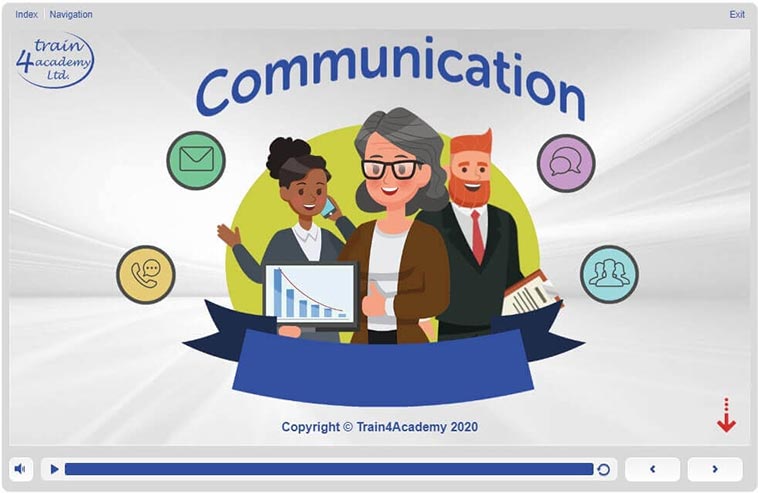
  • Welcome Screen - Communitcation Skills Training
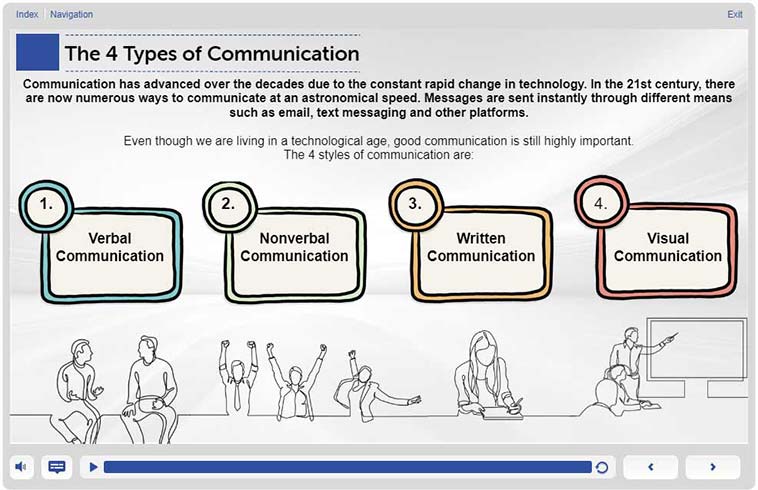
  • Why Goog Communication is Important- Communitcation Skills Training
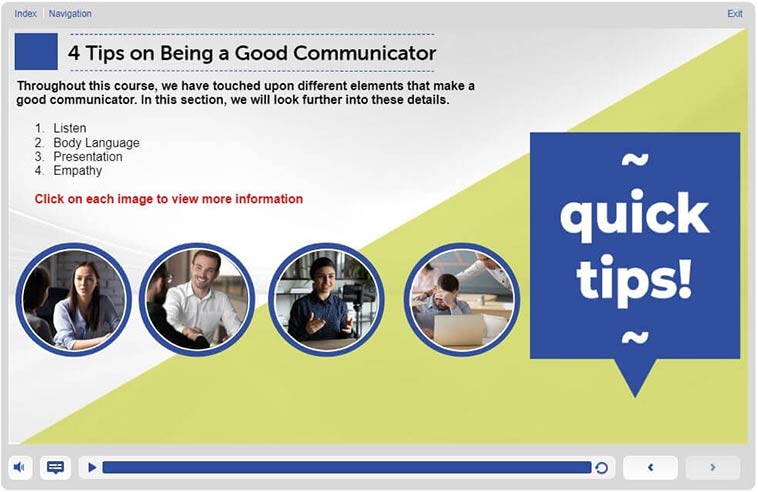
  • 4 Tips on Being a Good Communicator - Communitcation Skills Training

Course Aim

The aim of this training course is to provide you with knowledge of effective communication, how the communication process works and how communication barriers can be overcome. With this knowledge, you will be able to apply effective communication skills in the workplace to help improve professional relationships and support effective teamwork.


Learning Objectives

On completion of the course, you should be able to:

  • Give a definition of ‘good’ communication
  • List 4 statistics relevant to communication in the workplace
  • Explain why proper communication is important
  • List the 4 types of communication
  • Give a definition of verbal communication
  • State a benefit of good nonverbal communication
  • List some written verbal methods of communication
  • List some good communication practices
  • Identify why good communication is important
  • Recognise the different barriers to communication
  • List the 4 tips on being a good communicator
  • Recognise the benefit of attaining empathy in communication

Course Content

This course is made up of the following modules:

  • An Introduction to Communication

    This section introduces the learner to the course and what good communication is and why it is important in the workplace.

  • Module 1 - What is Communication?

    This section of the course concentrates on the definition of communication and the 4 categories relating to it. This section looks at the 4 categories in detail, which are verbal, non-verbal, written, and visual communication.

  • Module 2 - ‘Good’ Communication

    This section of the course covers what can be considered as ‘good’ communication, and the benefits of good communication within the workplace. It also looks at the common barriers to communication which can occur and how to overcome them.

  • Module 3 - Tips and Techniques of Communication

    In this final section, you will cover the cost that poor communication can have on a business. It then looks at how to adapt your communication skills for the better, by showing different tips and techniques to help yourself improve.

Download Course Overview (PDF)

Assessment

On completion of the course lessons and training material an online assessment will automatically unlock. The assessment will contain 15 multiple-choice questions and a mark of 75% or above will be required to pass.

The assessment will be marked instantly and so you will know straight away if you have passed or not. If you don't pass first time there's no need to worry. Unlimited resits at absolutely no additional charge are available so you can retake the assessment again as many times as you need to.


Communication Skills Training Certification

Our entire library of training courses are accredited by the CPD Certification Service as adhering to the universally recognised Continuing Professional Development (CPD) guidelines.
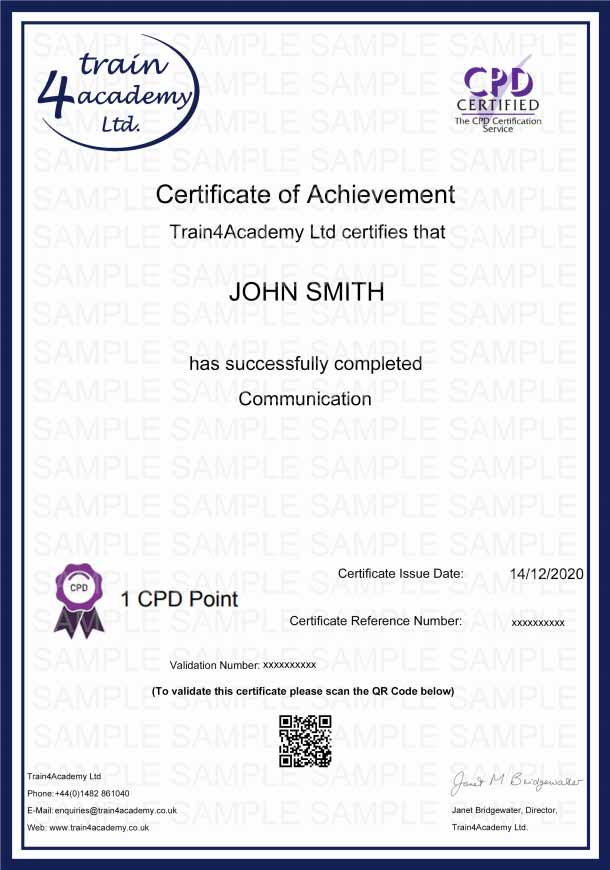
Communication Skills Training - Certificate Example

Upon passing the online assessment you will have the options to both print and download your Communication Skills Training Certificate in PDF format. In addition to this an automated email will also be sent to your chosen email address containing a link to your certificate ensuring you always have access to a copy.

Furthermore, a QR code is displayed on each certificate which when scanned by a smartphone links to our certification database. This allows employers, auditors and local authority inspectors, for example, to establish a certificates validity instantly and at any time.


Understanding Effective Communication Skills

Communication skills are the abilities we use to share information, express ideas and understand others. They involve communicating clearly and effectively through verbal, non-verbal, written and visual methods, as well as listening to and interpreting information received from others.

Good communication skills involve more than simply speaking or writing. They include active listening, asking questions, recognising body language and adapting how we communicate to suit different people and situations.

In the workplace, these skills help employees, managers and supervisors share information, understand instructions, avoid misunderstandings and build positive working relationships with colleagues and customers.

Communication barriers are anything that prevents information from being shared, received or understood correctly. In the workplace, these barriers can lead to misunderstandings, mistakes, reduced productivity and difficulties when working with colleagues or customers.

Some of the most common barriers to effective communication include:

  • Language barriers: Differences in language, unfamiliar terminology or excessive use of technical jargon can make information difficult to understand.
  • Poor listening: Interrupting others, becoming distracted or making assumptions before someone has finished speaking can result in important information being missed.
  • Physical barriers: Background noise, distance, poor internet connections and unsuitable working environments can make communication more difficult.
  • Emotional barriers: Stress, frustration, anxiety or a lack of confidence can affect how people communicate and interpret information.
  • Cultural differences: Differences in cultural backgrounds, communication styles and expectations can sometimes lead to misunderstandings.
  • Unclear communication: Providing incomplete instructions, using complicated language or failing to explain information clearly can cause confusion.
  • Non-verbal barriers: Inappropriate body language, facial expressions or tone of voice can contradict spoken messages or create unintended impressions.

Overcoming communication barriers requires employees to recognise potential difficulties and adapt how they communicate. This may involve using clear language, practising active listening, choosing an appropriate communication method and asking questions to confirm understanding.

For example, when giving instructions to a colleague, avoiding unnecessary technical jargon and encouraging questions can help ensure that the information is understood correctly.

Improving your communication skills involves developing how you share information, listen to others and respond in different situations. By practising effective communication techniques and recognising areas for improvement, you can become more confident when communicating with colleagues, managers and customers.

There are several ways to improve your communication skills:

  • Practise active listening: Give others your full attention, avoid interrupting and ask questions to ensure you understand what they are saying.
  • Communicate clearly: Use straightforward language, organise your thoughts and avoid unnecessary jargon to make your message easier to understand.
  • Be aware of your body language: Pay attention to your facial expressions, posture, eye contact and tone of voice, ensuring they support your intended message.
  • Adapt your communication style: Consider your audience and the situation, choosing the most appropriate language, tone and communication method.
  • Develop empathy: Consider other people's perspectives, feelings and communication needs to help build positive professional relationships.
  • Ask for feedback: Encourage colleagues and managers to provide constructive feedback on your communication and use it to identify areas for improvement.
  • Build confidence through practice: Take opportunities to participate in team discussions, deliver presentations and communicate with different people.

In the workplace, improving communication skills can help employees share information more effectively, reduce misunderstandings and develop stronger working relationships.

Communication skills develop through continuous learning and practice. Completing communication skills training can provide a foundation for understanding effective communication techniques, while applying those techniques in everyday workplace situations helps reinforce what you have learned.


The Importance of Communication Skills of the Workplace


Communication skills are important in the workplace because they help employees, managers and supervisors share information clearly, understand instructions and work effectively together. Good communication can reduce misunderstandings, strengthen professional relationships and contribute to a more productive working environment.

Effective workplace communication provides several important benefits:

  • Improved teamwork: Clear communication helps employees share ideas, coordinate tasks and work towards common goals.
  • Fewer misunderstandings: Providing clear instructions, asking questions and practising active listening can reduce confusion and help prevent avoidable mistakes.
  • Stronger professional relationships: Open and respectful communication helps build trust between colleagues, managers and customers.
  • Increased productivity: When employees understand their responsibilities and receive the information they need, they can complete tasks more efficiently.
  • Better problem-solving: Effective communication encourages employees to discuss concerns, exchange ideas and work together to find solutions.
  • Improved customer service: Listening to customers, understanding their needs and providing clear information can help create positive customer experiences.

For example, when a manager communicates clear instructions and encourages employees to ask questions, team members are more likely to understand their responsibilities and complete tasks correctly.

Developing good communication skills helps create a workplace where information is shared effectively, employees feel heard and teams can work together more successfull

Good communication skills are important for managers and team leaders because they help them provide clear instructions, support employees and maintain effective working relationships. Managers who communicate effectively can help their teams understand their responsibilities, work towards shared goals and feel confident raising questions or concerns.

There are several reasons why managers and team leaders need good communication skills:

  • Providing clear instructions: Communicating tasks, responsibilities and expectations clearly helps employees understand what is required of them.
  • Building trust: Open, honest and respectful communication helps strengthen professional relationships and encourages employees to share their ideas and concerns.
  • Supporting teamwork: Sharing important information and encouraging collaboration helps team members coordinate their work and achieve common objectives.
  • Giving constructive feedback: Providing clear, specific and respectful feedback helps employees recognise their strengths and identify areas for improvement.
  • Managing workplace conflict: Practising active listening, showing empathy and considering different perspectives can help managers address disagreements professionally.
  • Supporting employees through change: Explaining workplace changes, answering questions and addressing concerns helps employees understand how changes may affect their roles.

For example, when introducing a new workplace procedure, a manager who clearly explains the changes, listens to employee concerns and checks understanding can help their team adapt and reduce the risk of confusion.

Effective communication is an important leadership skill. It helps managers and team leaders provide guidance, support employee development and create a working environment where team members feel informed, respected and able to contribute.


Course Reviews

4.6.

(40 reviews)

Read more reviews


Related Online Training Courses

  • cert
    Bullying and Harassment

    £25.00 +VAT

    A definition of bullying and harassment at work is "unwanted behaviour that makes someone feel intimidated, humiliated or offended." Could this happen in your workplace? This online training course looks at all aspects of bullying and harassment at work and will help identify where your organisation is falling short or could improve..

  • cert
    Equality and Diversity

    £25.00 +VAT

    The Equality Act 2010 protects people from discrimination in the workplace and the wider society. It identified the nine protected categories, such as age, disability, becoming a transexual, marriage or civil partnership, race, religion, sex or sexual orientation.

Communication Skills Training Course CPD Certified Course

4.6 (40 reviews)

£25.00 +VAT per person

Discounts on bulk purchases
  • 10% Discount 10+ courses
  • 20% Discount 20+ courses
  • 30% Discount 50+ courses
  • 40% Discount 75+ courses
  • 50% Discount 100+ courses
  • Compare plans & pricing

Training 10 or more people? Let us quote you

Training Management Suite (TMS) included
with orders of 5 or more courses.

Course information
  • Certificate on Successful Completion
  • Access course on Desktop, Laptop or Tablet
  • 15 Multiple Choice Questions
  • Course Duration: 40 Minutes
  • CPD Points: 1

Frequently Asked Questions

Our training is completed online, using only a web browser.

After choosing the courses and completing the online transaction, you'll recieve an email providing access to the course. Use the details to register the course yourself or if it's for someone else, simply forward the email on.

Purchasing training for your team is simple.

Just add the courses you need to your basket and complete the checkout process. If you're purchasing 5 or more courses, we'll provide you with access to our Training Management System (TMS).

The TMS gives you full control over your learners, allowing you to enrol staff, monitor progress, track completion rates, and download certificates.

Once your account is set up, we're happy to show you around the system and help you get the most from its features. If you have any questions, our support team is always here to help at support@train4academy.co.uk.

Yes. We offer automatic discounts on larger orders, and any applicable discount will be applied instantly at checkout across all courses in the basket.

Depending on the number of courses purchased we provide the following discounts below. If you're looking to purchase a higher volume, please contact us and we'll be happy to discuss additional volume discounts.

  • Purchase 10+ courses and recieve 10%
  • Purchase 20+ courses and recieve 20%
  • Purchase 50+ courses and recieve 30%
  • Purchase 75+ courses and recieve 40%
  • Purchase 100+ courses and recieve 50%

Our training can be purchased easily using a debit or credit card.

If you're purchasing a larger volume of training and would prefer to be invoiced, please contact us on 01482 861 040 or email enquiries@train4academy.co.uk.

Our training is designed to fit around your schedule. Everybody receives 2 years from date of purchase, so there's no rush to complete your training course.

You can work through the training at your own pace, pause whenever you need to, and return whenever it's convenient. Your progress is automatically saved, allowing you to pick up exactly where you left off.

Even after you've successfully passed the assessment, you'll still be able to access the training materials whenever you need to refresh your knowledge

Read further FAQ