Basket 0 item(s) £0.00 + VAT
Call Us 01482 861 040

Prepare for the Key Changes Coming in October 2026 with our Sexual Harassment Awareness Training Course

Slips, Trips and Falls Training Course
4.6 (59 reviews)
Slips, Trips and Falls Training course cert

Unlimited Resits Customer Support Instant Access

£25.00 +VAT per person

Course information
  • Certificate on Successful Completion
  • Access course on Desktop, Laptop or Tablet
  • 30 Multiple Choice Questions
  • Course Duration: 90 Minutes
  • CPD Points: 2

This online Slips, Trips and Falls Training course is designed to help employees understand the common causes of slips, trips and falls in the workplace and the measures that can be taken to prevent accidents.

Slips, trips and falls are among the most common causes of workplace injuries. Understanding the risks and implementing appropriate safety measures can help reduce accidents and create a safer working environment for employees and members of the public.

This course provides learners with an understanding of workplace risk assessments, relevant health and safety legislation, and practical measures to identify and reduce slip, trip and fall hazards.


  • Work towards compliance with UK Health and Safety legislation
  • Train online at your own pace with a full audio voiceover
  • Assured by RoSPA & Accredited by CPD
  • Certificate on successful completion
  • Course duration: 90 minutes
  • Unlimited resits at no cost

Discounts on Bulk Purchases

Take advantage of our bulk discounts which will reduce your overall cost of training. Better still, any courses you order can be registered to users upto two years later so there's no need to worry about training credits expiring.

Courses Purchased Discount
10+ 10%
20+ 20%
50+ 30%
75+ 40%
100+ 50%


Who is this Online Slips, Trips and Falls Training for?

This training course is suitable for both employees and employers, helping them recognise common slip, trip and fall hazards in the workplace. Whether you work in an office, restaurant or factory, understanding these risks and how to reduce them can help prevent injuries to yourself and others.

Employers have a legal responsibility to protect the health and safety of their employees and others who may be affected by their work activities, so far as is reasonably practicable. Carrying out suitable and sufficient risk assessments, implementing appropriate safety measures and providing relevant information and training are important parts of meeting these responsibilities.

Completing a basic slips, trips and falls awareness course can also help employees recognise hazards and contribute to a safer working environment.


Course Screenshots

  • Slips Trips and Falls Training Course - Introduction Screen
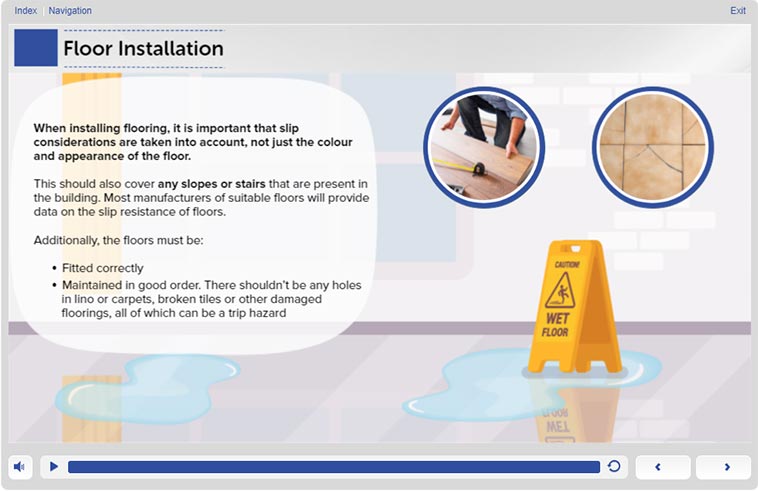
  • Slips Trips and Falls Training Course - Floor Installation
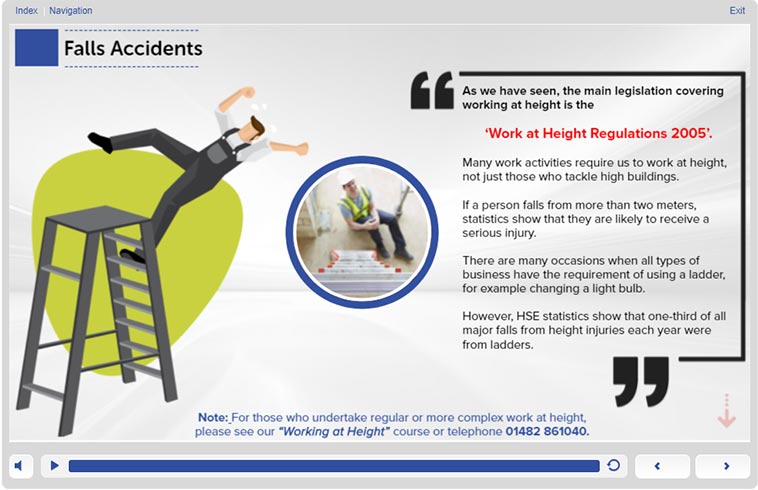
  • Slips Trips and Falls Training Course - Falls Accidents

Course Aim

The aim of this Slips, Trips and Falls course is to help learners understand how to identify and prevent slip, trip and fall hazards in the workplace. These incidents can result in serious injuries, making it important to recognise potential risks and implement appropriate preventative measures.

Common workplace hazards include spillages, trailing cables and unsafe working platforms. This course raises awareness of how to identify these hazards, understand the associated risks and take appropriate action to help prevent accidents and injuries.


Learning Objectives

On completion of the course, you should be able to:

  • Name the 3 principle Regulations relevant to this area of health and safety
  • Recognise the role of the ‘Responsible Person’
  • Identify the role and importance of ‘Accident Books’
  • Name who has a duty to enforce compliance under health and safety laws
  • Identify what the ‘Insurance Iceberg’ is
  • List some ‘direct’ and ‘indirect’ costs of accidents
  • List the four main legislations that affects health and safety in the workplace
  • Identify the responsibilities of employers, employees and those who enter the workplace

Course Content

This course is made up of the following modules:

  • An Introduction to Slips, Trips and Falls

    This section covers an introduction to slips, trips and falls and RIDDOR related statistics for slips, trips and falls accidents.

  • Module 1 - Compliance and Responsibilities

    This section covers what RIDDOR is it’s purpose, who the responsible person is, accident books and why it is important to have one, insurance, legislation which covers slips, trips and falls, compliance and how to enforce it, what happens when companies fail to comply to the law, what is classed as a ‘low risk’ environment.

  • Module 2 - Reducing Risks

    This section covers what is classed as a slip, hazards and risks associated with this type of injury, slip trip and fall risk assessments, responsibilities to workplace visitors and the general public, surfaces and how they can be slip resistant, correct footwear, environmental factors that increase the risk of slips, trips and falls, how cleaning and good housekeeping can be an effective measure, the safe use of ladders and step ladders, the 5S management system and what is classed as a ‘high risk’ environment.

Download Course Overview (PDF)

Assessment

On completion of the course lessons and training material an online assessment will automatically unlock. The assessment will contain 30 multiple-choice questions and a mark of 75% or above will be required to pass.

The assessment will be marked instantly and so you will know straight away if you have passed or not. If you don't pass first time there's no need to worry. Unlimited resits at absolutely no additional charge are available so you can retake the assessment again as many times as you need to.


Slips, Trips and Falls Training Certification

Our entire library of training courses is accredited by the CPD Certification Service as adhering to the universally recognised Continuing Professional Development (CPD) guidelines.

This training course and its content has also been assured by RoSPA, the Royal Society for the Prevention of Accidents.

Slips, Trips and Falls Training (Understanding) - Certificate Example

Upon passing the online assessment you will have the options to both print and download your Slips, Trips and Falls Training Certificate in PDF format. In addition to this an automated email will also be sent to your chosen email address containing a link to your certificate ensuring you always have access to a copy.

Furthermore, a QR code is displayed on each certificate which when scanned by a smartphone links to our certification database. This allows employers, auditors and local authority inspectors, for example, to establish a certificates validity instantly and at any time.


Common Slips, Trips and Falls Questions

Several pieces of UK health and safety legislation cover the prevention of slips, trips and falls in the workplace. These place responsibilities on employers to identify hazards, assess risks and implement appropriate safety measures to protect employees and others who may be affected by their work activities.

Some of the key legislation includes:

  • Health and Safety at Work etc. Act 1974:
    Requires employers to protect the health, safety and welfare of employees and others affected by their work activities, so far as is reasonably practicable.
  • Management of Health and Safety at Work Regulations 1999:
    Require employers to carry out suitable and sufficient risk assessments and implement appropriate preventative and protective measures.

Together, these laws help establish the responsibilities employers have for managing slip, trip and fall risks in the workplace.

Slips, trips and falls can occur in a wide range of workplaces and are often caused by unsafe working conditions, environmental hazards or unsuitable equipment. Recognising these hazards is important for reducing the risk of workplace accidents and injuries.

Some of the most common causes may include:

  • Wet or slippery floors: Spillages, recently cleaned surfaces and wet flooring can increase the risk of slipping.
  • Obstructed walkways: Trailing cables, clutter and equipment left in pedestrian areas can create trip hazards.
  • Uneven or damaged flooring: Loose carpets, damaged floor coverings and uneven surfaces can cause people to lose their footing.
These hazards can be present in offices, warehouses, factories and other working environments, making awareness important for employees and employers.

Slips, trips and falls training can be completed online, yes. Online training allows learners to develop an understanding of common workplace hazards, relevant health and safety legislation, risk assessments and measures to help prevent slips, trips and falls.

Online awareness training can be completed at a learner's own pace, making it a convenient option for employees and employers. However, additional workplace-specific instruction or practical training may be necessary depending on the risks involved and the employee's responsibilities.

Employers should regularly review their employees' training needs to ensure they have the knowledge and understanding necessary to work safely.

Refresher training may be necessary when workplace conditions or procedures change, new hazards are identified, or an employee's knowledge or competence needs updating. Employers should determine how often training is refreshed based on workplace risks and individual training needs.


Preventing Slips, Trips and Falls in the Workplace

Slips, trips and falls can be prevented by identifying workplace hazards, assessing the associated risks and implementing appropriate safety measures. Employers and employees both have an important role in maintaining a safe working environment.

Some of the key preventative measures can include:

  • Good housekeeping: Keep walkways clear of clutter, trailing cables and other obstructions.
  • Spill management: Clean up spillages promptly and take appropriate precautions to prevent access to slippery areas.
  • Floor maintenance: Ensure flooring is suitable, properly maintained and free from damage that could cause slips or trips.

Regular workplace inspections, effective hazard reporting and appropriate employee training can also help reduce the likelihood of slips, trips and falls.

Slips, trips and falls risk assessments are important because they help employers identify workplace hazards, evaluate the risks to employees and others, and determine appropriate measures to prevent accidents and injuries.

A suitable and sufficient risk assessment helps employers understand who may be harmed, how accidents could occur and what precautions are needed to reduce the risks. Assessments should also be reviewed when workplace conditions change, new hazards are identified or existing control measures are no longer effective.

For example, an assessment might identify a slippery entrance floor during wet weather and establish measures to reduce the risk of someone falling.

By identifying and managing risks, employers can help create a safer working environment and reduce the likelihood of slips, trips and falls.

If employees identify a slip or trip hazard in the workplace, they should take appropriate action to prevent accidents and report the hazard to their supervisor or manager as soon as possible.

Depending on the nature of the hazard, appropriate actions may include:

  • Reporting the hazard: Inform a supervisor, manager or responsible person so appropriate action can be taken.
  • Warning others: Alert colleagues and, where appropriate, prevent access to the affected area until it is safe.
  • Following workplace procedures: Comply with established safety procedures for reporting and managing hazards.

Employees should not attempt to resolve hazards that could put themselves or others at risk. These should be reported and managed by an appropriately trained or authorised person.

Employers have a legal responsibility to protect employees and others who may be affected by their work activities from the risks of slips, trips and falls, so far as is reasonably practicable. This includes identifying workplace hazards, assessing risks and implementing appropriate safety measures.

Some of the key responsibilities employers have included:

  • Carrying out risk assessments: Identify slip, trip and fall hazards, assess the risks and determine suitable control measures.
  • Maintaining a safe workplace: Ensure floors, walkways and working areas are appropriately maintained and kept free from avoidable hazards.
  • Providing information and training: Ensure employees receive appropriate health and safety information, instruction and training relevant to their work activities.

By fulfilling these responsibilities, employers can help reduce workplace accidents and create a safer environment for employees and others.


Course Reviews

4.6.

(59 reviews)

Read more reviews

Related Online Training Courses

  • Risk Assessment (Understanding)

    £25.00 +VAT

    For every task that must be undertaken in the workplace it is a legal requirement that a risk assessment must be completed to highlight any hazards that may be encountered. This course will help those responsible for completing risk assessments to do the task successfully. .

  • cert
    Accident Reporting (RIDDOR)

    £25.00 +VAT

    The reporting of Injuries, Diseases and Dangerous Occurrences Regulations 2013, puts the responsibilities for reporting accidents in the workplace onto the “responsible person”, usually owners, managers and supervisors in the smaller companies..

Slips, Trips and Falls Training course cert

4.6 (59 reviews)

£25.00 +VAT per person

Discounts on bulk purchases
  • 10% Discount 10+ courses
  • 20% Discount 20+ courses
  • 30% Discount 50+ courses
  • 40% Discount 75+ courses
  • 50% Discount 100+ courses
  • Compare plans & pricing

Training 10 or more people? Let us quote you

Training Management Suite (TMS) included
with orders of 5 or more courses.

Course information
  • Certificate on Successful Completion
  • Access course on Desktop, Laptop or Tablet
  • 30 Multiple Choice Questions
  • Course Duration: 90 Minutes
  • CPD Points: 2

Frequently Asked Questions

Our training is completed online, using only a web browser.

After choosing the courses and completing the online transaction, you'll recieve an email providing access to the course. Use the details to register the course yourself or if it's for someone else, simply forward the email on.

Purchasing training for your team is simple.

Just add the courses you need to your basket and complete the checkout process. If you're purchasing 5 or more courses, we'll provide you with access to our Training Management System (TMS).

The TMS gives you full control over your learners, allowing you to enrol staff, monitor progress, track completion rates, and download certificates.

Once your account is set up, we're happy to show you around the system and help you get the most from its features. If you have any questions, our support team is always here to help at support@train4academy.co.uk.

Yes. We offer automatic discounts on larger orders, and any applicable discount will be applied instantly at checkout across all courses in the basket.

Depending on the number of courses purchased we provide the following discounts below. If you're looking to purchase a higher volume, please contact us and we'll be happy to discuss additional volume discounts.

  • Purchase 10+ courses and recieve 10%
  • Purchase 20+ courses and recieve 20%
  • Purchase 50+ courses and recieve 30%
  • Purchase 75+ courses and recieve 40%
  • Purchase 100+ courses and recieve 50%

Our training can be purchased easily using a debit or credit card.

If you're purchasing a larger volume of training and would prefer to be invoiced, please contact us on 01482 861 040 or email enquiries@train4academy.co.uk.

Our training is designed to fit around your schedule. Everybody receives 2 years from date of purchase, so there's no rush to complete your training course.

You can work through the training at your own pace, pause whenever you need to, and return whenever it's convenient. Your progress is automatically saved, allowing you to pick up exactly where you left off.

Even after you've successfully passed the assessment, you'll still be able to access the training materials whenever you need to refresh your knowledge

Read further FAQ

Read more reviews