Basket 0 item(s) £0.00 + VAT
Call Us 01482 861 040

Prepare for the Key Changes Coming in October 2026 with our Sexual Harassment Awareness Training Course

Banksman Training Course

4.7 (39 reviews)
A Vehicle Banksman's role is to help guide large goods vehicles. RoSPA Assured

Unlimited Resits Customer Support Instant Access

£25.00 +VAT per person

Course information
  • Certificate on Successful Completion
  • Access course on Desktop, Laptop or Tablet
  • 15 Multiple Choice Questions
  • Course Duration: 45 Minutes
  • CPD Points: 1

This Banksman Training course covers a range of topics such as verbal and physical communication and identifying safe working practices which are vital to the wellbeing of those in the site vicinity. Working in areas with large, heavy vehicles and plant machinery comes with various risks. This awareness level course explains the pivotal role a Banksman plays in ensuring the health and safety of others whom operate in the area of reversing vehicles or lifting operations, can continue to do so safely.

Unfortunately, severe injuries and, in some tragic cases, deaths have been caused by reversing vehicles or accidents during lifting operations. This is why the role of a banksman is a necessary safety requirement and in turn they should be thoroughly trained to become aware of the risks and to understand the potential responsibilities, which are covered in this course.

Also known as a Vehicle Banksman or a Traffic Marshal, of which either can complete the training, this Banksman course will help to raise awareness on assessing the risks such as when needing to direct a loading operation safely and what distinctive clothing to wear to be clearly visible.


  • Work towards compliance with UK Health and Safety legislation
  • Train online at your own pace with a full audio voiceover
  • Assured by RoSPA & Accredited by CPD
  • Certificate on successful completion
  • Course duration: 45 minutes
  • Unlimited resits at no cost

Discounts on Bulk Purchases

Take advantage of our bulk discounts which will reduce your overall cost of training. Better still, any courses you order can be registered to users upto two years later so there's no need to worry about training credits expiring.

Courses Purchased Discount
10+ 10%
20+ 20%
50+ 30%
75+ 40%
100+ 50%


Who is this Online Banksman Training for?

This online training is ideal for all those who are in banksman, slinger, and signalling operation roles and for those wanting to fullfill the position in the future. Specifically those who work on sites or in warehouses directing vehicles.

Completing this course learners may also try LOLER Training and Vehicle Safety in the Workplace Training.


Course Screenshots
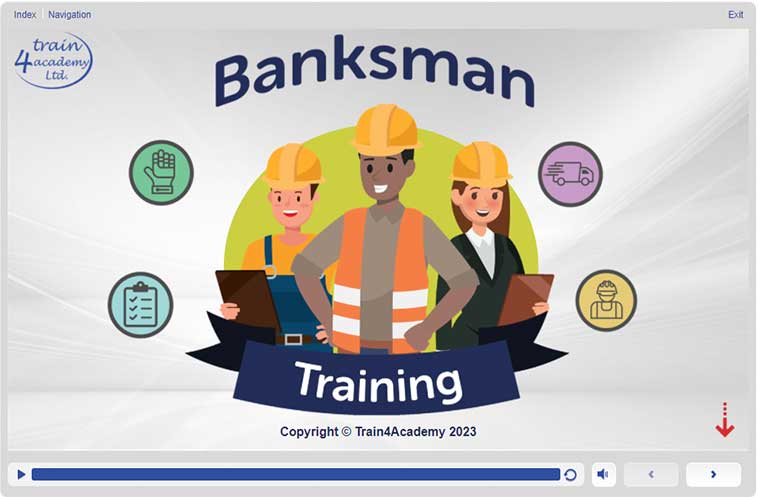
  • Banksman Training Course - Welcome Screen
  • Banksman Training Course - Appointed Banksman
  • Banksman Training Course - Different Responsibilites of a Banksman


Course Aim

This course aims to provide knowledge and raise awareness on the role of a Banksman and how it is imperative that roles, duties, and responsibilities are fulfilled safely. Due to the nature of the role, the individual and others around them are exposed to danger and are at risk of injury, or other serious repercussions, from moving vehicles, loads or plant machinery. Therefore, completing adequate training is important.


Learning Objectives

On completion of the course, you should be able to:

  • List banksman roles
  • Name some responsibilities of a banksman
  • Identify relevant key regulations
  • List the five steps to a risk assessment
  • Identify why a banksman may need to be appointed
  • Identify examples of hand signals used during vehicle moving operations
  • List some examples of verbal communication
  • List some examples of PPE (personal protective equipment/clothing)
  • Identify some skills that may be required for the role of a banksman
  • List some safe working practices
  • Identify some requirements a loading bay area should have
  • Identify the role a banksman plays during lifting operations
  • List some employer’s responsibilities

Course Content

This course is made up of the following modules:

  • An Introduction to Banksman Training

    This section introduces the learner to the course and looks at why a banksman may be appointed.

  • Module 1 - Banksman Roles and Responsibilities

    This section of the course concentrates on the roles and responsibilities of a banksman and their role in ensuring that safety is upheld when directing reversing vehicles or plant machinery during lifting operations.

  • Module 2 - Communication – Verbal and Physical Signals

    This section of the course covers the different signals that can be used by a banksman and the standard requirements they must meet. It demonstrates examples of physical hand signals and also verbal examples.

  • Module 3 - Safe Working Practices

    This final section will cover different safe working practices that should be upheld and also key legislation which helps implement these safe work practices in place. It looks at the different types of PPE (personal protective equipment) and also safe site design and loading bay operations.

Download Course Overview (PDF)

Assessment

On completion of the course lessons and training material an online assessment will automatically unlock. The assessment will contain 15 multiple-choice questions and a mark of 75% or above will be required to pass.

The assessment will be marked instantly and so you will know straight away if you have passed or not. If you don't pass first time there's no need to worry. Unlimited resits at absolutely no additional charge are available so you can retake the assessment again as many times as you need to.


Banksman Training Certificate

Our entire library of training courses is accredited by the CPD Certification Service as adhering to the universally recognised Continuing Professional Development (CPD) guidelines.

This training course and its content has also been assured by RoSPA, the Royal Society for the Prevention of Accidents.

Banksman Training Certificate - Example

Upon passing the online assessment you will have the options to both print and download your Banksman Training Certificate in PDF format. In addition to this an automated email will also be sent to your chosen email address containing a link to your certificate ensuring you always have access to a copy.

Furthermore, a QR code is displayed on each certificate which when scanned by a smartphone links to our certification database. This allows employers, auditors and local authority inspectors, for example, to establish a certificates validity instantly and at any time.


Common Banksman Training Questions

A Banksman is responsible for directing and supervising the safe movement of vehicles, plant machinery and lifting operations in areas where there is a risk to people or property.


Banksmen are commonly used on:

  • construction sites
  • warehouse loading bays
  • manufacturing facilities
  • distribution centres

Using recognised hand signals, clear communication and agreed safe working procedures, they help drivers complete manoeuvres safely while reducing the risk of collisions, injuries and damage to equipment.

A Banksman also monitors the surrounding work area for hazards such as:

  • blind spots
  • changing site conditions
  • uneven ground
  • unauthorised pedestrian access
  • workplaces where vehicles regularly manoeuvre in close proximity to pedestrians.

They ensure that vehicle movements are carried out safely and stop operations immediately if conditions become unsafe.

Yes. In most UK workplaces, the terms Banksman and Traffic Marshal are used interchangeably to describe the person responsible for directing vehicle movements safely. Although some industries favour one title over the other, the duties and responsibilities are generally the same.

Construction sites often use the term Banksman, particularly where plant machinery, excavators and lifting operations are involved. Warehouses, logistics companies and distribution centres may be more likely to use the term Traffic Marshal, especially when managing delivery vehicles, HGVs and loading bay operations.

Whether it's refered to as Banksman or Traffic Marshal in the place of work, the role focuses on maintaining clear communication between drivers and pedestrians, reducing the risks associated with reversing vehicles and ensuring vehicle movements are completed safely.

Banksman Training is recommended for anyone responsible for directing, supervising or assisting with vehicle movements where pedestrians, plant machinery or workplace transport activities create potential risks.

It is particularly valuable where:

  • Drivers have restricted visibility
  • Vehicles regularly reverse or manoeuvre in confined spaces
  • Pedestrians and vehicles share the same working area
  • Workplace transport forms part of daily operations

Employers may also choose to provide Banksman Training for anyone who regularly works around moving vehicles to improve workplace awareness and promote safer working practices.

Industries that commonly require Banksman Training include:

  • construction
  • manufacturing
  • warehousing
  • transport and logistics
  • waste management
  • ports
  • agriculture
  • industrial facilities.

Providing suitable training helps organisations reduce workplace transport risks, improve communication between drivers and pedestrians, and support compliance with UK health and safety responsibilities.

There is no specific law that states every workplace must appoint a Banksman or Traffic Marshal. However, UK health and safety legislation places a duty on employers to protect employees and others from risks associated with workplace transport.

Where vehicle movements present significant hazards, employers are expected to carry out suitable risk assessments and implement appropriate control measures. Depending on the nature of the work, appointing a trained Banksman may form part of a safe system of work, particularly where drivers have limited visibility, vehicles regularly reverse or pedestrians share the same working area.

The Health and Safety at Work etc. Act 1974, together with the Management of Health and Safety at Work Regulations 1999, requires employers to provide appropriate information, instruction, training and supervision to help ensure work activities are carried out safely.

Banksman Training helps organisations demonstrate that employees responsible for directing vehicle movements understand their role, communicate effectively and contribute to safer workplace transport operations.

There is no fixed legal expiry date for Banksman Training, but refresher training should be provided whenever it is necessary to ensure employees remain competent and up to date with safe working practices.

Many organisations choose to refresh Banksman Training every three years as good practice, although the appropriate interval will depend on the individual's experience, the complexity of their work and any changes to workplace procedures or equipment.


Regular refresher training helps;

  • reinforce safe communication techniques
  • to recognise hand signals
  • be aware of the risks and current workplace procedures
  • ensure banksmen continue carring out their responsibilities safely and confidently.


Why Banksman Training Matters

Every year, workplace transport incidents result in serious injuries and fatalities across a wide range of industries. Many of these accidents occur during routine manoeuvres such as reversing, loading and unloading, where drivers have limited visibility or pedestrians enter hazardous areas.

Banksman Training helps reduce these risks by promoting safe working practices and improving communication between drivers and those working nearby.

Effective Banksman Training focuses on:

  • Identifying hazards before vehicle movements begin.
  • Directing drivers using clear and recognised hand signals.
  • Monitoring blind spots and restricted visibility.
  • Keeping pedestrians clear of operational vehicle routes.
  • Supporting safe systems of work and site traffic management.

By improving awareness and encouraging consistent communication, Banksmen play an important role in helping prevent avoidable workplace transport accidents.

Reversing vehicles are involved in many workplace transport accidents because drivers often have restricted visibility behind or alongside the vehicle. Mirrors and reversing cameras can improve visibility, but they cannot eliminate blind spots or account for changing site conditions.

The risk increases further when pedestrians, plant machinery and vehicles operate within the same working area.

Common hazards include:

  • Blind spots around large vehicles.
  • Poor visibility caused by weather or lighting.
  • Pedestrians entering reversing zones.
  • Congested loading bays.
  • Noise preventing drivers from hearing warnings.
  • Changing site layouts.

A competent Banksman helps reduce these risks by monitoring the surrounding area, maintaining communication with the driver and ensuring reversing manoeuvres only continue when it is safe to do so.

Effective communication is essential whenever vehicles are manoeuvring in areas where visibility is restricted or pedestrians are present.

A Banksman acts as the link between the driver and the surrounding work environment, providing clear instructions while monitoring hazards that may not be visible from the driver's position.

Good communication includes:

  • Using recognised hand signals.
  • Maintaining eye contact where possible.
  • Agreeing signals before manoeuvres begin.
  • Giving clear and consistent instructions.
  • Stopping operations immediately if communication is lost.

Clear communication reduces confusion, improves driver confidence and helps ensure vehicle movements are completed safely.

Hand signals provide a simple and universally recognised method of communication between a Banksman and a driver, particularly where noise, distance or restricted visibility make verbal instructions difficult.

Using standardised signals helps ensure instructions are understood quickly and consistently, reducing the likelihood of misunderstanding during vehicle manoeuvres.

Hand signals are commonly used to:

  • Stop vehicle movements immediately.
  • Guide reversing vehicles safely.
  • Indicate left or right turns.
  • Control forward movements.
  • Signal when hazards are present.

For hand signals to be effective, both the driver and Banksman should understand the agreed signalling system before work begins and maintain clear visibility of one another throughout the manoeuvre.

Risk assessments help employers identify hazards associated with workplace transport before accidents occur. They form the foundation of a safe system of work by highlighting where additional control measures may be needed to protect drivers, pedestrians and other site personnel.

A suitable risk assessment considers both the working environment and the activities taking place.

Factors commonly assessed include:

  • Pedestrian walkways.
  • Blind spots.
  • Site access points.
  • Lighting and weather conditions.
  • Loading and unloading areas.
  • Vehicle types and manoeuvres.
  • Changing site conditions.

Where risks cannot be eliminated, measures such as appointing a trained Banksman, improving traffic management or introducing pedestrian segregation can help reduce the likelihood of workplace accidents.


Course Reviews

4.7.

(39 reviews)

Read more reviews


Related Online Training Courses

  • Risk Assessment (Understanding)

    £25.00 +VAT

    For every task that must be undertaken in the workplace it is a legal requirement that a risk assessment must be completed to highlight any hazards that may be encountered. This course will help those responsible for completing risk assessments to do the task successfully. .

  • cert
    Lifting Operations and Lifting Equipment Regulations 1998 (LOLER)

    £25.00 +VAT

    If your company uses lifting equipment, whether owned by them or not, you are subjected to the Provision and Use of Work Equipment Regulations (PUWER). LOLER also requires that all equipment is fit for purpose, appropriate, and regularly examined..

A Vehicle Banksman's role is to help guide large goods vehicles. cert

4.7 (39 reviews)

£25.00 +VAT per person

Discounts on bulk purchases
  • 10% Discount 10+ courses
  • 20% Discount 20+ courses
  • 30% Discount 50+ courses
  • 40% Discount 75+ courses
  • 50% Discount 100+ courses
  • Compare plans & pricing

Training 10 or more people? Let us quote you

Training Management Suite (TMS) included
with orders of 5 or more courses.

Course information
  • Certificate on Successful Completion
  • Access course on Desktop, Laptop or Tablet
  • 15 Multiple Choice Questions
  • Course Duration: 45 Minutes
  • CPD Points: 1


Frequently Asked Questions

Our training is completed online, using only a web browser.

After choosing the courses and completing the online transaction, you'll recieve an email providing access to the course. Use the details to register the course yourself or if it's for someone else, simply forward the email on.

Purchasing training for your team is simple.

Just add the courses you need to your basket and complete the checkout process. If you're purchasing 5 or more courses, we'll provide you with access to our Training Management System (TMS).

The TMS gives you full control over your learners, allowing you to enrol staff, monitor progress, track completion rates, and download certificates.

Once your account is set up, we're happy to show you around the system and help you get the most from its features. If you have any questions, our support team is always here to help at support@train4academy.co.uk.

Yes. We offer automatic discounts on larger orders, and any applicable discount will be applied instantly at checkout across all courses in the basket.

Depending on the number of courses purchased we provide the following discounts below. If you're looking to purchase a higher volume, please contact us and we'll be happy to discuss additional volume discounts.

  • Purchase 10+ courses and recieve 10%
  • Purchase 20+ courses and recieve 20%
  • Purchase 50+ courses and recieve 30%
  • Purchase 75+ courses and recieve 40%
  • Purchase 100+ courses and recieve 50%

Our training can be purchased easily using a debit or credit card.

If you're purchasing a larger volume of training and would prefer to be invoiced, please contact us on 01482 861 040 or email enquiries@train4academy.co.uk.

Our training is designed to fit around your schedule. Everybody receives 2 years from date of purchase, so there's no rush to complete your training course.

You can work through the training at your own pace, pause whenever you need to, and return whenever it's convenient. Your progress is automatically saved, allowing you to pick up exactly where you left off.

Even after you've successfully passed the assessment, you'll still be able to access the training materials whenever you need to refresh your knowledge

Read further FAQ