Machine Translated Content Available for 4 Languages
30 Multiple Choice Questions
Course Duration: 90 Minutes
CPD Points: 2
This online HACCP Level 2 is aimed at food workers, helping to provide an overall level of understanding of the HACCP principles. A course designed for those whose role it is, is to contribute their data towards the organisations food safety management system.
Contaminated food that potentially could make us ill is a major hazard in the food industry. HACCP (Hazard Analysis Critical Control Point) is a food safety management system which aims to identify hazards, be they physical, chemical, biological or allergic before they have chance to harm the food we are producing or selling.
Although a management strategic tool, the HACCP system can only operate successfully if all HACCP team members, and every person in the organisation who is asked to play a part in HACCP food safety, knows what they are doing and why. This course is intended to enable everyone who has a role to play that concerns HACCP, such as taking a measurement, observing a system, storing foods or making a recording of temperature, to then carry out their role conscientiously and correctly because they will understand its importance. This is a key course for all food workers.
Work towards compliance with UK & EU Food Safety and Hygiene Legislation
Meet the UK training requirements for food handlers
Train online at your own pace with a full audio voiceover
Take advantage of our bulk discounts which will reduce your overall cost of training. Better still, any courses you order can be registered to users upto two years later so there's no need to worry about training credits expiring.
Courses Purchased
Discount
10+
10%
20+
20%
50+
30%
75+
40%
100+
50%
Who is this HACCP Level 2 for?
This online training is designed for those who are responsible for HACCP systems and who contribute to their company HACCP system by providing data.
For example this could include: measuring cold storage or freezer temperatures, checking cooking temperatures and times, using probe thermometers, completing records, taking corrective actions
For those choosing to complete their Level 2 HACCP Training, learners often accompany this with a Level 2 Food Safety and Hygiene course.
If your job role is at a senior level within a food business such as manager or supervisor then you should be taking a
HACCP Level 3 course.
Course Screenshots
Course Aim
This course aims to give you, as a food worker, a good overall level of knowledge and understanding of what HACCP is, its origins, the HACCP principles and your role within the food safety management system operating in your food business enabling you to work with food hygienically and safely.
It covers how to implement the HACCP Twelve Step Logic Sequence and the 7 Codex Principles to develop an effective HACCP Plan and the consequences of poor food safety management systems implementation.
For those in a senior role as either supervisor or as a manager, we suggest progressing to the advanced Level 3 Food Hygiene Training to gain further in-depth understanding of food safety management systems.
Learning Objectives
On completion of the course, you should be able to:
Understand the origins of HACCP and its importance within the food industry
Know who should write a HACCP plan and what is included
Know the importance of maintaining HACCP documentation
Identify what is included in food hygiene laws
Know what Critical Control Points (CCPs) are and how to implement them
Know the 14 main food allergens and how to handle them safely
Understand the importance of preventing contamination and cross-contamination in HACCP systems
Identify food safety hazards and be able to control them effectively
Understand the role that cleaning and disinfection plays in a HACCP system
Course Content
This course is made up of the following modules:
Module 1 - An Introduction to Level 2 HACCP in Understanding
This section introduces the learner to the course. It looks at how food hygiene in all food processes is critical to ensure food remains safe for consumption. Any company involved in the manufacturing, processing or handling of food products can use HACCP. This course will help you, as a food-handler, to play your part in understanding your role and the importance of implementing a HACCP system.
Module 2 - Introduction to HACCP and Hazards Associated in the Food Industry
This module explores what HACCP is, it’s origins and how was developed. It looks at different food hazards and the dangers of contamination and cross-contamination. It also covers personal hygiene, PPE and legal requirements.
Module 3 - Module Name
This module looks at how to implement successful HACCP systems into a food business. It looks at the five steps of implementing HACCP, who should write the company’s HACCP plan and how to produce a HACCP plan.
On completion of the course lessons and training material an online assessment will automatically unlock. The assessment will contain 30 multiple-choice questions and a mark of 75% or above will be required to pass.
The assessment will be marked instantly and so you will know straight away if you have passed or not. If you don't pass first time there's no need to worry. Unlimited resits at absolutely no additional charge are available so you can retake the assessment again as many times as you need to.
Available in Multiple Languages
This training course includes machine generated translated content free of charge in the languages listed below:
Hungarian, Polish
Romanian & Russian
Please note: Course content which is not English may be machine translated and is made available for assistive purposes only. We cannot guarantee the accuracy of any translations.
HACCP Level 2 Certification
Our entire library of training courses is accredited by the CPD Certification Service as adhering to the universally recognised Continuing Professional Development (CPD) guidelines.
This training course and its content has also been assured by RoSPA, the Royal Society for the Prevention of Accidents.
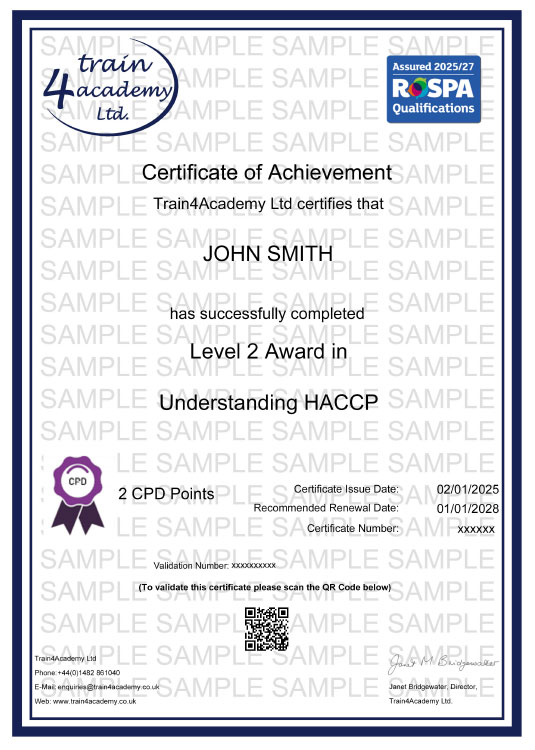
Upon passing the online assessment you will have the options to both print and download your HACCP Level 2 Certificate in PDF format. In addition to this an automated email will also be sent to your chosen email address containing a link to your certificate ensuring you always have access to a copy.
Furthermore, a QR code is displayed on each certificate which when scanned by a smartphone links to our certification database. This allows employers, auditors and local authority inspectors, for example, to establish a certificates validity instantly and at any time.
This Certificate does not have an Expiry Date. However, It is recommended that this training should be refreshed every 3 years in keeping with industry best practice guidelines. A Recommended Renewal Date will be printed on this certificate.
Common HACCP Level 2 Training Questions
HACCP Level 2 training provides food handlers with the knowledge and practical understanding needed to work safely within a food business that operates a Hazard Analysis and Critical Control Points (HACCP) system. Rather than teaching learners how to create a HACCP plan, the course focuses on how to follow existing food safety procedures, recognise potential hazards, and understand why monitoring and control measures are essential in preventing food contamination.
For employers, investing in HACCP Level 2 training helps create a workforce that understands its role in maintaining food safety standards. Employees gain the confidence to identify risks before they become problems, while customers benefit from safer food products that have been prepared and handled using recognised food safety practices. This shared understanding helps reduce the likelihood of food safety incidents, protects a business's reputation, and supports compliance with UK food safety legislation.
HACCP Level 2 training typically covers:
Key topics covered in HACCP Level 2 training and their importance
Topic
Why it matters
Food safety hazards
Helps staff identify biological, chemical, physical and allergen hazards before they compromise food safety.
The seven HACCP principles
Explains how food safety risks are identified, monitored and controlled throughout food production.
Critical Control Points (CCPs)
Teaches staff where food safety controls are most important and how to maintain them.
Monitoring procedures
Ensures employees understand how to check that food safety controls remain effective.
Corrective actions
Explains the appropriate steps to take if a food safety control fails or falls outside acceptable limits.
Record keeping
Demonstrates the importance of maintaining accurate food safety records to support compliance and traceability.
Ultimately, HACCP Level 2 training gives employees the knowledge to contribute positively to a business's food safety culture. Every member of staff plays an important role in protecting consumers, and understanding how their day-to-day actions influence food safety helps create a more consistent and reliable approach to producing safe food.
HACCP Level 2 is intended for anyone whose role involves handling, preparing, manufacturing, packing or storing food within a business that operates a HACCP-based food safety management system. It is particularly valuable for employees who need to understand why food safety procedures are followed, rather than simply carrying them out without explanation.
From an employer's perspective, ensuring that staff receive appropriate HACCP training demonstrates a commitment to maintaining high food safety standards. Employees who understand the reasons behind food safety controls are generally better equipped to recognise potential issues, follow procedures consistently and report concerns before they affect product safety.
HACCP Level 2 is suitable for:
Food production operatives
Food manufacturing employees
Kitchen staff and chefs
Catering assistants
Bakery workers
Food packers
Warehouse and storage staff handling food
Retail food employees
New starters in food production
Anyone working under an existing HACCP system
Choosing the right level of training is equally important. While HACCP Level 2 is ideal for staff responsible for following established food safety procedures, supervisors, team leaders and those responsible for developing or managing HACCP systems may benefit from progressing to HACCP Level 3 training.
There is no specific UK law that states every food handler must hold a HACCP Level 2 certificate. However, food businesses are legally required to ensure that employees receive food hygiene and food safety training appropriate to the work they carry out. Where staff work within a HACCP-based food safety management system, HACCP Level 2 training is widely recognised as an appropriate way of demonstrating that they have received suitable instruction.
For employers, providing recognised HACCP training can help demonstrate due diligence during inspections and audits by showing that employees understand the principles behind the procedures they are expected to follow. For employees, the training provides practical knowledge that supports safer working practices and helps maintain consistent food safety standards throughout the business.
While not a legal requirement in itself, HACCP Level 2 helps businesses demonstrate that:
Staff have received appropriate food safety training.
Employees understand HACCP procedures.
Food safety responsibilities are clearly communicated.
Risks of contamination are reduced through informed working practices.
The business is committed to maintaining effective food safety management.
Ultimately, the value of HACCP Level 2 extends beyond compliance. Well-trained employees are more likely to identify hazards, follow monitoring procedures correctly and contribute to producing safe food, helping to protect customers and the reputation of the business they work for.
Yes. HACCP Level 2 training is particularly well suited to employees working in food manufacturing, where maintaining consistent food safety standards is essential throughout every stage of production. Whether handling raw ingredients, operating production lines, packing finished products or storing food before distribution, employees need to understand how their role contributes to preventing contamination and producing safe food.
The course provides learners with a practical understanding of how a HACCP-based food safety management system works within a manufacturing environment. Rather than teaching employees to develop HACCP plans, Level 2 focuses on helping them follow existing procedures, recognise potential food safety hazards and understand the importance of Critical Control Points (CCPs), monitoring activities and corrective actions. This knowledge helps employees appreciate why food safety procedures must be followed consistently and how even small mistakes can have serious consequences for both consumers and the business.
Food manufacturing roles that benefit from HACCP Level 2 training
Role
How HACCP Level 2 supports the role
Production Operatives
Understand food safety procedures, recognise hazards and follow production controls correctly.
Packing and Labelling Staff
Reduce the risk of contamination and ensure products are packed and labelled safely and accurately.
Quality Control Assistants
Support monitoring activities and understand the importance of maintaining HACCP standards.
Warehouse and Storage Staff
Maintain safe storage conditions and understand how poor handling can affect food safety.
Hygiene and Cleaning Teams
Recognise how effective cleaning and sanitation help control contamination risks within food production.
New Food Manufacturing Employees
Develop a solid understanding of their responsibilities within an established HACCP system.
For employers, providing HACCP Level 2 training demonstrates a commitment to developing knowledgeable employees who understand the importance of food safety beyond simply following instructions. Staff who recognise potential hazards and understand why control measures exist are more likely to follow procedures consistently, identify issues early and contribute to a positive food safety culture. In turn, this helps businesses protect consumers, support legal compliance and maintain the high standards expected by customers, retailers and food safety auditors.
Why HACCP Level 2 Matters
HACCP Level 2 training is about far more than gaining a certificate. It helps employees understand why food safety procedures exist and the important role they play in protecting consumers. Every task carried out in a food business, from checking temperatures and preventing cross-contamination to following cleaning schedules and reporting problems, contributes to producing safe food.
For employers, having staff trained to Level 2 creates a stronger food safety culture where employees understand the reasons behind workplace procedures rather than simply following instructions. This leads to greater consistency, improved compliance and a reduced risk of costly mistakes that could result in product recalls, customer complaints or damage to the company's reputation.
HACCP Level 2 helps businesses to:
Improve employee awareness of food safety risks.
Reduce the likelihood of contamination.
Promote consistent working practices.
Support compliance with food safety legislation.
Protect consumers and business reputation.
Prepare staff for audits and inspections.
Ultimately, every employee who understands HACCP contributes to a safer workplace. Food safety isn't the responsibility of one department—it's a shared responsibility across the entire business, and Level 2 training helps everyone understand the part they play.
One of the greatest benefits of HACCP Level 2 training is that it encourages employees to identify potential problems before they become serious food safety incidents. Rather than reacting to contamination after it has occurred, HACCP teaches staff to recognise hazards, follow established controls and report anything that could compromise food safety.
Employees who understand why monitoring activities are carried out are more likely to recognise when something isn't right, whether that's an incorrect storage temperature, damaged packaging, poor hygiene practices or equipment that isn't operating correctly. Early intervention often prevents small issues from developing into expensive recalls or risks to public health.
Examples of food safety risks that trained employees are better equipped to identify include:
Examples of food safety risks that trained employees are better equipped to identify
Potential issue
Why early action matters
Incorrect chilled storage temperature
Prevents harmful bacteria from multiplying and compromising food safety.
Damaged packaging
Reduces the risk of contamination during storage, handling or transport.
Poor hand hygiene
Minimises the transfer of harmful microorganisms to food, equipment and surfaces.
Cross-contamination between raw and ready-to-eat foods
Helps prevent foodborne illness by keeping harmful bacteria away from food that won't be cooked again.
Equipment not operating correctly
Ensures food is processed safely and consistently, reducing the risk of unsafe products reaching consumers.
Developing this awareness benefits everyone involved. Employers reduce operational risk, employees gain confidence in carrying out their responsibilities and customers receive food that has been produced with safety at the forefront.
A strong food safety culture develops when every employee understands that food safety is part of their daily responsibilities rather than simply a management requirement. HACCP Level 2 training helps build this culture by explaining not only what employees need to do, but why those actions matter.
When staff appreciate the reasons behind monitoring procedures, cleaning schedules, allergen controls and record keeping, they are more likely to follow them consistently and report concerns without hesitation. This creates an environment where food safety becomes part of everyday decision-making rather than an occasional consideration.
A positive food safety culture is supported when employees:
Follow established HACCP procedures consistently.
Report hazards or equipment faults promptly.
Take ownership of food safety responsibilities.
Understand the importance of accurate monitoring.
Work together to maintain high food safety standards.
Businesses with a strong food safety culture often experience fewer incidents, greater consistency and increased confidence during customer audits and regulatory inspections.
HACCP Level 2 training helps food businesses meet their legal responsibilities by ensuring employees understand the food safety procedures they are expected to follow as part of the organisation's HACCP-based food safety management system. While the certificate itself is not a legal requirement, having knowledgeable employees is an important part of maintaining safe food production and demonstrating that staff have received appropriate instruction for their role.
Employees who understand food safety hazards, Critical Control Points (CCPs), monitoring procedures and corrective actions are more likely to follow company procedures consistently and recognise when something isn't right. This reduces the risk of food safety incidents and supports businesses in maintaining the standards expected by regulators, customers and third-party auditors.
How HACCP Level 2 training supports legal compliance
Area
How HACCP Level 2 helps
Employee competence
Provides employees with the knowledge needed to understand and follow established HACCP procedures.
Consistent working practices
Helps staff apply food safety controls consistently throughout production and food handling activities.
Hazard awareness
Improves employees' ability to identify biological, chemical, physical and allergen hazards before they become food safety incidents.
Monitoring and reporting
Encourages employees to report issues promptly and follow corrective action procedures when required.
Audit readiness
Supports businesses by creating a workforce that understands the importance of food safety procedures, monitoring and accurate record keeping.
For employers, HACCP Level 2 training is an investment in building a knowledgeable workforce that understands both the practical and legal importance of food safety. Employees who know why procedures exist are more likely to follow them consistently, report concerns promptly and contribute to a positive food safety culture. In turn, this helps businesses maintain compliance with food safety legislation, meet customer expectations and demonstrate a commitment to producing safe food.
Understanding HACCP principles is only part of maintaining food safety. The real value of HACCP Level 2 training comes from knowing how to apply that knowledge in everyday working environments, whether that's a food manufacturing facility, commercial kitchen, bakery or food distribution centre.
The following workplace scenarios demonstrate how employees can recognise potential hazards, follow established HACCP procedures and take appropriate action to help prevent food safety incidents. Each example reflects situations that could occur during normal working activities and highlights how informed decisions help protect consumers, support legal compliance and maintain high food safety standards.
Workplace Scenario
1 / 4
Monitoring a Critical Control Point (CCP)
Situation
As part of the daily opening checks, a production operative notices that the temperature display on a chilled storage unit is reading 8°C, even though company procedures require chilled food to be stored between 0°C and 5°C. The unit contains cooked chicken that is due to be used in production later that morning.
Rather than continuing with production, the employee recognises that temperature control is a Critical Control Point (CCP) within the company's HACCP system and reports the issue immediately.
What actions should be taken?
Stop using the affected ingredients until they have been assessed.
Inform the supervisor or quality team immediately.
Record the temperature deviation.
Arrange for the refrigeration unit to be inspected.
Follow the site's corrective action procedure before production continues.
Key takeaway
Monitoring Critical Control Points is one of the most important responsibilities within a HACCP system. Employees who understand acceptable limits know when food safety may be compromised and can take prompt action to help prevent unsafe products from reaching consumers.
Workplace Scenario
Managing Allergen Risks
Situation
While carrying out routine packing duties, an employee notices that a batch of sandwiches containing cheese has been labelled as "Dairy Free". The products are still on the production line and have not yet been dispatched.
ecause they understand the importance of allergen controls, the employee stops the process and reports the issue before the products leave the factory.
What actions should be taken?
Stop the packing process immediately.
Isolate the affected products.
Inform the supervisor or quality department.
Relabel or safely dispose of products following company procedures.
Record the incident and corrective action taken.
Key takeaway
Food allergens can present serious health risks to consumers. HACCP Level 2 training helps employees recognise the importance of accurate labelling and understand why allergen controls are an essential part of food safety management.
Workplace Scenario
Preventing Cross-Contamination
Situation
During a routine stock check, a warehouse operative notices that trays of raw chicken have accidentally been stored on a shelf directly above prepared salads awaiting dispatch.
The employee understands that storing raw food above ready-to-eat products creates a risk of cross-contamination and immediately reports the issue.
What actions should be taken?
Remove the ready-to-eat food from the area.
Assess whether any products may have been contaminated.
Store raw poultry in the designated location.
Inform the supervisor.
Record the incident if required by company procedures.
Key takeaway
Correct food storage plays a vital role in preventing cross-contamination. Employees who understand HACCP principles recognise unsafe storage practices and take action before contamination can occur.
Workplace Scenario
Monitoring Food Safety Equipment
Situation
During a scheduled hourly equipment check, a production operative tests the metal detector using the approved test pieces. The detector fails to identify one of the test samples.
The employee understands that the equipment is an important food safety control and immediately stops production in accordance with company procedures.
What went wrong?
Stop the production line.
Isolate products produced since the last successful test.
Report the equipment failure immediately.
Arrange for the metal detector to be checked and re-tested.
Restart production only when the equipment has passed all required checks.
Key takeaway
Routine monitoring helps identify problems before products leave the factory. Understanding why monitoring activities are carried out enables employees to respond quickly and reduce the risk of physical contamination reaching consumers.
4.7
Course Reviews
4.7.
(441 reviews)
4.7
441 Reviews
satisfactory
Bariu Kehinde Posted 21-Sep-2026
55
very good experience
stefanPosted 07-Sep-2026
55
great
Marusya Posted 17-Aug-2026
55
well laid out course and super easy to follow the training for the test
SamPosted 15-Aug-2026
55
This course is easy to follow and gives all information we need to know about safety when dealing with food
Catering, arguably the most diverse form of food handing is constant in its fundamentals, that is, the use of quality ingredients, cooked thoroughly, and protected once cooked. This level 2 food hygiene course will meet all legislative and audit requirements, fulfilling your due diligence needs..
In any food producing situation, the role of the supervisor is critical. This level 3 course, written to the highest standards, is entertaining and engaging which helps to make complex subject more accessible. This an invaluable course for all supervisors, managers and staff aspiring to these positions.
Machine Translated Content Available for 4 Languages
30 Multiple Choice Questions
Course Duration: 90 Minutes
CPD Points: 2
Frequently Asked Questions
Our training is completed online, using only a web browser.
After choosing the courses and completing the online transaction, you'll recieve an email providing access to the course. Use the details to register the course yourself or if it's for someone else, simply forward the email on.
Purchasing training for your team is simple.
Just add the courses you need to your basket and complete the checkout process. If you're purchasing 5 or more courses, we'll provide you with access to our Training Management System (TMS).
The TMS gives you full control over your learners, allowing you to enrol staff, monitor progress, track completion rates, and download certificates.
Once your account is set up, we're happy to show you around the system and help you get the most from its features. If you have any questions, our support team is always here to help at support@train4academy.co.uk.
Yes. We offer automatic discounts on larger orders, and any applicable discount will be applied instantly at checkout across all courses in the basket.
Depending on the number of courses purchased we provide the following discounts below. If you're looking to purchase a higher volume, please contact us and we'll be happy to discuss additional volume discounts.
Purchase 10+ courses and recieve 10%
Purchase 20+ courses and recieve 20%
Purchase 50+ courses and recieve 30%
Purchase 75+ courses and recieve 40%
Purchase 100+ courses and recieve 50%
Our training can be purchased easily using a debit or credit card.
If you're purchasing a larger volume of training and would prefer to be invoiced, please contact us on 01482 861 040 or email enquiries@train4academy.co.uk.
Our training is designed to fit around your schedule. Everybody receives 2 years from date of purchase, so there's no rush to complete your training course.
You can work through the training at your own pace, pause whenever you need to, and return whenever it's convenient. Your progress is automatically saved, allowing you to pick up exactly where you left off.
Even after you've successfully passed the assessment, you'll still be able to access the training materials whenever you need to refresh your knowledge