You are here:HomeHealth and Safety Awareness of Health and Safety at Work Training Online
Online Awareness of Health and Safety at Work Training
25.00+ VAT
Awareness of Health and Safety at Work Training Course
4.8 (218 reviews)
Unlimited Resits Customer Support Instant Access
£25.00 +VAT per person
Course information
Certificate on Successful Completion
Access course on Desktop, Laptop or Tablet
Machine Translated Content Available for 9 Languages
20 Multiple Choice Questions
Course Duration: 60 Minutes
CPD Points: 1
The aim of this course is to give you a basic level of understanding relating to the essentials of health and safety matters. It has been designed for both new starters in the workplace and existing employees who may have little or no recent training on the basics of health and safety.
It covers employee and employers’ responsibilities and raises awareness of the kinds of risks and hazards that may be present in a variety of working environments and various control measures that should be in place where there is a risk to health.
Risks exist in most places of work. Employers have a legal duty to reduce risks, as far as possible, by identifying the risks and hazards and putting in place the relevant safety measures and control procedures to eliminate, or reduce, the hazards to a safe level to make sure that the working environment remains safe for everyone.
Having a good understanding of health and safety is essential for everyone in the workplace, whether you are an employee, self-employed, a supervisor or a manager. By adopting good health and safety practices, you will help yourself and others work in a safer way.
Although health and safety could apply to our own homes, where accidents unfortunately do happen, this course, along with all the laws, regulations and guidance, refers to health and safety in the workplace.
Work towards compliance with UK Health and Safety legislation
Train online at your own pace with a full audio voiceover
Take advantage of our bulk discounts which will reduce your overall cost of training. Better still, any courses you order can be registered to users upto two years later so there's no need to worry about training credits expiring.
Courses Purchased
Discount
10+
10%
20+
20%
50+
30%
75+
40%
100+
50%
Who is this Awareness of Health and Safety at Work Training for?
This course is ideal for anybody within the workplace as it covers the variety of health and safety issues that may occur within different job roles. It is important that all members of staff are aware of the safety precautions that should be undertaken to protect their health and others.
As employers have a duty of care to ensure that the health and safety of all members of staff are maintained, it is essential that they have the appropriate knowledge and skills to successfully implement that. This course provides both employees and employers with the tools they need to put in precautionary measures in place to help minimise risk to health.
For those who are in a senior role looking to complete an advanced level of training, it's recommended that they take a Health & Safety for Managers course.
Have you started working remotely? Health and Safety for Homeworkers is an ideal course to help understand how to create a safe and comfortable work environment.
Course Screenshots
Course Aim
This course aims to introduce the fundamental principles of health and safety in the workplace. It is designed to raise awareness of common risks and hazards across various working environments and to promote positive safety practices that help protect both you and those around you.
For those looking to build on this foundation and achieve a recognised qualification in workplace safety, we also offer online IOSH training courses with tutor support.
Learning Objectives
On completion of the course, you should be able to:
The importance of practising good health and safety
What health and safety means
The costs associated with poor health and safety
A definition of ‘hazard’ and ‘risk’
What hazards and risks can be present in a variety of environments
The role of the Health and Safety Executive (HSE)
The importance of a risk assessment
The 5 steps of a risk assessment
What ‘Control Measures’ are and their importance
The things you can do to work safer in your environment
Yours and your employer’s legal responsibilities
Where to go to get further help and advice on health and safety matters in your workplac
Course Content
This course is made up of the following modules:
Introduction to Health and Safety
This section introduces the learner to the course and shows the learner some RIDDOR statistics.
Module 1 - Health and Safety Matters
This section of the course concentrates on how to get help and advise for health and safety within your own organisation. It also looks at how to prepare for work, by addressing personal hygiene, alcohol and substance abuse and general physical and mental health.
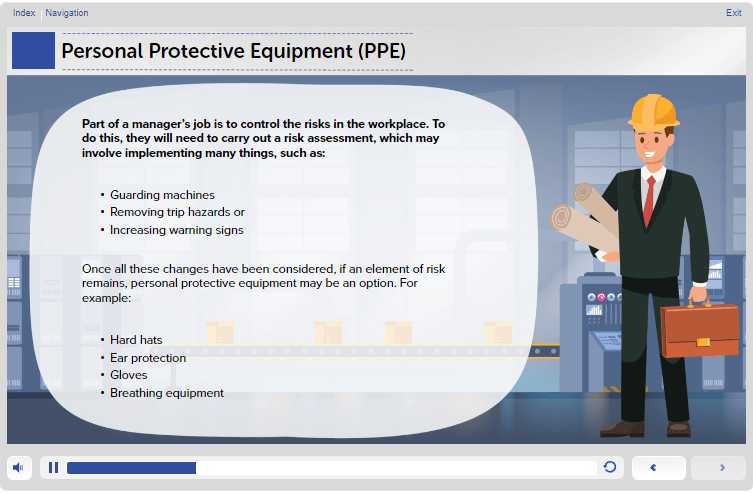
This module also looks at the importance of PPE (personal protective equipment) and the different types of PPE that are available.
Module 2 - Risks in Different Environments
This module aims to highlight the different areas of risk that can be present in a variety of working environments. It looks at how some environments we work in can present risks to workers’ health and well-being.
Module 3 - Other Health and Safety Essentials
In this final section, you will cover other important, relevant information and procedures relating to health and safety. This includes accident reporting, first aid, fire safety rules, emergency procedures and RIDDOR.
On completion of the course lessons and training material an online assessment will automatically unlock. The assessment will contain 20 multiple-choice questions and a mark of 75% or above will be required to pass.
The assessment will be marked instantly and so you will know straight away if you have passed or not. If you don't pass first time there's no need to worry. Unlimited resits at absolutely no additional charge are available so you can retake the assessment again as many times as you need to.
Awareness of Health and Safety at Work Training Certification
Our entire library of training courses is accredited by the CPD Certification Service as adhering to the universally recognised Continuing Professional Development (CPD) guidelines.
This training course and its content has also been assured by RoSPA, the Royal Society for the Prevention of Accidents.
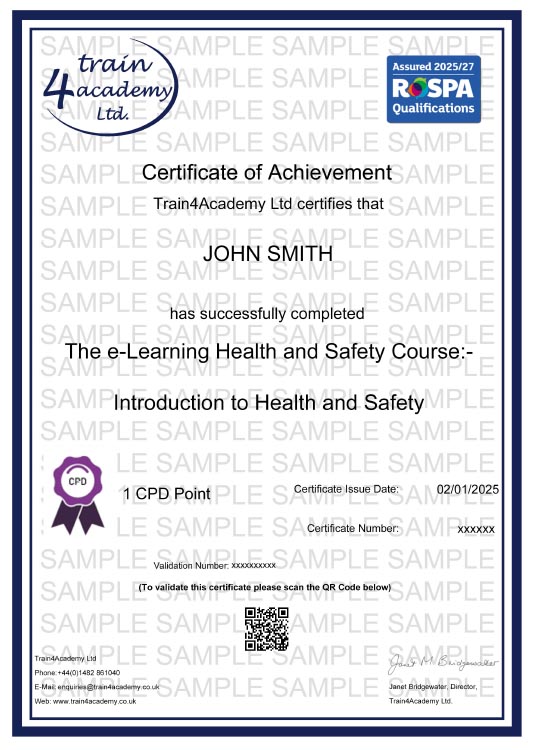
Upon passing the online assessment you will have the options to both print and download your Awareness of Health and Safety at Work Training Certificate in PDF format. In addition to this an automated email will also be sent to your chosen email address containing a link to your certificate ensuring you always have access to a copy.
Furthermore, a QR code is displayed on each certificate which when scanned by a smartphone links to our certification database. This allows employers, auditors and local authority inspectors, for example, to establish a certificates validity instantly and at any time.
Available in Multiple Languages
This training course includes machine generated translated content free of charge in the languages listed below:
Bulgarian, Hungarian, Latvian, Lithuanian
Polish, Portuguese, Romanian
Russian & Slovak
Please note: Course content which is not English may be machine translated and is made available for assistive purposes only. We cannot guarantee the accuracy of any translations.
Common Basic Health and Safety Training Questions
This level of training is designed for employees who require a general awareness of health and safety, regardless of their industry or job role. It forms the foundation for creating safer workplaces and helps individuals understand both their own responsibilities and the importance of protecting colleagues, visitors and members of the public.
Often referred to as Level 1 Health and Safety Training or Introduction to Health and Safety, it introduces the core principles of workplace safety, helping learners recognise common hazards, understand potential risks and follow safe working practices.
Comparison of health and safety training levels
Training level
Best suited for
Purpose
Level 1
New employees, apprentices and anyone needing a general
introduction to workplace health and safety.
Provides a solid understanding of workplace hazards, safe
working practices and basic legal responsibilities.
Level 2
Employees with greater day-to-day health and safety
responsibilities.
Builds upon the fundamentals, helping learners apply health
and safety principles more confidently within their role.
Level 3
Supervisors, team leaders and managers responsible for
overseeing workplace health and safety.
Develops the knowledge required to manage health and safety
responsibilities, support compliance and promote safe working
environments.
In simple terms, basic health and safety training encourages employees to take responsibility for workplace safety. For example, if someone notices a spillage, they're more likely to recognise it as a hazard and either clean it up safely or report it immediately, rather than assuming somebody else will deal with it.
Providing employees with basic health and safety training demonstrates an employer's commitment to creating a safe working environment. By ensuring everyone understands common workplace hazards, safe working practices and their responsibilities, organisations can help reduce the likelihood of accidents and encourage a positive safety culture.
Basic training can be completed by many job roles, including:
New employees
Office workers
Retail and customer-facing staff
Warehouse and logistics employees
Hospitality and catering staff
Managers and supervisors
Employees refreshing their knowledge
Basic health and safety training is designed to be relevant across a wide range of industries because every workplace presents its own hazards and risks
Key benefits of completing basic health and safety training
Understand your responsibilities for working safely.
Recognise common workplace hazards and risks.
Develop safer working habits from day one.
Support legal compliance within your organisation.
Help create a safer and more positive workplace for everyone.
While employees may later complete additional training specific to their role, such as COSHH, manual handling, working at height or fire safety, a basic understanding of workplace health and safety provides the knowledge needed to recognise risks, follow safe procedures and contribute to a safer working environment.
For many organisations, basic health and safety training provides an effective way of introducing new employees to the fundamental principles of workplace safety. It helps ensure staff understand their responsibilities, recognise common workplace hazards and follow safe working practices from the beginning of their employment.
There is no specific UK law that states every employee must complete a basic health and safety training course. Employers are legally required to provide employees with appropriate health and safety information, instruction, training and supervision to help them work safely.
What does UK health and safety law require?
Legal requirement
What it means in practice
Provide suitable training
Employees should receive health and safety training relevant to
their role and the risks they may encounter.
Provide information and instruction
Workers should understand workplace hazards, emergency
procedures and safe methods of working.
Provide appropriate supervision
Employees should receive the level of supervision needed to
carry out their work safely, particularly when they are new or
inexperienced.
Review training when circumstances change
Additional training may be required if job roles, equipment,
workplace procedures or identified risks change.
Refreshing basic health and safety knowledge every three years is considered good practice. However, refresher training may be required sooner if an employee's role changes, new equipment is introduced or workplace risks increase.
While there is no legal expiry date for basic health and safety awareness training in the UK, employers have a responsibility to ensure employees remain competent and receive additional training whenever it is appropriate.
Regular training can also help improve confidence, encourage the reporting of hazards and contribute to a stronger health and safety culture across the organisation.
Although there is no statutory requirement to renew a basic health and safety certificate after a specific period, reviewing employees' knowledge at regular intervals helps demonstrate an ongoing commitment to workplace safety and supports continuous improvement.
Workplace Scenario
1 / 4
Slippery Floor in the Office Kitchen
Situation
An employee walks into the office kitchen to make a drink and notices a small puddle of water on the floor. Assuming somebody else will clean it up, they walk away without reporting it. A colleague later slips on the wet floor, suffering a minor wrist injury.
Why was basic training important?
Basic health and safety training teaches employees to recognise everyday hazards and understand that even small risks should be reported or dealt with safely. By identifying hazards early, accidents can often be prevented before someone is injured.
Key takeaway
Report the hazard immediately, display a wet floor sign if available and arrange for the spill to be cleaned safely. Employees should never ignore hazards simply because they appear minor.
Workplace Scenario
Incorrect Manual Handling
Situation
During winter, the office heating is operating while several windows remain open. Portable heaters have also been plugged in because some staff feel cold.
Why was basic training important?
Basic health and safety training encourages employees to recognise when a task may present a risk and to follow safe working practices. It also highlights when additional training, such as manual handling training, may be required.
Key takeaway
Assess the load before lifting, use safe lifting techniques and seek assistance or mechanical lifting equipment where appropriate.
Workplace Scenario
Blocked Fire Exit
Situation
Several deliveries are temporarily placed in front of a designated fire exit while stock is being unpacked. Although staff intend to move them later, the exit remains partially blocked throughout the morning.
Why was basic training important?
Basic health and safety training helps employees understand the importance of emergency procedures and keeping escape routes clear at all times. Fire exits must remain accessible so people can evacuate quickly during an emergency.
Key takeaway
Remove any obstructions immediately and ensure all emergency exits remain clear and clearly identifiable throughout the working day.
Workplace Scenario
Damaged Electrical Cable
Situation
An employee notices that the power cable on a portable fan has become damaged, exposing internal wiring. Rather than reporting the issue, they continue using the equipment until another colleague receives a small electric shock.
Why was basic training important?
Basic health and safety training teaches employees to recognise unsafe equipment and understand the importance of reporting defects immediately. Using damaged electrical equipment increases the risk of injury and should never be ignored.
Key takeaway
Stop using the equipment immediately, report the fault to the appropriate person and ensure the item is removed from use until it has been repaired or replaced.
Why Basic Health and Safety Training Matters
Basic health and safety training is important because it gives employees the knowledge and confidence to recognise workplace hazards, understand potential risks and work safely from day one. Regardless of the industry, every workplace presents hazards that can lead to accidents if they are not identified or managed correctly. By providing employees with a basic understanding of health and safety, organisations can help reduce the likelihood of injuries, encourage safer working practices and create a working environment where everyone understands their responsibilities.
For employers, basic health and safety training also demonstrates a commitment to protecting employees while supporting compliance with UK health and safety legislation. Rather than simply reacting to incidents, effective training helps organisations prevent many accidents before they occur.
What can happen without basic health and safety training?
Potential consequences include:
Increased workplace accidents caused by poor hazard awareness or unsafe working practices.
Serious or life-changing injuries that affect employees, contractors, visitors and members of the public.
Enforcement action by the Health and Safety Executive (HSE) or local authority where legal duties are not met.
Significant financial penalties following serious breaches of health and safety legislation.
Higher levels of sickness absence, lost productivity and operational disruption.
Damage to an organisation's reputation and employee confidence.
The greatest consequence of poor health and safety isn't a fine or enforcement notice. It's the risk of preventable accidents that can cause serious or life-changing injuries. Basic health and safety training provides employees with the knowledge needed to recognise hazards, make safer decisions and contribute to a workplace where health and safety becomes part of everyday working life.
Hazards exist in every workplace, regardless of the industry. Some are obvious, such as exposed electrical wiring or wet floors, while others may develop over time through poor housekeeping, unsafe working practices or damaged equipment. Basic health and safety training teaches employees to remain alert, report concerns promptly and take appropriate action before a hazard leads to an accident or injury.
Basic health and safety training encourages employees to take an active role in workplace safety by:
Regularly checking their work area for obvious hazards.
Following safe working procedures at all times.
Reporting unsafe conditions, damaged equipment or defective PPE promptly.
Raising concerns if a task appears unsafe or outside their level of training.
Reporting accidents and near misses so corrective action can be taken.
Helping keep work areas clean, organised and free from unnecessary hazards.
Recognising workplace hazards is one of the most important skills employees develop through basic health and safety training. By identifying potential dangers early and reporting them promptly, employees can help prevent accidents, protect their colleagues and contribute to a safer working environment where health and safety becomes everyone's responsibility.
Without appropriate basic health and safety training, employees may be unaware of workplace hazards, safe working procedures or their responsibilities. This can have serious consequences for both individuals and organisations.
For employers, failing to provide appropriate health and safety information, instruction and training can also lead to wider consequences. These may include enforcement action from the Health and Safety Executive (HSE) or local authority, financial penalties for serious breaches of health and safety law, increased sickness absence, higher insurance costs and damage to an organisation's reputation.
Safe working practices are often built on small, consistent actions. Whether it's checking equipment before use, keeping walkways clear, reporting hazards or wearing the correct personal protective equipment (PPE), these everyday behaviours all contribute to reducing unnecessary risks and creating a safer working environment.
Basic health and safety training encourages safe working practices by helping employees develop the knowledge, awareness and habits needed to carry out their work safely every day. Rather than simply explaining workplace rules, the training helps employees understand why safe procedures exist and how following them protects both themselves and those around them.
Examples of safe working practices
Following workplace procedures
Using PPE correctly
Keeping work areas tidy
Checking equipment before use
Reporting hazards promptly
Following emergency procedures
Safe working habits every employee should develop
Basic health and safety training encourages employees to make safety part of their daily routine by:
Thinking about potential risks before starting a task.
Following workplace policies and safe systems of work.
Wearing the correct PPE whenever it is required.
Reporting unsafe conditions, damaged equipment or near misses.
Asking for guidance if they are unsure how to carry out a task safely.
Looking out for the safety and wellbeing of colleagues and visitors.
Developing these habits helps employees make informed decisions throughout the working day, rather than relying solely on supervision. Over time, safe working practices become second nature, helping to reduce workplace risks and creating an environment where health and safety is considered during every task, no matter how routine it may seem.
A positive safety culture is created when everyone understands that health and safety is a shared responsibility rather than the responsibility of one individual or department. Basic health and safety training helps establish this mindset by giving employees the knowledge and confidence to recognise hazards, follow safe working practices and look out for the wellbeing of others.
When employees understand the importance of working safely, they are more likely to report hazards, follow workplace procedures and encourage safe behaviours among colleagues. Over time, these everyday actions help create a workplace where health and safety becomes part of the organisation's culture, rather than simply a set of rules to follow.
Characteristics of a positive safety culture
Employees recognise and report hazards without hesitation.
Safe working procedures are followed consistently.
Communication about health and safety is open, honest and encouraged.
Managers and employees work together to improve workplace safety.
Lessons are learned from accidents and near misses to help prevent future incidents.
Everyone understands that protecting people is a shared responsibility.
4.8
Course Reviews
4.8.
(218 reviews)
4.8
218 Reviews
An easy training procedure to follow. can take it at your own pace and refresh slides if needed
AmyPosted 16-Sep-2026
55
THANKS
YousefPosted 10-Sep-2026
55
excellent
MikePosted 31-Aug-2026
55
thank you
SafetPosted 16-Jul-2026
55
Very good well developed course.
SimbarashePosted 02-Apr-2026
55
Good.
kerrisPosted 28-Mar-2026
55
An informative, worthwhile and interesting course.
PaulPosted 06-Mar-2026
55
Easy to grasp.
LewisPosted 13-Jun-2025
55
Reply from Train4Academy
Hi Lewis, thank you for your feedback. We always design our courses with simplicity in mind. It's great to read you had a enjoyable user experience with our online training.
Very good.
NeilPosted 27-May-2025
45
Reply from Train4Academy
Hi Neil, great feedback but do please let us know how we can turn that 4 star rating to a 5. We look forward to supporting your future training requirements.
It did exactly what I expected from a health and safety course.
MichaelPosted 22-Apr-2025
55
Reply from Train4Academy
Hi Michael, thank you for your feedback. It's good to know it does exactly what it set out to do. We appreciate your sharing your experience with us.
Working from has become a common practice for many people and with it comes benefits to the work and life balance. Though a familiar place, and easy to overlook potential hazards, working from home still has its own risks, just like working in an office..
Looking after the health and safety of an organisation or business, and its staff is a role often taken on by a those at a senior or managerial lover. A thorough understanding of the health and safety is required from legislation to safety organisation and management.
Machine Translated Content Available for 9 Languages
20 Multiple Choice Questions
Course Duration: 60 Minutes
CPD Points: 1
Frequently Asked Questions
Our training is completed online, using only a web browser.
After choosing the courses and completing the online transaction, you'll recieve an email providing access to the course. Use the details to register the course yourself or if it's for someone else, simply forward the email on.
Purchasing training for your team is simple.
Just add the courses you need to your basket and complete the checkout process. If you're purchasing 5 or more courses, we'll provide you with access to our Training Management System (TMS).
The TMS gives you full control over your learners, allowing you to enrol staff, monitor progress, track completion rates, and download certificates.
Once your account is set up, we're happy to show you around the system and help you get the most from its features. If you have any questions, our support team is always here to help at support@train4academy.co.uk.
Yes. We offer automatic discounts on larger orders, and any applicable discount will be applied instantly at checkout across all courses in the basket.
Depending on the number of courses purchased we provide the following discounts below. If you're looking to purchase a higher volume, please contact us and we'll be happy to discuss additional volume discounts.
Purchase 10+ courses and recieve 10%
Purchase 20+ courses and recieve 20%
Purchase 50+ courses and recieve 30%
Purchase 75+ courses and recieve 40%
Purchase 100+ courses and recieve 50%
Our training can be purchased easily using a debit or credit card.
If you're purchasing a larger volume of training and would prefer to be invoiced, please contact us on 01482 861 040 or email enquiries@train4academy.co.uk.
Our training is designed to fit around your schedule. Everybody receives 2 years from date of purchase, so there's no rush to complete your training course.
You can work through the training at your own pace, pause whenever you need to, and return whenever it's convenient. Your progress is automatically saved, allowing you to pick up exactly where you left off.
Even after you've successfully passed the assessment, you'll still be able to access the training materials whenever you need to refresh your knowledge