Basket 0 item(s) £0.00 + VAT
Call Us 01482 861 040

Prepare for the Key Changes Coming in October 2026 with our Sexual Harassment Awareness Training Course

Forklift Truck Safety Training

4.6 (110 reviews)
Forklift and Lift Truck Safety Training Course RoSPA Assured

Unlimited Resits Customer Support Instant Access

£25.00 +VAT per person

Course information
  • Certificate on Successful Completion
  • Access course on Desktop, Laptop or Tablet
  • 15 Multiple Choice Questions
  • Course Duration: 45 Minutes
  • CPD Points: 1

This online Forklift and Lift Truck Safety Training course provides knowledge of the dangers and hazards surrounding lift trucks and forklift vehicles. These vehicles can be seen as essential for the day to day running of organisations; due to this, it is highly important that all persons who work with lift trucks have been appropriately trained. Being aware of the accidents and injuries these vehicles can cause will help workers to gain awareness on how to implement the correct safety measures and protect themselves from any potential risks or hazards.

This online forklift training course covers a range of topics from legislation, training, to the importance of maintenance on forklift and lift truck vehicles. The learner will have the opportunity to gain knowledge on their specific responsibilities when it comes to operating lift trucks and use that knowledge during real-life working operations.

The Lifting Operations and Lifting Equipment Regulations 1998 (LOLER) and Provision and use of work equipment regulations 1998 (PUWER) are two important regulations relevant to lift trucks and forklifts. This online forklift course looks at how these regulations play a key role when it comes to lift truck or forklift operations.


  • Work towards compliance with UK Health and Safety legislation
  • Train online at your own pace with a full audio voiceover
  • Assured by RoSPA & Accredited by CPD
  • Certificate on successful completion
  • Course duration: 45 minutes
  • Unlimited resits at no cost

Discounts on Bulk Purchases

Take advantage of our bulk discounts which will reduce your overall cost of training. Better still, any courses you order can be registered to users upto two years later so there's no need to worry about training credits expiring.

Courses Purchased Discount
10+ 10%
20+ 20%
50+ 30%
75+ 40%
100+ 50%


Who is this Online Forklift Truck Safety Training for?

If your job involves operating forklifts or lift truck vehicles, then this online forklift certification course will benefit you. It will also benefit those who's job requires them to work in areas where FLTs are operated. It looks at the relevant risks and hazards surrounding lift trucks and how to input the correct safety measures to help protect workers from accidents or injuries.

It also looks at the relevant regulations relating to lifting equipment and why they are important.

Completing this training course alone would not permit staff to operate a FLT. For FLT operators this online course should supplement practical training or provide those working around FLTs with the knowledge and awareness of hazards and how to safely work around FLTs.

Forklift operators often rely on trained banksmen for safe maneuvering—see our Banksman course for more on this critical coordination.

Our Banksman Training course is ideal for situations where forklift operators require the support of a vehicle traffic marshall, providing essential guidance on safe and efficient coordination during vehicle manoeuvring.


Course Screenshots
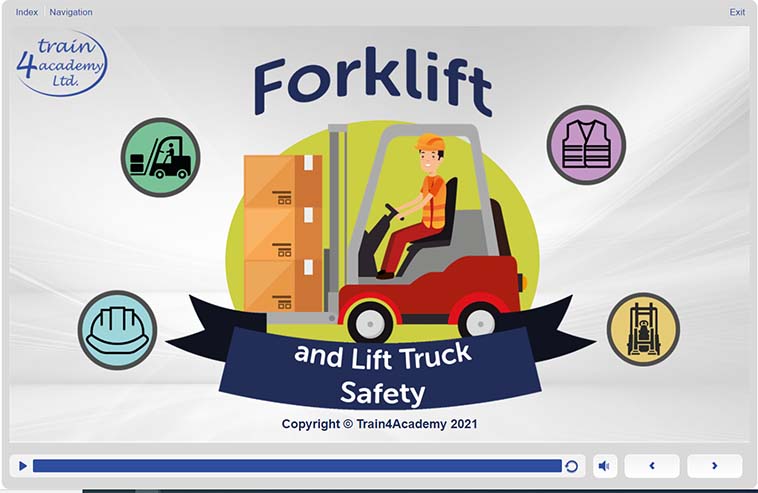
  • Forklift and Lift Truck Safety Training - Welcome Screen
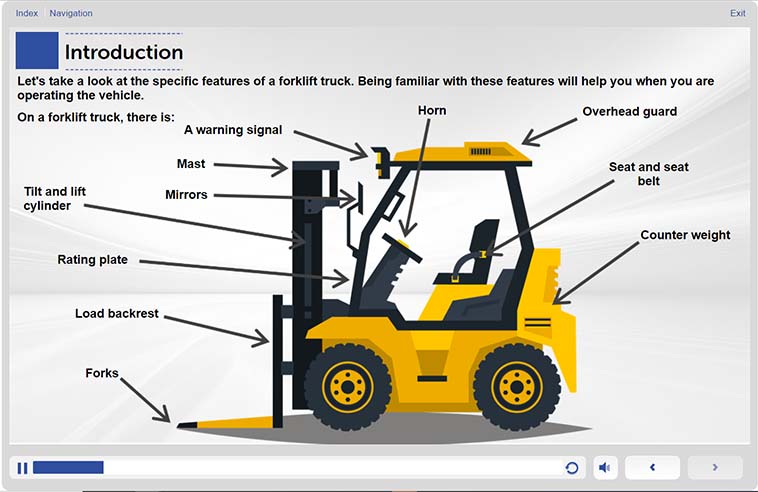
  • Forklift and Lift Truck Safety Training - Introduction to features of a foklift truck
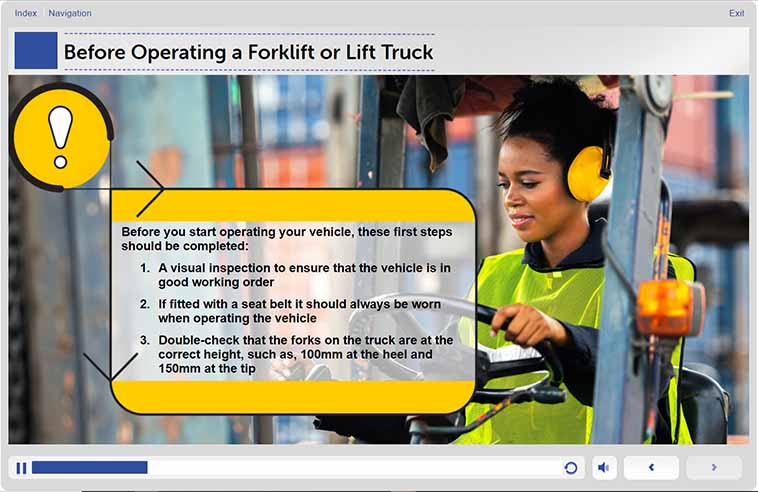
  • Forklift and Lift Truck Safety Training - Before Operating a Forklift or Lift Truck


Course Aim

The aim of this course is to provide a good level of knowledge on forklift and lift truck safety. It is important that thorough training has been completed by all persons who plan to operate a lift truck, and that they are aware of the risks and hazards surrounding these vehicles, or surrounding activities involved with lift trucks.


Learning Objectives

On completion of the course, you should be able to:

  • Name some features that are on a lift truck
  • List what to do before operating a lift truck
  • Identify LOLER and PUWER regulations
  • List some employer’s responsibilities
  • Name some responsibilities that employee’s hold
  • List some accidents that can occur caused by lift trucks
  • Identify the 5 steps to a risk assessment
  • List some safety measures that can be implemented for lift trucks
  • Identify why lift truck training is important
  • Identify why speed limits are important and how they can be used
  • Identify the purpose of site markings and signage
  • List some important elements that a loading bay area should have
  • Name some reversing and signalling safety measures
  • Identify the meaning of the Safe Stop Procedure
  • Identify why lift truck maintenance is important for safety
  • List some lift truck safety ‘do’s and don’ts’

Course Content

This course is made up of the following modules:

  • Introduction to Forklift and Lift Truck Safety

    This section introduces the learner to the course. It looks at some specific features that can be found on a lift truck and where to find them, such as, load capacity signage, level controls, etc

  • Module 1 - Hazards and Risks

    This section of the course concentrates the definitions of hazard and risk. It looks at the relevant regulations that are put in place to help prevent workers from coming into harm with lifting equipment. It also looks at how thorough planning before operations is beneficial in protecting the health of workers and others within the vicinity.

  • Module 2 - Competent and Safe Operators

    This section of the course covers the different responsibilities that both the employee and employer have when it comes to the operation of lift trucks and forklifts. It also looks at what a safe and competent operator should do, and how training is essential for all workers who will operate a forklift or lift truck vehicle.

  • Module 3 - Implementation of Safety Measures

    In this final section, you will cover some safety measures that can be implemented to help prevent any risks or hazards surrounding lift trucks within the workplace. For example, you will look at speed limits, safe site design and loading bays. This section also looks at some lift truck and forklift do’s and don’ts, to demonstrate how all workers can avoid unnecessary accidents or injuries by following basic procedures.

Download Course Overview (PDF)

Assessment

On completion of the course lessons and training material an online assessment will automatically unlock. The assessment will contain 15 multiple-choice questions and a mark of 75% or above will be required to pass.

The assessment will be marked instantly and so you will know straight away if you have passed or not. If you don't pass first time there's no need to worry. Unlimited resits at absolutely no additional charge are available so you can retake the assessment again as many times as you need to.


Online Forklift Truck Safety Training Certification

Our entire library of training courses is accredited by the CPD Certification Service as adhering to the universally recognised Continuing Professional Development (CPD) guidelines.

This training course and its content has also been assured by RoSPA, the Royal Society for the Prevention of Accidents.
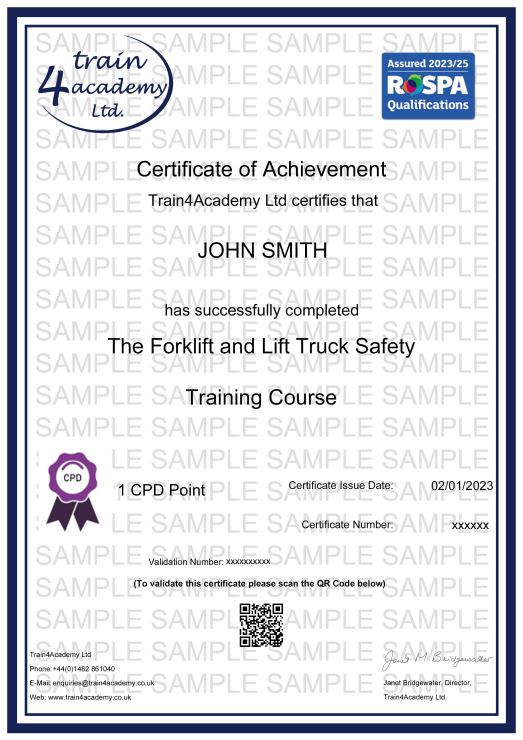
Forklift and Lift Truck Safety Training - Certificate Example

Upon passing the online assessment you will have the options to both print and download your Forklift and Lift Safety Training Certificate in PDF format. In addition to this an automated email will also be sent to your chosen email address containing a link to your certificate ensuring you always have access to a copy.

Furthermore, a QR code is displayed on each certificate which when scanned by a smartphone links to our certification database. This allows employers, auditors and local authority inspectors, for example, to establish a certificates validity instantly and at any time.


Common Forklift and Lift Truck Training Questions

Most forklift accidents don't happen because of a single mistake. They usually result from a combination of unsafe behaviours, poor workplace practices or inadequate training. The good news is that most of these risks can be significantly reduced with the right knowledge and safe operating procedures.

The most common causes of forklift accidents

  • Poor Operator Awareness: Failing to notice pedestrians, blind spots or moving vehicles can quickly lead to collisions.
  • Limited Visibility: Large loads, blind corners and reversing all reduce visibility and require extra care.
  • Unstable Loads: Overloading or poorly balanced loads can shift unexpectedly and affect the truck's stability.
  • Travelling Too Fast: Speed reduces control, increases stopping distances and makes overturns more likely.
  • Poor Maintenance: Daily inspections help identify worn tyres, brake defects and hydraulic leaks before they become serious hazards.
  • Lack of Training: Without proper training, operators may not understand safe lifting techniques, workplace hazards or emergency procedures.

According to the Health and Safety Executive (HSE), vehicles at work continue to be one of the leading causes of fatal and major workplace injuries.

These figures highlight why forklift safety training is more than a legal requirement. It's an essential part of protecting operators, pedestrians and everyone working around lift trucks.

While there is no law that specifically requires operators to hold a forklift licence, employers have a legal duty to ensure that anyone operating a forklift or lift truck is properly trained, competent and able to use the equipment safely.

Several pieces of UK health and safety legislation work together to create these responsibilities.

Legislation / Guidance What it means for forklift and lift truck safety
Health and Safety at Work etc. Act 1974 Employers must protect the health, safety and welfare of employees and anyone affected by their work activities.
PUWER 1998 Forklifts must be suitable for the task, properly maintained and only operated by trained, competent people.
LOLER 1998 Forklifts used for lifting loads must be thoroughly examined, maintained and used safely.
Management of Health and Safety at Work Regulations 1999 Employers must assess workplace risks and put suitable control measures in place, including training where required.
HSE Approved Code of Practice L117 Provides recognised guidance on operator training, refresher training and maintaining competence. Following L117 helps demonstrate compliance with legal duties.

There is no legal requirement to renew forklift training after a fixed number of years. However, the Health and Safety Executive (HSE) recommends that employers regularly review operator competence and provide refresher training whenever it is needed to ensure operators continue to work safely.

Forklift safety training should not be viewed as a one-off event. As workplaces, equipment and working practices change, regular refresher training helps reinforce safe operating techniques, correct unsafe habits and keep operators up to date with current best practice.

Refresher training is recommended when:

  • An operator has been involved in an accident or near miss.
  • Unsafe operating practices have been observed.
  • A different type of forklift or lift truck is introduced.
  • Workplace layouts or operating conditions change.
  • An operator returns to work after a long absence.
  • Employers believe additional training would improve safety or competence.

Employee refresher training helps operators:

  • Improve hazard awareness.
  • Reinforce safe lifting and load handling techniques.
  • Stay familiar with workplace traffic management procedures.
  • Maintain confidence and competence.
  • Reduce the risk of accidents, injuries and equipment damage.


The Importance of Forklift and Lift Truck Training

Employers have a legal responsibility to provide a safe working environment for anyone who may be affected by forklift operations. This extends beyond simply supplying equipment and includes ensuring operators are trained, supervised and working within safe systems of work.

A proactive approach to forklift safety not only helps organisations comply with legislation but also reduces accidents, protects employees and improves operational efficiency.

Employers should ensure:

  • Operators receive suitable forklift safety training.
  • Only competent and authorised employees operate forklifts.
  • Forklifts are regularly inspected and properly maintained.
  • Daily pre-use checks are completed and recorded.
  • Risk assessments are carried out and reviewed.
  • Traffic routes and pedestrian walkways are clearly identified.
  • Operators receive refresher training when required.
  • Defects and near misses are reported promptly.

Forklifts and lift trucks are essential for moving heavy loads efficiently, but they are also among the most hazardous vehicles used in the workplace. Without proper training and safe working practices, even routine tasks can quickly lead to serious injuries, damaged equipment and costly business disruption.

Creating a safe working environment protects not only forklift operators, but also pedestrians, contractors and visitors who may be working nearby. Good forklift safety reduces accidents, improves confidence and helps businesses meet their legal responsibilities under UK health and safety legislation.

A strong forklift safety culture helps to.

Benefit Why it Matters
Protect Employees Reduces the risk of injuries, workplace accidents and serious incidents involving forklifts and lift trucks.
Improve Pedestrian Safety Helps keep pedestrians safely separated from moving vehicles, reducing the likelihood of collisions.
Protect Loads and Equipment Minimises damage to stock, warehouse racking, pallets and forklift trucks, reducing repair and replacement costs.
Support Legal Compliance Helps employers meet their responsibilities under UK health and safety legislation and HSE guidance.
Improve Productivity Fewer accidents and equipment failures result in less downtime, fewer delays and more efficient operations.
Build Operator Confidence Well-trained operators feel more competent, make better decisions and work more safely every day.

A safer workplace isn't created by training alone. It relies on good planning, clear procedures and a working environment that supports safe behaviour every day.

Small improvements to workplace layout and traffic management can make a significant difference in reducing the likelihood of accidents.

Ways to improve forklift safety

Safety Measure How it improves forklift safety
Clearly marked pedestrian walkways Helps keep employees, visitors and contractors safely separated from moving forklifts and lift trucks.
Physical barriers Reduces the risk of pedestrians accidentally entering forklift operating areas.
Clear safety signage Reminds operators and pedestrians of site rules, traffic routes, speed limits and known hazards.
One-way traffic systems Reduces vehicle conflict in busy areas and helps operators follow predictable routes.
Good lighting Improves visibility in warehouses, yards, loading bays and areas where forklifts reverse or turn.
Speed limits Gives operators more time to react and reduces the risk and severity of collisions.
High-visibility PPE Makes pedestrians easier for forklift operators to see, especially in busy or low-light areas.
Regular inspections Helps identify equipment defects, damaged surfaces and workplace hazards before they lead to accidents.

Forklift safety training provides benefits that extend far beyond initial certification. As operators gain experience, regular training and refresher courses help maintain competence, reinforce safe habits and support continuous improvement across the workplace.

For employers, investing in safety training demonstrates a commitment to employee wellbeing while helping reduce operational risks and associated costs.

Long-term benefits for operators

  • Increased confidence.
  • Better hazard awareness.
  • Safer operating techniques.
  • Greater understanding of workplace responsibilities.
  • Improved career development opportunities.

Long-term benefits for employers

  • Fewer workplace accidents.
  • Reduced equipment damage.
  • Lower maintenance and repair costs.
  • Improved legal compliance.
  • Increased productivity.
  • Stronger safety culture.
  • Greater employee confidence and morale.


Course Reviews

4.6.

(110 reviews)

Read more reviews


Related Online Training Courses

  • Fire Safety (Understanding)

    £25.00 +VAT

    Fire can break out in any premises. It is unpredictable and deadly, but by understanding fire safety and taking precautions, the outcomes of fire can be minimised. This online training course is ideal for those who have the authority to control systems in buildings & those who should follow correct fire prevention systems..

  • cert
    Display Screen Equipment (DSE) Awareness

    £25.00 +VAT

    This DSE course is designed in line with the Display Screen Regulations Act (1992). The online training course helps to educate the user about DSE; tablets, touch screen devices, computers, laptops and mobile phones. DSE will inform the learner of the risks associated with use of these devices. .

Forklift Truck Safety Training Course RoSPA Assured

4.6 4.6 (110 reviews)

£25.00 +VAT per person

Discounts on bulk purchases
  • 10% Discount 10+ courses
  • 20% Discount 20+ courses
  • 30% Discount 50+ courses
  • 40% Discount 75+ courses
  • 50% Discount 100+ courses
  • Compare plans & pricing

Training 10 or more people? Let us quote you

Training Management Suite (TMS) included
with orders of 5 or more courses.

Course information
  • Certificate on Successful Completion
  • Access course on Desktop, Laptop or Tablet
  • 15 Multiple Choice Questions
  • Course Duration: 45 Minutes
  • CPD Points: 1


Frequently Asked Questions

Our training is completed online, using only a web browser.

After choosing the courses and completing the online transaction, you'll recieve an email providing access to the course. Use the details to register the course yourself or if it's for someone else, simply forward the email on.

Purchasing training for your team is simple.

Just add the courses you need to your basket and complete the checkout process. If you're purchasing 5 or more courses, we'll provide you with access to our Training Management System (TMS).

The TMS gives you full control over your learners, allowing you to enrol staff, monitor progress, track completion rates, and download certificates.

Once your account is set up, we're happy to show you around the system and help you get the most from its features. If you have any questions, our support team is always here to help at support@train4academy.co.uk.

Yes. We offer automatic discounts on larger orders, and any applicable discount will be applied instantly at checkout across all courses in the basket.

Depending on the number of courses purchased we provide the following discounts below. If you're looking to purchase a higher volume, please contact us and we'll be happy to discuss additional volume discounts.

  • Purchase 10+ courses and recieve 10%
  • Purchase 20+ courses and recieve 20%
  • Purchase 50+ courses and recieve 30%
  • Purchase 75+ courses and recieve 40%
  • Purchase 100+ courses and recieve 50%

Our training can be purchased easily using a debit or credit card.

If you're purchasing a larger volume of training and would prefer to be invoiced, please contact us on 01482 861 040 or email enquiries@train4academy.co.uk.

Our training is designed to fit around your schedule. Everybody receives 2 years from date of purchase, so there's no rush to complete your training course.

You can work through the training at your own pace, pause whenever you need to, and return whenever it's convenient. Your progress is automatically saved, allowing you to pick up exactly where you left off.

Even after you've successfully passed the assessment, you'll still be able to access the training materials whenever you need to refresh your knowledge

Read further FAQ