Basket 0 item(s) £0.00 + VAT
Call Us 01482 861 040

Prepare for the Key Changes Coming in October 2026 with our Sexual Harassment Awareness Training Course

Customer Service Training Course

4.7 (57 reviews)
Customer Service Training CPD Certified Course

Unlimited Resits Customer Support Instant Access

£25.00 +VAT per person

Course information
  • Certificate on Successful Completion
  • Access course on Desktop, Laptop or Tablet
  • 15 Multiple Choice Questions
  • Course Duration: 45 Minutes
  • CPD Points: 1

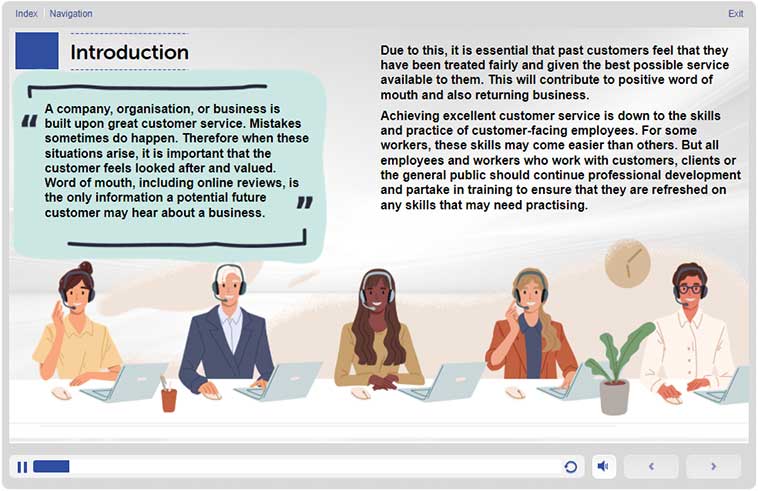
This Customer Service Skills training course covers how employees who are in a customer-oriented role can improve their skills to ensure that their client or customer is receiving the best service possible. These skills are highly important for many customer-facing industries. A company, organisation, or business is built upon great customer service.

Mistakes sometimes do happen. Therefore, when these situations arise, it is important that the customer feels looked after and valued. Word of mouth, including online reviews, is the only information a potential future customer may hear about a business.

Due to this, it is essential that past customers feel that they have been treated fairly and given the best possible service available to them. This will contribute to positive word of mouth and also returning business.

Achieving excellent customer service is down to the skills and practice of customer-facing employees. For some workers, these skills may come easier than others. But all employees and workers who work with customers, clients or the public should continue professional development and partake in training to ensure that they are refreshed on any skills that may need practising.


  • Train online at your own pace with a full audio voiceover
  • Accredited by CPD
  • Certificate on successful completion
  • Course duration: 45 minutes
  • Unlimited resits at no cost

Discounts on Bulk Purchases

Take advantage of our bulk discounts which will reduce your overall cost of training. Better still, any courses you order can be registered to users upto two years later so there's no need to worry about training credits expiring.

Courses Purchased Discount
10+ 10%
20+ 20%
50+ 30%
75+ 40%
100+ 50%


Who is this Online Customer Service Training for?

This course is ideal for employees whose job role involves some element involving working with clients or customers. Whether that is in retail, the hospitality business or customer care representatives, in person or via the telephone, all workers should have the knowledge and skills to communicate with customers effectively, giving them a positive customer experience.


Course Screenshots
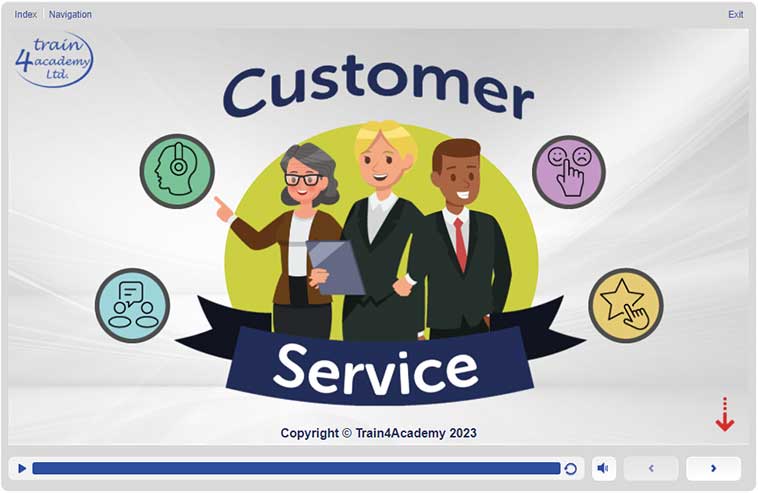


Course Aim

This course aims to provide knowledge on how to improve customer service skills. It looks at how to build positive customer relations through the use of techniques, listening skills and remaining calm and positive.


Learning Objectives

On completion of the course, you should be able to:

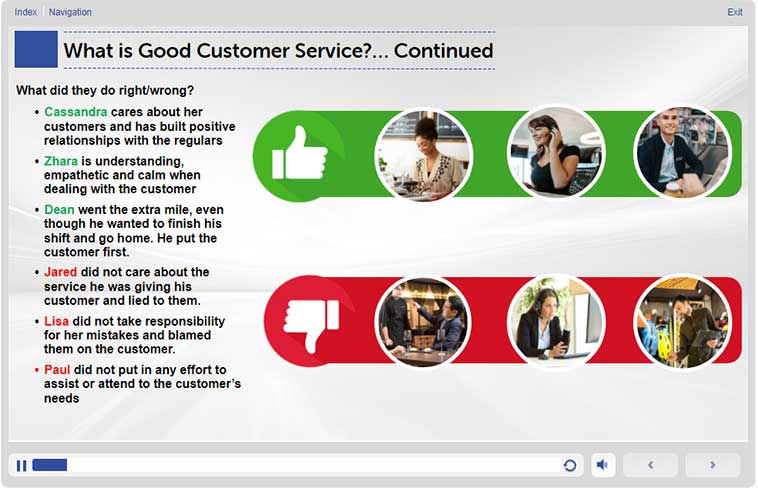
  • Identify an example of good and poor customer service
  • List some consequences that may outcome due to poor customer service
  • List some benefits of great customer service
  • Name some skills that contribute to giving a great customer service experience
  • Identify techniques that can help you to build your telephone customer service skills
  • Recognise statements that use positive wording rather than negative
  • Recognise why handling customer complaints is important
  • List some steps and procedures that can be taken when dealing with complaints
  • Recognise techniques to help control stress management at work

Course Content

This course is made up of the following modules:

  • An Introduction to Customer Service

    This section introduces the learner to the course and explains why good customer service is important.

  • Module 1 - Benefits and Consequences

    This section of the course concentrates on the benefits of great customer service experiences and the consequences of poor customer service. It looks at how great customer service can boost a business or company, as well as the professional development of the employee.

  • Module 2 - Improving Customer Service Skills

    This section of the course looks at how employees can develop their customer service skills and why developing these skills is important. This includes the use of body language, positive choice of words and how to implement to face the challenges that they may face with communicating with customers via the telephone.

  • Module 3 - Handling Complaints

    This final section will cover how to handle complaints. It looks at a step-by-step procedure on how to deal with a complaint. It also looks at how to manage the stresses that may come with emotional customers and how to handle your emotions when dealing with high pressured situations.

Download Course Overview (PDF)

Assessment

On completion of the course lessons and training material an online assessment will automatically unlock. The assessment will contain 15 multiple-choice questions and a mark of 75% or above will be required to pass.

The assessment will be marked instantly and so you will know straight away if you have passed or not. If you don't pass first time there's no need to worry. Unlimited resits at absolutely no additional charge are available so you can retake the assessment again as many times as you need to.


Customer Service Essentials Training Certification

Our entire library of training courses is accredited by the CPD Certification Service as adhering to the universally recognised Continuing Professional Development (CPD) guidelines.
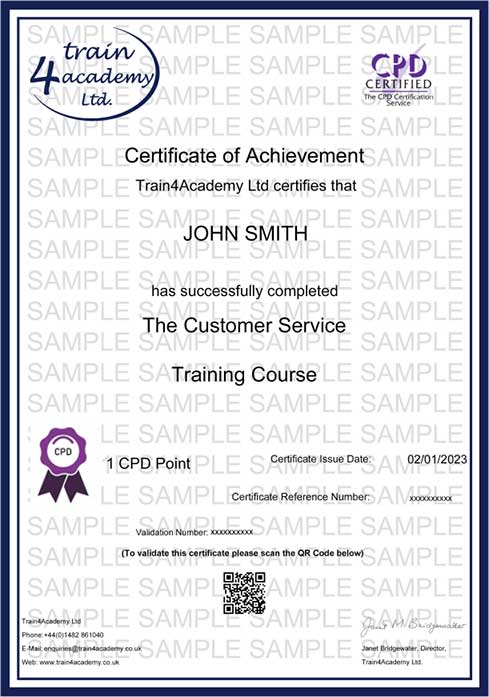
Customer Service Training - Certificate Example

Upon passing the online assessment you will have the options to both print and download your Customer Service Training Certificate in PDF format. In addition to this an automated email will also be sent to your chosen email address containing a link to your certificate ensuring you always have access to a copy.

Furthermore, a QR code is displayed on each certificate which when scanned by a smartphone links to our certification database. This allows employers, auditors and local authority inspectors, for example, to establish a certificates validity instantly and at any time.


Common Customer Service Training Questions

Customer service training helps employees develop the knowledge, confidence, and practical skills needed to provide excellent service before, during, and after every customer interaction. Whether you're supporting customers in person, over the phone, by email, or through live chat, effective training teaches you how to communicate professionally, solve problems, and deliver a positive customer experience.

A good customer service training course focuses on the essential skills employees use every day when interacting with customers.

Training Area What You'll Learn
Communication How to communicate clearly, professionally and confidently.
Active Listening Understanding customer needs by listening carefully and asking the right questions.
Complaint Handling Techniques for resolving customer concerns calmly and professionally.
Problem Solving Finding practical solutions that benefit both the customer and the business.
Customer Care Creating positive experiences that encourage customer satisfaction and loyalty.
Professionalism Representing your organisation in a courteous, respectful and consistent manner.

Customer service training develops the practical communication, problem-solving and interpersonal skills needed to deliver consistently excellent customer experiences.

Customer service training teaches the practical skills needed to deliver professional, positive, and consistent customer experiences. While every organisation has its own procedures, the core skills remain the same across almost every customer-facing role. From communicating effectively and resolving complaints to understanding customer needs and building trust, these skills help employees provide excellent service while representing their organisation professionally.

A comprehensive customer service training course helps learners develop a wide range of transferable workplace skills.

Key Customer Service Skills and Why They Matter
Skill Why It Matters
Communication Helps you explain information clearly, manage expectations, and build positive customer relationships.
Active Listening Allows you to fully understand customer concerns before responding or offering a solution.
Empathy Demonstrates understanding and helps customers feel valued and respected.
Problem-Solving Enables you to identify practical solutions while balancing customer needs with company policies.
Complaint Handling Provides techniques for resolving issues calmly, professionally, and efficiently.
Professionalism Ensures every interaction reflects positively on your organisation and builds customer confidence.
Adaptability Helps you respond effectively to different personalities, situations, and communication channels.
Teamwork Encourages collaboration with colleagues to deliver a consistent customer experience.

While customer service is often associated with retail and contact centres, excellent service skills are valuable in almost every industry where people interact with customers.

Customer service training supports a wide range of roles including
Job Role How Customer Service Training Helps
Retail Assistants Improve customer interactions, handle returns professionally, and build customer loyalty.
Customer Service Advisors Manage enquiries confidently while resolving issues efficiently.
Receptionists Create positive first impressions and communicate professionally with visitors and clients.
Call Centre Agents Develop active listening, telephone etiquette, and complaint handling skills.
Hospitality Staff Deliver excellent guest experiences and respond effectively to customer requests.
Healthcare Reception Teams Communicate clearly, show empathy, and support patients professionally.
Sales Professionals Build trust with customers while providing helpful advice and product knowledge.
Office Administrators Handle customer enquiries and maintain professional business relationships.

Regardless of the industry, customers expect clear communication, professionalism, and helpful service.

Customer service training is suitable for learners at all experience levels. whether you're entering your first customer-facing role or have years of experience, structured training helps build confidence and reinforces best practice.

This online course is particularly useful if you are:

  • Starting a new customer service role.
  • Returning to work after a career break.
  • Moving into a customer-facing position.
  • Looking to refresh existing knowledge.
  • Preparing for promotion or additional responsibilities.
  • Supporting customers through telephone, email, live chat, or face-to-face communication.

Customer service training also supports organisations that want to deliver a consistent standard of service across their teams.

Customer expectations continue to evolve, and people increasingly expect quick, professional, and personalised service. Employees who receive structured training are better prepared to respond confidently, adapt to different situations, and create positive customer experiences across every communication channel.

Customer service training can help employees:

  • Understand customer needs more effectively.
  • Communicate with empathy and professionalism.
  • Handle complaints calmly and constructively.
  • Build rapport and trust with customers.
  • Manage difficult conversations confidently.
  • Deliver a more consistent customer experience.
  • Support positive teamwork and collaboration.

One of the biggest advantages of customer service training is that the skills can be applied across many different careers and industries.

While workplace experience is valuable, experience alone doesn't always teach best practice.

Structured customer service training helps employees:

  • Understand proven customer service techniques.
  • Develop consistent communication skills.
  • Learn how to respond professionally under pressure.
  • Build confidence before challenging situations occur.
  • Understand how customer service contributes to business success.

Training complements real-world experience by providing practical guidance that employees can apply immediately. It develops practical skills that benefit both individuals and organisations. From improving communication and confidence to increasing customer satisfaction and supporting career progression, the knowledge gained can have a lasting impact long after the training has been completed.


Why Are Customer Service Skills Important?


Customer service skills play a vital role in building trust because they help create positive, consistent, and reliable experiences for customers. When people feel listened to, respected, and supported, they're more likely to return to a business, recommend it to others, and remain loyal over time. Every customer interaction contributes to the overall relationship, making strong customer service skills an important part of building long-term customer confidence.

Trust isn't built through a single interaction, it develops through consistent, positive experiences.

How Customer Service Skills Build Trust
Customer Service Skill How It Builds Trust
Active Listening Shows customers that their concerns are understood and taken seriously.
Empathy Helps customers feel valued by recognising their situation and responding with understanding.
Professionalism Creates confidence that enquiries will be handled respectfully and consistently.
Honesty Setting realistic expectations helps establish credibility and reliability.
Reliability Following through on promises demonstrates that customers can depend on your business.

Small actions can have a big impact. It's often the small, everyday interactions that leave the strongest impression.

For example:

  • Greeting customers warmly.
  • Listening without interrupting.
  • Keeping customers informed.
  • Delivering on promises.
  • Thanking customers for their patience.
  • Following up when appropriate.

Over time, these consistent behaviours demonstrate reliability and help strengthen customer relationships.

Clear, professional, and respectful communication helps customers understand information, builds confidence, reduces misunderstandings, and creates a positive customer experience. The way you communicate can shape how customers perceive both you and your organisation.

Good communication helps employees provide accurate information while ensuring customers feel heard, respected, and supported throughout their journey.

Benefits of Effective Customer Communication
Benefit Why It's Important
Builds Customer Confidence Clear communication reassures customers that their enquiry is being handled professionally.
Reduces Misunderstandings Explaining information clearly helps avoid confusion and unnecessary follow-up questions.
Improves Customer Satisfaction Customers value honest, helpful, and easy-to-understand communication.
Sets Clear Expectations Keeping customers informed about timescales, processes, or next steps builds trust.
Creates Positive Experiences Friendly and professional conversations leave a lasting positive impression.

Effective communication involves more than simply providing information. It requires understanding the customer's needs, using appropriate language, and adapting your communication style to suit the situation.

Good customer service communication includes:

  • Listening carefully before responding.
  • Speaking clearly and professionally.
  • Using simple, easy-to-understand language.
  • Asking questions to clarify customer needs.
  • Confirming that the customer understands the information provided.
  • Remaining polite and respectful throughout the conversation.

These habits help create productive conversations where customers feel valued and informed.

Whether a customer has a simple question or a more complex concern, strong customer service skills help create positive outcomes while maintaining professionalism and customer confidence.

Resolving customer problems isn't always about providing the answer the customer wants. Often, it's about listening carefully, explaining the available options, and ensuring the customer feels supported throughout the process.

Successfully resolving customer issues usually requires a combination of different customer service skills working together.

A simple approach to solving customer problems. Many customer enquiries can be resolved by following a structured approach.

  • Listen carefully to understand the customer's concern.
  • Ask questions if more information is needed.
  • Acknowledge the issue and demonstrate understanding.
  • Identify the most appropriate solution based on company procedures.
  • Explain the next steps clearly so the customer knows what to expect.
  • Confirm the issue has been resolved before ending the conversation.

Following a consistent process helps employees resolve problems efficiently while giving customers confidence that their concerns are being taken seriously.

The ability to communicate effectively, solve problems, work professionally, and build positive relationships is important in almost every industry. Whether you're starting your first job, changing careers, or working towards a promotion, strong customer service skills can help you stand out and progress professionally.

Many customer-facing roles require employees to interact with customers, colleagues, suppliers, and stakeholders every day. Developing these skills not only improves workplace performance but also demonstrates that you're confident, reliable, and capable of handling a wide variety of situations.

Customer service skills support many of the qualities employers look for when recruiting new staff or promoting existing employees.

Customer Service Skills and Their Career Benefits
Customer Service Skill Career Benefit
Communication Helps you work effectively with customers, colleagues, and managers.
Problem-Solving Demonstrates initiative and the ability to find practical solutions.
Professionalism Builds trust and shows you can represent an organisation positively.
Adaptability Shows you can respond confidently to changing situations and customer needs.
Teamwork Supports collaboration and contributes to a positive working environment.
Emotional Intelligence Helps build stronger workplace relationships and manage challenging situations professionally.

Developing customer service skills can help you:

  • Build confidence when speaking with customers and colleagues.
  • Demonstrate leadership potential.
  • Improve workplace communication.
  • Handle challenging conversations professionally.
  • Take on greater responsibility.
  • Prepare for supervisory or management roles.
  • Adapt more easily to new roles or industries.

These are qualities that support long-term career growth across many different professions.

While products and pricing are important, excellent customer service is often what sets one business apart from another. Organisations that invest in developing customer service skills are better positioned to create positive customer relationships and support long-term business growth. Every interaction between an employee and a customer has the potential to influence how a business is perceived.

Well-developed customer service skills contribute to many areas of business performance.

Business Benefits of Strong Customer Service Skills
Business Benefit How Customer Service Skills Help
Higher Customer Satisfaction Positive interactions help customers feel valued and supported.
Improved Customer Retention Satisfied customers are more likely to return and continue using your products or services.
Stronger Brand Reputation Consistently professional service builds trust and encourages positive reviews.
Increased Customer Loyalty Excellent service helps strengthen long-term customer relationships.
More Referrals Happy customers are more likely to recommend your business to others.
Greater Employee Confidence Well-trained staff feel more capable when supporting customers.

Although no business can prevent every problem, the way those problems are handled can have a lasting impact on customer perception.


Course Reviews

4.7.

(57 reviews)

Read more reviews


Related Online Training Courses

View our current list of HR & Business courses you can take online now.

  • cert
    Communication

    £25.00 +VAT

    Effective communication is essential to any business or company but achieving this is not easy. This online training course will highlight the barriers to good communication and helps all those who need to communicate with others to do so effectively, whether that be verbal or non-verbal communication.

  • cert
    Time Management

    £25.00 +VAT

    How is that some managers seem to fit far more productive work into their days than others? The answer is the clever use of their time through time management. This is almost wholly due to their organisational skills, but these skills can be learnt. An important course for supervisors, managers and those wishing to move into these positions..

Customer Service Training CPD Certified Course

4.7 (57 reviews)

£25.00 +VAT per person

Discounts on bulk purchases
  • 10% Discount 10+ courses
  • 20% Discount 20+ courses
  • 30% Discount 50+ courses
  • 40% Discount 75+ courses
  • 50% Discount 100+ courses
  • Compare plans & pricing

Training 10 or more people? Let us quote you

Training Management Suite (TMS) included
with orders of 5 or more courses.

Course information
  • Certificate on Successful Completion
  • Access course on Desktop, Laptop or Tablet
  • 15 Multiple Choice Questions
  • Course Duration: 45 Minutes
  • CPD Points: 1

Frequently Asked Questions

Our training is completed online, using only a web browser.

After choosing the courses and completing the online transaction, you'll recieve an email providing access to the course. Use the details to register the course yourself or if it's for someone else, simply forward the email on.

Purchasing training for your team is simple.

Just add the courses you need to your basket and complete the checkout process. If you're purchasing 5 or more courses, we'll provide you with access to our Training Management System (TMS).

The TMS gives you full control over your learners, allowing you to enrol staff, monitor progress, track completion rates, and download certificates.

Once your account is set up, we're happy to show you around the system and help you get the most from its features. If you have any questions, our support team is always here to help at support@train4academy.co.uk.

Yes. We offer automatic discounts on larger orders, and any applicable discount will be applied instantly at checkout across all courses in the basket.

Depending on the number of courses purchased we provide the following discounts below. If you're looking to purchase a higher volume, please contact us and we'll be happy to discuss additional volume discounts.

  • Purchase 10+ courses and recieve 10%
  • Purchase 20+ courses and recieve 20%
  • Purchase 50+ courses and recieve 30%
  • Purchase 75+ courses and recieve 40%
  • Purchase 100+ courses and recieve 50%

Our training can be purchased easily using a debit or credit card.

If you're purchasing a larger volume of training and would prefer to be invoiced, please contact us on 01482 861 040 or email enquiries@train4academy.co.uk.

Our training is designed to fit around your schedule. Everybody receives 2 years from date of purchase, so there's no rush to complete your training course.

You can work through the training at your own pace, pause whenever you need to, and return whenever it's convenient. Your progress is automatically saved, allowing you to pick up exactly where you left off.

Even after you've successfully passed the assessment, you'll still be able to access the training materials whenever you need to refresh your knowledge

Read further FAQ