Basket 0 item(s) £0.00 + VAT
Call Us 01482 861 040

Prepare for the Key Changes Coming in October 2026 with our Sexual Harassment Awareness Training Course

Time Management Training Course

4.7 (30 reviews)
Online Time Management Training Course CPD Certified Course

Unlimited Resits Customer Support Instant Access

£25.00 +VAT per person

Course information
  • Certificate on Successful Completion
  • Access course on Desktop, Laptop or Tablet
  • Course Duration: 30 Minutes
  • CPD Points: 1

This online Time Management Training course provides practical techniques to help learners organise their workload, prioritise tasks and make more effective use of their working time. Poor time management can lead to missed deadlines, unfinished tasks, unnecessary delays and reduced productivity, particularly when employees are dealing with competing priorities or frequent distractions.

The course looks at common causes of poor time management and the habits and behaviours that can make it difficult to stay organised. Learners will explore practical ways to manage tasks, reduce procrastination and distractions, prioritise their workload and develop more effective working habits.

These skills can be applied across a wide range of working environments, whether employees are based in a workplace, working remotely or dividing their time between the two. By recognising where time is being lost and using appropriate time management techniques, learners can take greater control of their workload and focus their time on the tasks that matter most.


  • Train online at your own pace with a full audio voiceover
  • Accredited by CPD
  • Certificate on successful completion
  • Course duration: 30 minutes
  • Unlimited resits at no cost

Discounts on Bulk Purchases

Take advantage of our bulk discounts which will reduce your overall cost of training. Better still, any courses you order can be registered to users upto two years later so there's no need to worry about training credits expiring.

Courses Purchased Discount
10+ 10%
20+ 20%
50+ 30%
75+ 40%
100+ 50%


Who is this Online Time Management Training for?

This online training is suitable for employees at all levels who want to improve how they organise their workload and manage their working time. It can be particularly useful for employees who regularly manage competing tasks, priorities or deadlines, as well as team leaders, supervisors and managers responsible for organising their own workload or coordinating the work of others.

Those undertaking team leader and management training may also find time management skills particularly valuable as their responsibilities increase.


Course Screenshots
  • Welcome Screen - Time Management Training
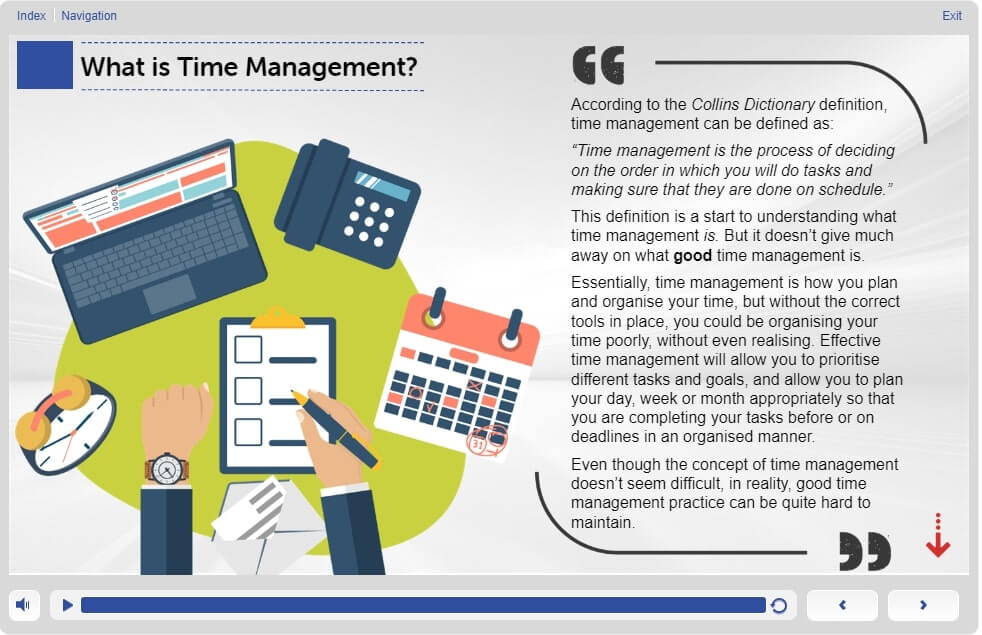
  • What is Time Management? - Time Management Training
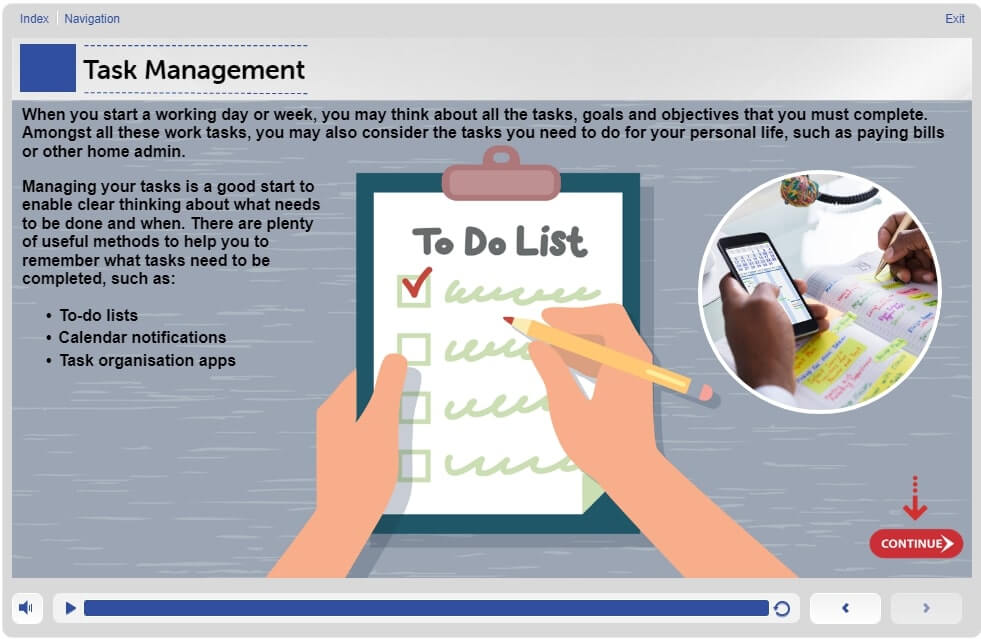
  • Task Management - Time Management Training

Course Aim

The aim of this course is to give learners the knowledge and practical techniques needed to organise their workload, prioritise tasks and make more effective use of their working time. Learners will understand how poor time management habits can affect their working day and how techniques for managing tasks, deadlines, distractions and procrastination can help them take greater control of their workload.


Learning Objectives

On completion of the course, you should be able to:

  • Give a definition of ‘good’ time management’
  • Explain why time management is important
  • List the benefits of good time management
  • Identify the causes of poor time management
  • Give a definition of ‘procrastination’
  • List some techniques to tackle procrastination
  • List some effective techniques of practising good time management
  • Explain how a tidy space can help with good time management
  • Recognise how you manage your own time
  • Identify what is meant by ‘task management’
  • Give some examples of effective task management technique

Course Content

This course is made up of the following modules:

  • An Introduction to Time Management

    This section introduces the learner to the course and what time management is and why it is important in the workplace

  • Module 1 - Causes of Poor Time Management

    This section of the course concentrates on the causes of poor time management. Understanding what causes are, can help to develop an understanding of how to avoid certain habits and behaviours, which could be impacting your time management.

  • Module 2 - How to Manage your Time Effectively

    This section of the course covers different techniques on how to manage your time effectively, for example, keeping a tidy space and introducing the 'time management matrix'.

  • Module 3 - The Importance of Delegation

    In this final section, you will cover why delegating tasks can be an important exercise when it comes to maintaining good time management. It looks at how to delegate properly and professionally in ways that can benefit both yourself or another employee.

Download Course Overview (PDF)

Assessment

On completion of the course lessons and training material an online assessment will automatically unlock. The assessment will contain 15 multiple-choice questions and a mark of 75% or above will be required to pass.

The assessment will be marked instantly and so you will know straight away if you have passed or not. If you don't pass first time there's no need to worry. Unlimited resits at absolutely no additional charge are available so you can retake the assessment again as many times as you need to.


Time Management Certification

Our entire library of training courses are accredited by the CPD Certification Service as adhering to the universally recognised Continuing Professional Development (CPD) guidelines.

Time Management Certificate

Upon passing the online assessment you will have the options to both print and download your Time Management Training Certificate in PDF format. In addition to this an automated email will also be sent to your chosen email address containing a link to your certificate ensuring you always have access to a copy.

Furthermore, a QR code is displayed on each certificate which when scanned by a smartphone links to our certification database. This allows employers, auditors and local authority inspectors, for example, to establish a certificates validity instantly and at any time.


Common Time Management Training Questions

Yes. Online training can help employees develop time management skills by teaching them how to recognise poor working habits and introducing practical techniques for planning, prioritising and managing their available time. These techniques can then be applied and practised as part of an employee's normal working routine.

Online time management training can help learners develop their understanding of areas such as:

  • Planning and prioritising tasks – deciding what needs attention first and organising work around deadlines and priorities.

  • Recognising time-wasting habits – identifying behaviours such as procrastination, unnecessary interruptions or spending too long on low-priority tasks.

  • Managing distractions – understanding what commonly interrupts focused work and considering ways to reduce or control those distractions.

  • Organising workloads – breaking work into manageable tasks and making better use of the time available.

  • Delegating appropriately – recognising when work can be allocated to others rather than trying to manage every task personally.

However, completing an online course alone does not automatically make someone better at managing their time. The real improvement comes when learners apply the techniques they have learned, review what works for them and develop more effective working habits over time.

Time management training can benefit employees by helping them develop more organised and effective working habits. By understanding how they use their working time and applying appropriate techniques, employees can become better equipped to structure their day and focus their attention on meaningful work.

Potential benefits for employees include:

  • Improved organisation
  • Better focus
  • More effective use of working time
  • Greater confidences
  • Less last-minute pressure
  • Improved productivity

Time management training can provide employees with useful techniques, but developing these skills also requires putting them into practice and adapting them to individual roles and working environments.

Time management training can benefit employees at different levels of an organisation and does not need to be limited to managers or team leaders. The need for training should depend on an employee's role, responsibilities and development needs rather than their job title alone.

How time management applies to different employee roles
Employee or role How time management may apply
Employees Organising daily tasks, working towards deadlines and managing changing priorities.
Remote or hybrid workers Structuring the working day and managing distractions when working with greater independence.
Team leaders and supervisors Balancing their own responsibilities with supporting employees and coordinating team activities.
Managers Managing competing demands, planning ahead, delegating appropriately and ensuring important work receives sufficient attention.
Employees taking on new responsibilities Adjusting to increased workloads, new deadlines or greater responsibility for planning their own work.

Employers should therefore consider where time management skills are needed within particular roles rather than assuming training is only relevant once someone moves into management. Equally, training does not necessarily need to be provided to every employee simply because they work for the organisation; it should address an identified learning or development need.

Yes. Time management training can help employees develop a more structured approach to situations where several tasks or responsibilities compete for their attention. Rather than simply working through tasks in the order they arrive, employees can learn to assess what requires attention first and plan their available time accordingly.

When deciding between competing priorities, employees may need to consider:

  • Urgency When does the task actually need to be completed?
  • Importance What are the consequences of completing or delaying the task?
  • Deadlines Are there fixed dates or commitments that need to be met?
  • Dependencies Are colleagues, customers or other activities waiting for the task to be completed?
  • Available time Can the work realistically be completed alongside existing responsibilities?
  • Delegation Can an appropriate task be reassigned to someone else?

However, good time management cannot always resolve competing priorities. If several important tasks cannot realistically be completed within the available time, the problem may be the workload rather than the employee's ability to manage their time.

In these situations, employees should communicate conflicting demands rather than simply attempting to work faster. A manager may need to clarify priorities, adjust deadlines, redistribute work or provide additional support so that expectations remain realistic.


The Importance of Time Management


Employees have a limited amount of working time in which to complete their responsibilities. Managing that time effectively helps employees organise their work, understand what requires attention and use their available time where it can provide the most value.

Effective time management can support the workplace by helping employees to:

  • Stay organised – having a clear understanding of tasks, responsibilities and upcoming commitments.
  • Focus on important work – giving appropriate attention to tasks that contribute most to individual, team or organisational objectives.
  • Plan ahead – considering upcoming work rather than continually reacting to tasks as they arise.
  • Make better use of available time – reducing unnecessary time spent on low-value activities and working in a more structured way.
  • Respond to changing demands – reviewing plans and adjusting how time is allocated when priorities or circumstances change.
  • Maintain greater control of their working day – understanding what needs to be achieved and having a realistic plan for approaching it.

Good time management should not be about filling every available minute with more work. Its purpose is to help employees make informed decisions about how their time is used, so that the right work receives the right level of attention at the right time.

Poor time management can reduce productivity when working time is spent inefficiently or important tasks do not receive the attention they require. An employee may appear busy throughout the day but still make limited progress if their time is repeatedly lost to distractions, poor planning or lower-priority activities.

Productivity can be affected in several ways:

  • Important work may be delayed – spending too much time on less important activities can leave insufficient time for higher-priority tasks.
  • Frequent task switching can reduce focus – repeatedly moving between unrelated activities can interrupt concentration and make tasks take longer to complete.
  • Poor planning can create unnecessary pressure – leaving work until later than necessary can result in tasks being rushed or requiring additional effort to complete.
  • Time can be spent reactively – without clear priorities, employees may continually respond to whichever request arrives next rather than focusing on work that provides greater value.
  • Work may need to be repeated – rushing or failing to allocate sufficient attention to a task can contribute to mistakes, corrections and duplicated effort.
  • Delays can affect other people – where colleagues or other activities depend on a task being completed, poor management of time can reduce productivity beyond the individual employee.

Improving productivity therefore does not necessarily mean working faster or completing more tasks. Effective time management helps employees use their available time more purposefully, giving important work sufficient attention while reducing avoidable activities that consume time without contributing meaningfully to the required outcome.


Course Reviews

4.7.

(30 reviews)

Read more reviews

Related Online Training Courses

  • cert
    Change Management

    £25.00 +VAT

    Change and survive. This is a given for most companies. If we look back 10 or 20 years, you will see how most aspects of business life have changed, and staff must change to meet the new systems, yet for some change can cause unsettlement and anxiety.

  • cert
    Communication

    £25.00 +VAT

    Effective communication is essential to any business or company but achieving this is not easy. This online training course will highlight the barriers to good communication and helps all those who need to communicate with others to do so effectively, whether that be verbal or non-verbal communication.

Time Management Training Course CPD Certified Course

4.7 (30 reviews)

£25.00 +VAT per person

Discounts on bulk purchases
  • 10% Discount 10+ courses
  • 20% Discount 20+ courses
  • 30% Discount 50+ courses
  • 40% Discount 75+ courses
  • 50% Discount 100+ courses
  • Compare plans & pricing

Training 10 or more people? Let us quote you

Training Management Suite (TMS) included
with orders of 5 or more courses.

Course information
  • Certificate on Successful Completion
  • Access course on Desktop, Laptop or Tablet
  • 15 Multiple Choice Questions
  • Course Duration: 30 Minutes
  • CPD Points: 1


Frequently Asked Questions

Our training is completed online, using only a web browser.

After choosing the courses and completing the online transaction, you'll recieve an email providing access to the course. Use the details to register the course yourself or if it's for someone else, simply forward the email on.

Purchasing training for your team is simple.

Just add the courses you need to your basket and complete the checkout process. If you're purchasing 5 or more courses, we'll provide you with access to our Training Management System (TMS).

The TMS gives you full control over your learners, allowing you to enrol staff, monitor progress, track completion rates, and download certificates.

Once your account is set up, we're happy to show you around the system and help you get the most from its features. If you have any questions, our support team is always here to help at support@train4academy.co.uk.

Yes. We offer automatic discounts on larger orders, and any applicable discount will be applied instantly at checkout across all courses in the basket.

Depending on the number of courses purchased we provide the following discounts below. If you're looking to purchase a higher volume, please contact us and we'll be happy to discuss additional volume discounts.

  • Purchase 10+ courses and recieve 10%
  • Purchase 20+ courses and recieve 20%
  • Purchase 50+ courses and recieve 30%
  • Purchase 75+ courses and recieve 40%
  • Purchase 100+ courses and recieve 50%

Our training can be purchased easily using a debit or credit card.

If you're purchasing a larger volume of training and would prefer to be invoiced, please contact us on 01482 861 040 or email enquiries@train4academy.co.uk.

Our training is designed to fit around your schedule. Everybody receives 2 years from date of purchase, so there's no rush to complete your training course.

You can work through the training at your own pace, pause whenever you need to, and return whenever it's convenient. Your progress is automatically saved, allowing you to pick up exactly where you left off.

Even after you've successfully passed the assessment, you'll still be able to access the training materials whenever you need to refresh your knowledge

Read further FAQ