Customer Notice: Essential maintenance will take place from Monday 20 July at 5:00 PM until 9:00 AM on Tuesday 21 July 2026. Thank you for your patience.

  Basket 0 item(s) £0.00 + VAT
Call Us 01482 861 040

Prepare for the Key Changes Coming in October 2026 with our Sexual Harassment Awareness Training Course

Equality, Diversity and Inclusion Training Course

4.6 (69 reviews)
Equality, Diversity and Inclusion Training Course CPD Certified Course
Unlimited Resits Customer Support Instant Access

£25.00 +VAT per person

Course information
  • Certificate on Successful Completion
  • Access course on Desktop, Laptop or Tablet
  • 15 Multiple Choice Questions
  • Course Duration: 30 Minutes
  • CPD Points: 1

This Equality, Diversity and Inclusion (EDI) Training course is ideal for employers, managers, and other staff members. It is essential to be aware of the nine protected characteristics to ensure that staff are treated equally and not discriminated against. It also looks at why a diverse workforce should be encouraged due to the qualities that people from all different backgrounds can bring to contribute to a rich team of people.

This online training course will help you to understand the key legislation that plays a role in protecting workers from discrimination; this is the Equality Act 2010. Every person within the workplace deserves the same opportunities and ability to grow and progress their professional development, and employers, managers and supervisors play an integral part in making sure that this happens.

Awareness is key, and undertaking this equality, diversity and inclusion training is a great step towards raising awareness for yourself or other employees. It will help to ensure awareness of how to be inclusive is obtained as well as understanding what is classed as victimisation, unfair treatment, and discrimination within the workplace.


  • Train online at your own pace with a full audio voiceover
  • Accredited by CPD
  • Certificate on successful completion
  • Course duration: 30 minutes
  • Unlimited resits at no cost

Discounts on Bulk Purchases

Take advantage of our bulk discounts which will reduce your overall cost of training. Better still, any courses you order can be registered to users upto two years later so there's no need to worry about training credits expiring.

Courses Purchased Discount
10+ 10%
20+ 20%
50+ 30%
75+ 40%
100+ 50%


Who is this Online Equality, Diversity and Inclusion Training for?

This online course can is suited for learners of all levels regardless of job role. Managers, supervisors, employees and employers all have a moral responsibility to actively promote a healthy equal and diverse workplace. As this is an awareness training course, no formal understanding or prior knowledge of this subject matter is required.


Course Screenshots
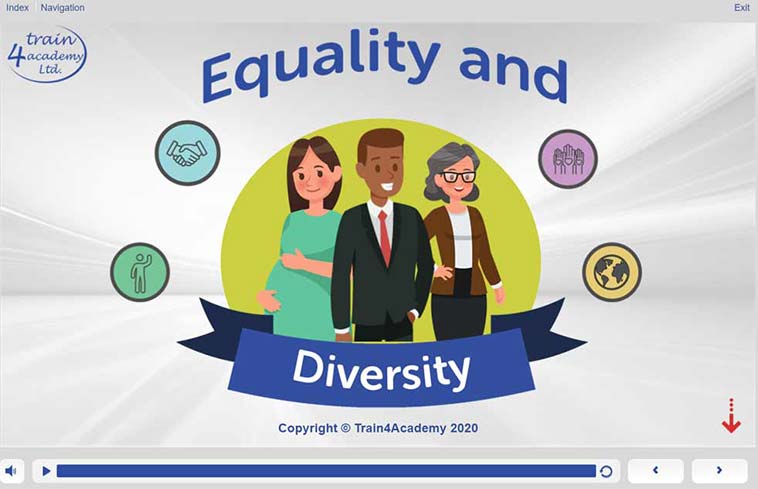
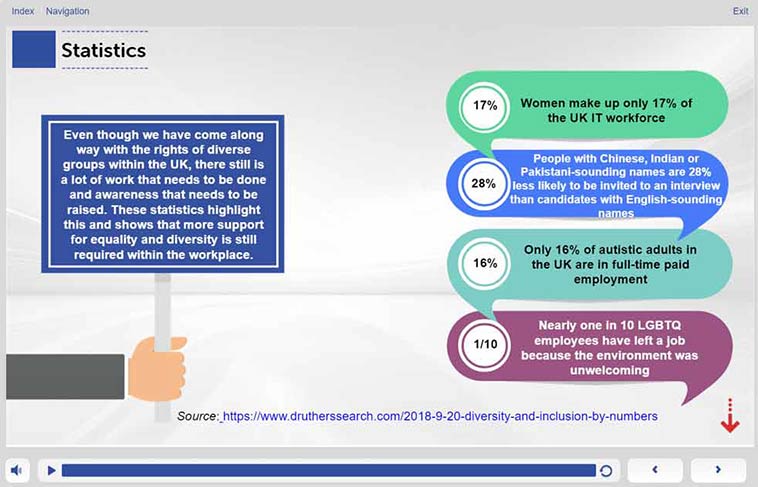
  • Introduction – Defining Equality and Diversity
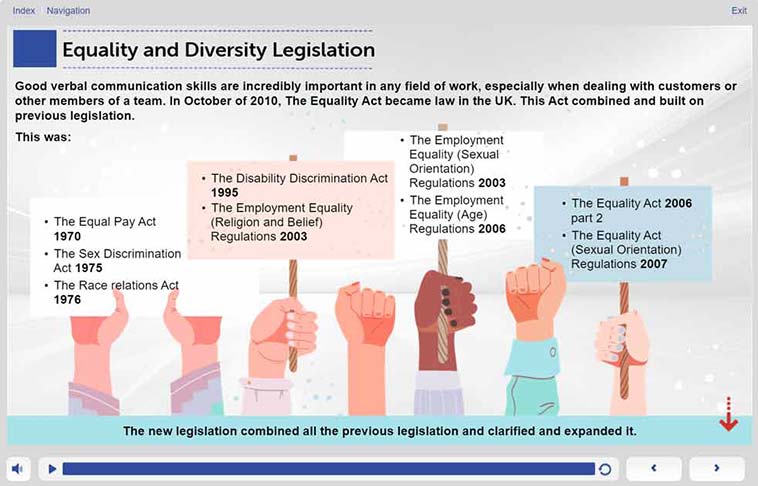
  • Equality and Diversity - Meeting Legal Requirements
  • Types of Discrimination – Equality and Diversity

Course Aim

The aim of this course is to provide you with the knowledge of what equality, diversity and inclusion is, and the relevant acts and legislation’s related to it. With this knowledge, you will be able to implement essential equality and diversity within your workplace or be able to recognise when equality or diversity has not been upheld.

For those having trouble executing their EDI plan may need to develop leadership and management skills to help deliver the process and set the vision.


Learning Objectives

On completion of the course, you should be able to:

  • Give the definition of equality
  • Give the definition of diversity
  • Give the definition of inclusion
  • List some characteristics of discrimination triggers
  • List some harmful myths surrounding certain groups of people
  • Give a definition of verbal communication
  • State a benefit of good nonverbal communication
  • Identify the benefits of a diverse workforce
  • Identify the Equality Act 2010
  • Name some acts that help to build the Equality Act 2010
  • Identify the difference between ‘direct discrimination’ and ‘indirect discrimination’
  • Recognise the main changes brought about by the Equality Act 2010
  • Identify what public bodies must do under the Equality Act 2010

Course Content

This course is made up of the following modules:

  • Introduction - Defining Equality, Diversity and Inclusion

    Find out what is meant by Equality, Diversity and Inclusion and how they can be promoted within a working environment.

  • Module 1 - Meeting Legal Requirements

    This section will cover the Equality Act 2010 and the nine protected characteristics, which include age, disability, gender management, marriage and civil partnership, pregnancy and maternity, race, religion or belief, gender and sexual orientation.

  • Module 2 - Types of Discrimination

    Find out about direct and indirect discrimination including the definition of victimisation, bullying and whistleblowing. Discover how you can personally help to develop a fairer, more inclusive working environment

Download Course Overview (PDF)

Assessment

On completion of the course lessons and training material an online assessment will automatically unlock. The assessment will contain 15 multiple-choice questions and a mark of 75% or above will be required to pass.

The assessment will be marked instantly and so you will know straight away if you have passed or not. If you don't pass first time there's no need to worry. Unlimited resits at absolutely no additional charge are available so you can retake the assessment again as many times as you need to.


Equality, Diversity and Inclusion Training Certification

Our entire library of training courses is accredited by the CPD Certification Service as adhering to the universally recognised Continuing Professional Development (CPD) guidelines.
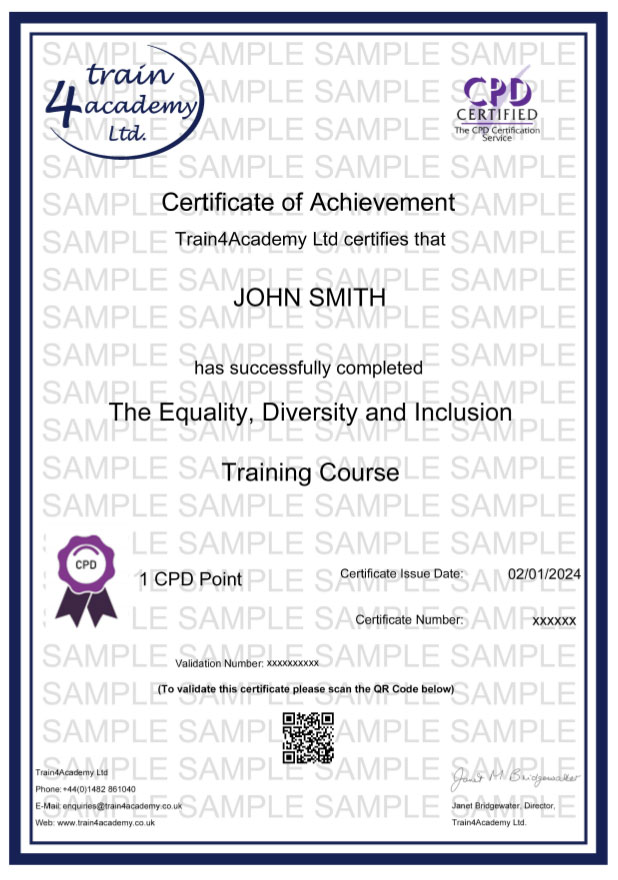
Equality and Diversity Training - Certificate Example

Upon passing the online assessment you will have the options to both print and download your Equality, Diversity and Inclusion Training Certificate in PDF format. In addition to this an automated email will also be sent to your chosen email address containing a link to your certificate ensuring you always have access to a copy.

Furthermore, a QR code is displayed on each certificate which when scanned by a smartphone links to our certification database. This allows employers, auditors and local authority inspectors, for example, to establish a certificates validity instantly and at any time.


Common EDI Training Questions

Equality and diversity training helps employees, managers and employers understand how to create a fair, respectful and inclusive workplace. It explains how to treat people fairly, recognise discrimination and promote equal opportunities, helping to create a working environment where everyone feels valued and respected.

What does equality and diversity training typically cover?
Topic What you'll learn
Equality Understanding equal opportunities and ensuring people are treated fairly without unlawful discrimination.
Diversity Recognising and valuing the differences between individuals, including backgrounds, experiences and perspectives.
Inclusion Creating a workplace where everyone feels respected, supported and able to contribute.
Equality Act 2010 An overview of UK equality legislation and the legal responsibilities of employers and employees.
Protected Characteristics Understanding the nine protected characteristics and how the law safeguards individuals from discrimination.
Types of Discrimination Identifying direct discrimination, indirect discrimination, harassment and victimisation, along with practical workplace examples.
Workplace Responsibilities Learning how everyone can contribute to an inclusive culture by promoting respectful behaviour and challenging inappropriate conduct.
Best Practice Practical ways to support equality, diversity and inclusion in recruitment, communication, teamwork and everyday decision-making.

Equality and diversity training is beneficial for anyone working within an organisation, regardless of their role, industry or level of experience. While employers have a responsibility to foster an inclusive workplace, creating a culture of equality and respect requires everyone to understand their responsibilities and the impact their behaviour can have on colleagues, customers and the wider organisation.

Who can benefit from equality and diversity training?
Role Why the training is important
Employees Learn how to treat colleagues fairly, recognise inappropriate behaviour and contribute to an inclusive workplace.
Managers and Team Leaders Understand how to manage people fairly, make unbiased decisions and support diverse teams while meeting legal responsibilities.
HR Professionals Develop a deeper understanding of equality legislation, workplace policies and best practices for recruitment, performance management and employee relations.
Business Owners and Employers Gain the knowledge needed to create inclusive workplace policies, reduce legal risks and promote a positive organisational culture.
Supervisors Learn how to handle workplace issues fairly, support team members and challenge discriminatory behaviour when it occurs.
Recruitment Managers Ensure recruitment and selection processes are fair, objective and free from unlawful discrimination.
Customer-Facing Staff Build awareness of equality and diversity when interacting with customers from a wide range of backgrounds and communities.
Volunteers and Temporary Workers Understand expected workplace standards and contribute positively to an inclusive working environment from day one.

Equality is about fair treatment and equal opportunities. Diversity recognises and values people's differences, while inclusion ensures everyone feels respected, supported and able to contribute. Together, they help create a positive and inclusive workplace.

The differences between equality, diversity and inclusion
Term Meaning Workplace Example
Equality Ensuring people are treated fairly and have equal access to opportunities without unlawful discrimination. Using fair recruitment and promotion processes based on skills, experience and merit rather than personal characteristics.
Diversity Recognising, respecting and valuing the differences between individuals, including their backgrounds, experiences, perspectives and identities. Building teams with people from a wide range of ages, cultures, abilities, religions and life experiences.
Inclusion Creating a workplace where everyone feels respected, supported and able to participate fully, regardless of their background or personal characteristics. Encouraging everyone to share ideas in meetings, making reasonable adjustments where needed and creating an environment where all employees feel they belong.

Failing to promote equality and diversity can have a negative impact on both employees and organisations. Without a fair and inclusive workplace, employees may experience discrimination, harassment or unequal opportunities, leading to lower morale, reduced productivity and higher staff turnover. Organisations may also face legal, financial and reputational risks if they fail to meet their responsibilities under the Equality Act 2010.

Potential consequences of not promoting equality and diversity
Area Potential Impact
Employee Wellbeing Lower morale, increased stress and reduced job satisfaction.
Staff Retention Higher employee turnover and increased recruitment costs.
Team Performance Poor collaboration, workplace conflict and reduced productivity.
Legal Compliance An increased risk of grievances, employment tribunals and discrimination claims.
Business Reputation Damage to employer reputation and reduced trust among customers and stakeholders.
Recruitment Difficulty attracting and retaining talented employees from diverse backgrounds.

Promoting equality and diversity helps create a workplace where people are treated fairly, feel respected and have equal opportunities to succeed. Regular training, supported by inclusive policies and leadership, can help reduce these risks while creating a more positive, productive and legally compliant working environment.


Why EDI in the Workplace Matters

Promoting equality and diversity also helps reduce the risk of discrimination, supports compliance with the Equality Act 2010 and encourages a positive working environment where everyone can thrive.

Promoting equality and diversity can help organisations to:

  • Create a fair and respectful workplace where everyone is treated equally.
  • Reduce the risk of discrimination, harassment and victimisation.
  • Improve employee wellbeing, engagement and job satisfaction.
  • Encourage collaboration by valuing different perspectives and experiences.
  • Attract and retain a diverse and talented workforce.
  • Support compliance with the Equality Act 2010 and workplace policies.
  • Enhance the organisation's reputation with employees, customers and stakeholders.

When equality and diversity are embedded into everyday workplace practices, everyone benefits. Employees are more likely to feel valued and included, while organisations can build stronger teams, make better decisions and create a culture where people have the opportunity to perform at their best.

Employers have legal responsibilities under the Equality Act 2010 to prevent discrimination, harassment and victimisation in the workplace. Providing equality and diversity training is widely recognised as an effective way to help employees understand these responsibilities and promote fair treatment.

While the law doesn't usually require organisations to provide specific equality and diversity training, it can demonstrate that an employer has taken reasonable steps to prevent unlawful discrimination. This may be an important consideration if an organisation needs to show it has taken appropriate action to educate staff and promote an inclusive working environment.

The Equality Act 2010 is the main piece of legislation that protects people in the UK from discrimination, harassment and victimisation. It brought together several previous anti-discrimination laws into a single Act, making it easier for employers, employees and organisations to understand their rights and responsibilities.

The Act applies to many areas of everyday life, including employment, education, the provision of goods and services, housing and public services. In the workplace, it helps ensure that people are treated fairly and are not disadvantaged because of certain personal characteristics protected by law.

The Equality Act 2010 protects people from discrimination based on the following protected characteristics:

  • Age
  • Disability
  • Gender reassignment
  • Marriage and civil partnership
  • Pregnancy and maternity
  • Race
  • Religion or belief
  • Sex
  • Sexual orientation

Promoting equality and diversity requires more than having policies in place—it involves creating a workplace culture where fairness, respect and inclusion are part of everyday working practices. By embedding these principles into recruitment, management and employee development, organisations can help ensure everyone has equal opportunities to succeed.

Organisations can promote equality and diversity by:

  • Providing regular training to help employees understand their responsibilities and recognise discrimination, harassment and unconscious bias.
  • Implementing clear workplace policies that set out expectations for equality, diversity and inclusion.
  • Recruiting fairly by using objective selection criteria and providing equal opportunities throughout the hiring process.
  • Supporting inclusive leadership by encouraging managers to lead by example and make fair, unbiased decisions.
  • Encouraging open communication so employees feel comfortable raising concerns and sharing different perspectives.
  • Making reasonable adjustments where appropriate to remove barriers for employees with disabilities.
  • Reviewing workplace practices regularly to identify and address potential inequalities or barriers to inclusion.
  • Celebrating diversity by recognising different cultures, backgrounds and experiences throughout the organisation.

Creating an inclusive workplace is an ongoing process rather than a one-time initiative. Regular equality and diversity training, supported by clear policies and inclusive leadership, helps organisations build a culture where people feel respected, valued and able to contribute their best.


Course Reviews

4.6.

(69 reviews)

Read more reviews


Related Online Training Courses

  • cert
    Unconscious Bias Training

    £25.00 +VAT

    Raise awareness of unconscious biased thinking at the workplace to understand decision-making is not what we think. A diverse workplace needs to understand the root causes of bad decision-making could be down to opinions formed by several different biases..

  • cert
    Leadership

    £25.00 +VAT

    A leader is one that stands out from the crowd to set a direction, build a vision and encourage others to follow. Leadership can be learned, and this course is intended to help those aspire to be good leaders to achieve their goals and shine in their various workplace..

Equality and Driversity Training Course CPD Certified Course

4.6 (69 reviews)

£25.00 +VAT per person

Discounts on bulk purchases
  • 10% Discount 10+ courses
  • 20% Discount 20+ courses
  • 30% Discount 50+ courses
  • 40% Discount 75+ courses
  • 50% Discount 100+ courses
  • Compare plans & pricing

Training 10 or more people? Let us quote you

Training Management Suite (TMS) included
with orders of 5 or more courses.

Course information
  • Certificate on Successful Completion
  • Access course on Desktop, Laptop or Tablet
  • 15 Multiple Choice Questions
  • Course Duration: 30 Minutes
  • CPD Points: 1


Frequently Asked Questions

Our training is completed online, using only a web browser.

After choosing the courses and completing the online transaction, you'll recieve an email providing access to the course. Use the details to register the course yourself or if it's for someone else, simply forward the email on.

Purchasing training for your team is simple.

Just add the courses you need to your basket and complete the checkout process. If you're purchasing 5 or more courses, we'll provide you with access to our Training Management System (TMS).

The TMS gives you full control over your learners, allowing you to enrol staff, monitor progress, track completion rates, and download certificates.

Once your account is set up, we're happy to show you around the system and help you get the most from its features. If you have any questions, our support team is always here to help at support@train4academy.co.uk.

Yes. We offer automatic discounts on larger orders, and any applicable discount will be applied instantly at checkout across all courses in the basket.

Depending on the number of courses purchased we provide the following discounts below. If you're looking to purchase a higher volume, please contact us and we'll be happy to discuss additional volume discounts.

  • Purchase 10+ courses and recieve 10%
  • Purchase 20+ courses and recieve 20%
  • Purchase 50+ courses and recieve 30%
  • Purchase 75+ courses and recieve 40%
  • Purchase 100+ courses and recieve 50%

Our training can be purchased easily using a debit or credit card.

If you're purchasing a larger volume of training and would prefer to be invoiced, please contact us on 01482 861 040 or email enquiries@train4academy.co.uk.

Our training is designed to fit around your schedule. Everybody receives 2 years from date of purchase, so there's no rush to complete your training course.

You can work through the training at your own pace, pause whenever you need to, and return whenever it's convenient. Your progress is automatically saved, allowing you to pick up exactly where you left off.

Even after you've successfully passed the assessment, you'll still be able to access the training materials whenever you need to refresh your knowledge

Read further FAQ