Basket 0 item(s) £0.00 + VAT
Call Us 01482 861 040

Prepare for the Key Changes Coming in October 2026 with our Sexual Harassment Awareness Training Course

Anti-Bribery Training Course

4.7 (71 reviews)
Help employees know their responsibilities with an anti bribery and corruption policy CPD Certified Course

Unlimited Resits Customer Support Instant Access

£25.00 +VAT per person

Course information
  • Certificate on Successful Completion
  • Access course on Desktop, Laptop or Tablet
  • 15 Multiple Choice Questions
  • Course Duration: 30 Minutes
  • CPD Points: 1

This Anti-Bribery and Corruption course helps individuals recognise the risks of bribery and corruption in the workplace, including situations where bribery may not be immediately apparent. It raises awareness of the serious legal, financial and reputational consequences that bribery can have for individuals and organisations.

The course explores how employers can establish anti-bribery policies and procedures, alongside the responsibilities employees have in recognising, preventing and reporting potential bribery within the workplace.

Bribery can result in criminal penalties, damage to an organisation's reputation, loss of business and other serious consequences. Anti-bribery training helps employees understand these risks and supports organisations in promoting ethical conduct and reducing the risk of bribery and corruption.


  • Train online at your own pace with a full audio voiceover
  • Accredited by CPD
  • Certificate on successful completion
  • Course duration: 30 minutes
  • Unlimited resits at no cost

Discounts on Bulk Purchases

Take advantage of our bulk discounts which will reduce your overall cost of training. Better still, any courses you order can be registered to users upto two years later so there's no need to worry about training credits expiring.

Courses Purchased Discount
10+ 10%
20+ 20%
50+ 30%
75+ 40%
100+ 50%


Who is this Online Anti-Bribery Training for?

This Anti-Bribery course is suitable for employees and organisations looking to improve their understanding of bribery risks and the measures used to prevent bribery in the workplace. Learners will develop their awareness of potential bribery situations, the importance of following workplace policies and procedures, and how to help protect themselves and their organisation.

Bribery and money laundering can be linked, so completing our Anti-Money Laundering (AML) training course can provide valuable additional knowledge and support an organisation's wider approach to preventing financial crime.


Course Screenshots
  • Anti-Bribery Training - Welcome Screen
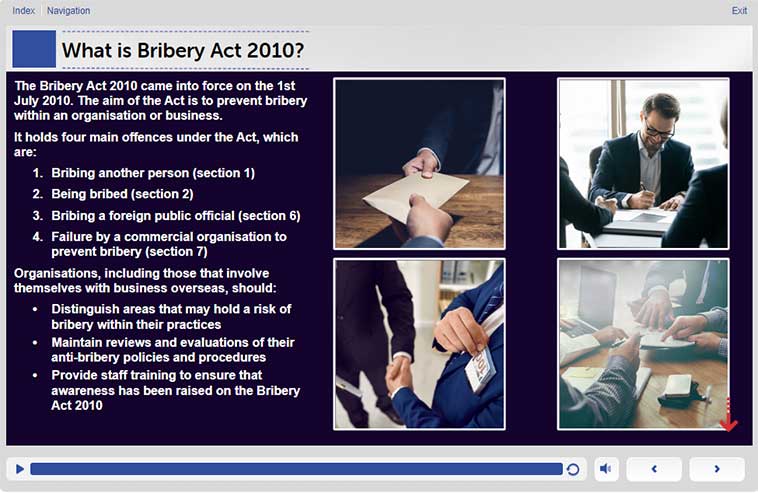
  • Anti-Bribery Training - Define Bribery
  • Anti-Bribery Training - Bribery Definition


Course Aim

The aim of this course is to provide learners with an understanding of the Bribery Act 2010, how it supports the prevention of bribery in the workplace, and the legal responsibilities and potential consequences for individuals and organisations under the Act.


Learning Objectives

On completion of the course, you should be able to:

  • Identify what a ‘bribe’ is
  • List some examples of why a bribe may be offered or taken
  • Identify the aim of the Bribery Act 2010 and when it came into force
  • List the four main offences under the Bribery Act 2010
  • Identify the functions and activities covered by the Bribery Act 2010
  • Identify the three conditions covered by the Bribery Act relating to section 3
  • Identify who is classed as a public foreign official
  • Explain an ‘associated person’ is
  • List some responsibilities you and your organisation holds
  • Identify the penalties that can be given to organisations and individuals who commit bribery offences
  • List some questions that you can ask yourself when you receive a gift to determine whether it was meant as a bribe
  • Identify the ‘three critical factors’
  • Explain what whistleblowing is and how it relates to bribery

Course Content

This course is made up of the following modules:

  • An Introduction to Defining Bribery

    This section introduces the learner to the course. It looks at how bribery can cause damage to businesses, organisations and individuals. It also provides statistics on bribery and convictions that have been handed since the legislation came into play.

  • Module 1 - What is the Bribery Act 2010?

    This section of the course concentrates on the definition of a 'bribe' and what the current legislation is. It looks at the four main offences under the Act.

  • Module 2 - Roles and Responsibilities

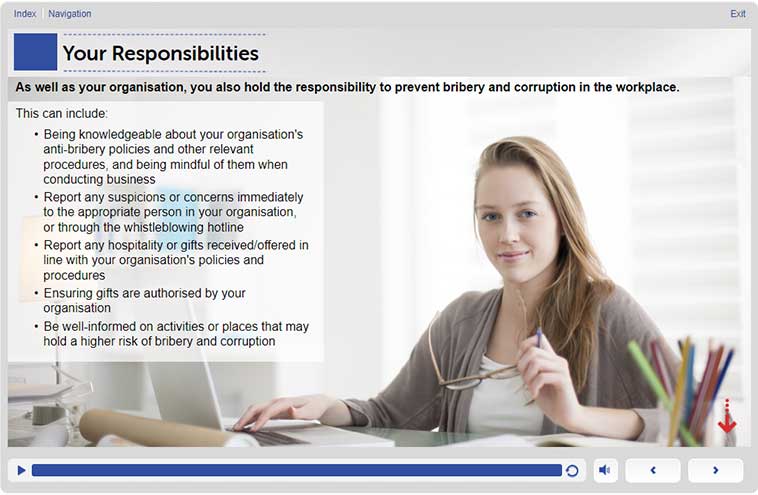
    This section of the course will look at the roles and responsibilities both individuals and organisations hold. This includes implementing sufficient anti-bribery policies and procedures. It also looks at the penalties that may be handed out due to bribery taking place.

  • Module 3 - Determining Bribery

    In this final section of the course, you will look at determining whether a gift may be considered kindness or a bribe. There are different ways to approach gifts from customers, clients or third parties, and what you should do if you receive one. It also looks at what 'whistleblowing' is and how it is relevant to bribery.

Download Course Overview (PDF)

Assessment

On completion of the course lessons and training material an online assessment will automatically unlock. The assessment will contain 15 multiple-choice questions and a mark of 75% or above will be required to pass.

The assessment will be marked instantly and so you will know straight away if you have passed or not. If you don't pass first time there's no need to worry. Unlimited resits at absolutely no additional charge are available so you can retake the assessment again as many times as you need to.


Anti-Bribery Training Certification

Our entire library of training courses is accredited by the CPD Certification Service as adhering to the universally recognised Continuing Professional Development (CPD) guidelines.
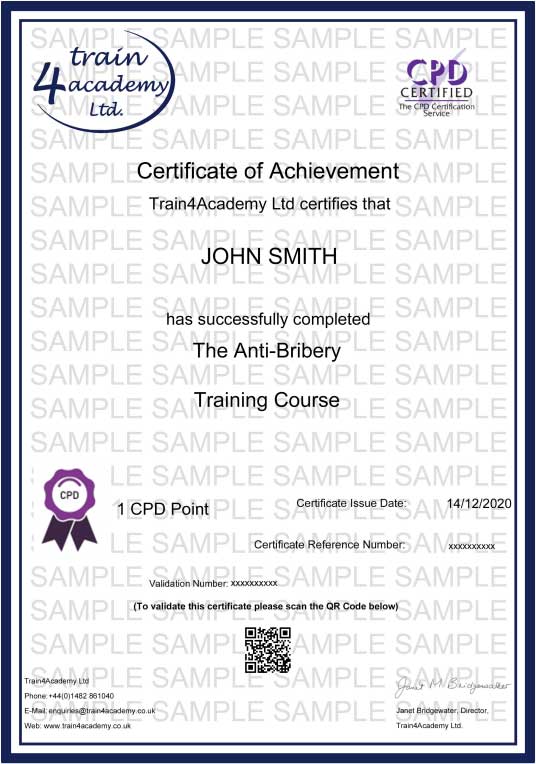
Anti-Bribery Training - Certificate Example

Upon passing the online assessment you will have the options to both print and download your Anti-Bribery Training Certificate in PDF format. In addition to this an automated email will also be sent to your chosen email address containing a link to your certificate ensuring you always have access to a copy.

Furthermore, a QR code is displayed on each certificate which when scanned by a smartphone links to our certification database. This allows employers, auditors and local authority inspectors, for example, to establish a certificates validity instantly and at any time.


Common Anti-Bribery Training Questions

The Bribery Act 2010 is UK legislation designed to prevent and tackle bribery by establishing criminal offences for individuals and organisations. It applies to bribery in both the public and private sectors and covers certain conduct occurring in the UK and overseas.

The Act establishes four main offences:

  • Offering, promising or giving a bribe
  • Requesting, agreeing to receive or accepting a bribe
  • Bribing a foreign public official
  • Failure of commercial organisations to prevent bribery

The Act also encourages organisations to establish appropriate procedures to prevent bribery, helping to promote ethical business practices and reduce legal and financial risk

The Bribery Act 2010 does not explicitly require all employees to complete anti-bribery training. However, organisations are expected to take appropriate measures to prevent bribery, which may include providing training to employees and other relevant individuals.

Under Section 7 of the Act, relevant commercial organisations can be held criminally liable if an associated person commits bribery intending to obtain or retain business or a business advantage for the organisation. Having adequate procedures in place to prevent bribery provides a statutory defence.

The Ministry of Justice identifies communication, including training, as one of its six principles for preventing bribery. The need for training should therefore be assessed according to an organisation's bribery risks, the responsibilities of its employees and the nature of its activities.

There is no legally prescribed frequency for refreshing anti-bribery training under the Bribery Act 2010. However, organisations should regularly review their training needs to ensure employees remain aware of bribery risks, their responsibilities and the procedures in place to prevent bribery.

Refresher training may be appropriate when:

  • Legislation or guidance changes
  • Workplace policies or procedures change
  • New bribery risks are identified
  • Knowledge or awareness needs updating

The frequency of refresher training should reflect the organisation's level of bribery risk and the responsibilities of its employees.


Preventing Bribery in the Workplace

The six principles are guidance, not separate legal requirements. They help commercial organisations determine what bribery prevention procedures may be appropriate, particularly in relation to the adequate procedures defence under Section 7 of the Bribery Act 2010.

The six principles are:

  • 1. Proportionate procedures
  • 2. Top-level commitment
  • 3. Risk assessment
  • 4. Due diligence
  • 5. Communication (including training)
  • 6. Monitoring and review

These principles help organisations develop and maintain effective bribery prevention measures, reducing the likelihood of bribery occurring within their business activities.

Employees who suspect bribery in the workplace should report their concerns promptly, following their organisation's anti-bribery or whistleblowing procedures. They do not need to prove that bribery has occurred before raising a genuine concern.

Some of the key steps employees take can also include:

  • Reporting concerns.
  • Provide the relevant information
  • Avoiding an involvement

Employees should report concerns honestly and in good faith, allowing the appropriate individuals or authorities to assess and investigate the situation.

A gift is generally given as a gesture of goodwill or appreciation, whereas a bribe involves offering, promising, giving, requesting or accepting an advantage in circumstances that amount to improper influence or other prohibited conduct.

Gifts are not automatically unlawful under the Bribery Act 2010. However, they may constitute bribery depending on their purpose, value, timing and the circumstances in which they are offered or accepted.

For example, a supplier giving a customer a modest promotional gift may be acceptable under workplace policies. However, offering an expensive gift to influence an employee's decision when awarding a contract could constitute bribery.

Employees should always follow their organisation's gifts and hospitality policies and seek guidance if they are unsure whether a gift is appropriate.

Employers should take appropriate steps to prevent bribery within their organisation, including identifying potential risks and establishing procedures to reduce the likelihood of bribery occurring.

Under Section 7 of the Bribery Act 2010, relevant commercial organisations can be held criminally liable if an associated person commits bribery intending to obtain or retain business or a business advantage for the organisation. Having adequate procedures in place to prevent bribery provides a statutory defence.

Some of the key measures employers can take include:

  • Establish anti-bribery policies
  • Provide appropriate training
  • Assess bribery risks
  • Provide reporting procedures
  • Monitor and review: Regularly review anti-bribery measures to ensure they remain appropriate and effective.

These measures can help organisations promote ethical business practices, reduce bribery risks and demonstrate their commitment to preventing bribery.


Course Reviews

4.7.

(71 reviews)

Read more reviews


Related Online Training Courses

  • cert
    General Data Protection Regulations (GDPR) 2018

    £25.00 +VAT

    This new regulation will have massive repercussions for most businesses who deal with data, whether that be simply employees records, or information about customers. Your staff need to know how these changes will impact your business and their communications with others.

  • cert
    Anti-Money Laundering

    £25.00 +VAT

    Terrorists require funds, and in order to prevent them benefiting from honest sources, the Money Laundering Terrorist Financing and Transfer of Funds Regulations 2017 was passed. This course will help those who handle finances to understand the implications of this law & how they can play their part in preventing terrorists receiving funding illegally..

Help employees know their responsibilities with an anti-bribery and corruption training CPD Certified Course

4.7

£25.00 +VAT per person

Discounts on bulk purchases
  • 10% Discount 10+ courses
  • 20% Discount 20+ courses
  • 30% Discount 50+ courses
  • 40% Discount 75+ courses
  • 50% Discount 100+ courses
  • Compare plans & pricing

Training 10 or more people? Let us quote you

Training Management Suite (TMS) included
with orders of 5 or more courses.

Course information
  • Certificate on Successful Completion
  • Access course on Desktop, Laptop or Tablet
  • 15 Multiple Choice Questions
  • Course Duration: 30 Minutes
  • CPD Points: 1

Frequently Asked Questions

Our training is completed online, using only a web browser.

After choosing the courses and completing the online transaction, you'll recieve an email providing access to the course. Use the details to register the course yourself or if it's for someone else, simply forward the email on.

Purchasing training for your team is simple.

Just add the courses you need to your basket and complete the checkout process. If you're purchasing 5 or more courses, we'll provide you with access to our Training Management System (TMS).

The TMS gives you full control over your learners, allowing you to enrol staff, monitor progress, track completion rates, and download certificates.

Once your account is set up, we're happy to show you around the system and help you get the most from its features. If you have any questions, our support team is always here to help at support@train4academy.co.uk.

Yes. We offer automatic discounts on larger orders, and any applicable discount will be applied instantly at checkout across all courses in the basket.

Depending on the number of courses purchased we provide the following discounts below. If you're looking to purchase a higher volume, please contact us and we'll be happy to discuss additional volume discounts.

  • Purchase 10+ courses and recieve 10%
  • Purchase 20+ courses and recieve 20%
  • Purchase 50+ courses and recieve 30%
  • Purchase 75+ courses and recieve 40%
  • Purchase 100+ courses and recieve 50%

Our training can be purchased easily using a debit or credit card.

If you're purchasing a larger volume of training and would prefer to be invoiced, please contact us on 01482 861 040 or email enquiries@train4academy.co.uk.

Our training is designed to fit around your schedule. Everybody receives 2 years from date of purchase, so there's no rush to complete your training course.

You can work through the training at your own pace, pause whenever you need to, and return whenever it's convenient. Your progress is automatically saved, allowing you to pick up exactly where you left off.

Even after you've successfully passed the assessment, you'll still be able to access the training materials whenever you need to refresh your knowledge

Read further FAQ